If You Build Them - Coral Reefs
-February 24, 2026
I spent last week snorkeling with my family along the coasts of Cozumel and Honduras. Each stop offered the same pattern.
There were moments of breathtaking life — coral towers teeming with fish, parrotfish scraping algae, schools moving like clouds. Then, just a few hundred yards away, the ocean flattened into stretches of sand and scattered rock. The water was warm, clear, shallow, and seemingly perfect. But structurally, it was quiet. Sparse.
My son pointed it out first.
“Why isn’t there reef here too?”
It was the kind of question that sounds simple but lingers.
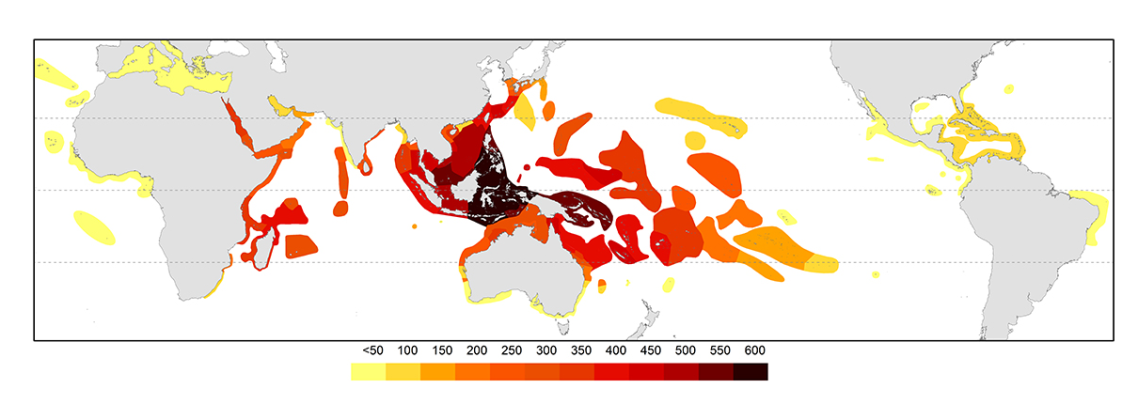
Coral reefs are among the most productive ecosystems on Earth. They transform space into life. Yet across tropical coastlines, they appear in clusters rather than continuous belts. Between them are vast areas that feel — visually at least — underutilized relative to the abundance reefs create.
That observation raises a policy question we rarely ask: if reefs generate extraordinary ecological and economic value, and if suitable areas exist where reefs are absent primarily due to structural limitation, should we build more of them?
A System Under Stress — and Time Matters
This question takes on greater urgency against the backdrop of warming oceans. Marine heat waves, disease outbreaks, and repeated bleaching events have placed many reef systems under sustained stress. Some reefs recover; others do not. The pattern is uneven, but the direction is clear enough to prompt concern.
Corals evolved within relatively narrow temperature bands. Even modest, sustained warming relative to historical norms can disrupt the symbiotic relationships that power reef growth. Bleaching does not always mean death, but repeated stress events reduce resilience and increase mortality risk.
In theory, reef ecosystems could migrate poleward over long timescales as waters warm. In practice, reef migration is slow, constrained by substrate availability, water chemistry, light, and episodic cold events. Natural processes alone may not reposition reef ecosystems fast enough to match the pace of environmental change.
That reality suggests a policy implication: if reefs face increasing stress where they exist today and limited capacity to expand naturally, some degree of human-assisted adaptation may be necessary.
Reefs Are Infrastructure — We Just Don’t Treat Them That Way
Coral reefs do not only support fish and divers. They protect coastlines, sustain tourism economies, and support fisheries. In the United States alone, reefs generate more than $3 billion annually in combined tourism, fisheries, and coastal protection benefits, including roughly $1.8 billion in avoided flood damages.
In any other context, an asset delivering billions in annual value and reducing storm risk would be categorized as infrastructure.
But reefs are funded as conservation programs.
Federal coral funding operates largely at the scale of research grants and localized restoration projects, while traditional coastal protection projects routinely receive hundreds of millions or billions in investment. The mismatch is not economic — it is categorical. We fund reefs according to how we label them.
Structure Creates Life
What my family saw in the Caribbean reflects a simple ecological reality: structure drives biodiversity. Where reef framework exists, life accumulates rapidly. Where it does not, biological density drops.
Artificial reef programs and coral gardening projects worldwide repeatedly demonstrate that when structure is introduced into suitable environments, fish biomass rises, species richness increases, and ecosystems begin assembling around the new habitat. In parts of Southeast Asia and the Caribbean, engineered reef installations have drawn dense fish communities within years.
Structure begets life.
That does not mean every reef-absent area should become a reef. Tropical marine environments are mosaics of reefs, seagrass beds, mangroves, and sand plains, each serving ecological roles. But it does suggest that some reef gaps are structural rather than environmental — places where habitat could exist but does not.
And that distinction matters.
From Veron, Stafford-Smith, DeVantier et al., 2015
The Opportunity Is Targeted Expansion
The policy case for reef creation is not about replacing existing ecosystems. It is about identifying locations where habitat complexity is the limiting factor and enhancing those areas in ways that increase overall ecosystem productivity.
Stable sand flats lacking hard substrate, previously degraded reef zones, and nearshore areas where reef structure would provide fisheries or coastal protection benefits represent logical candidates. In these contexts, reef creation is less ecological disruption than ecological amplification.
We already do this on land. We restore wetlands, plant forests, and construct living shorelines. Reef creation is simply the marine analogue — still emerging, but conceptually familiar.
Economic Development That Looks Like Conservation
Reef expansion is not only an ecological idea; it is an economic one.
New reef habitat can support tourism capacity through additional dive and snorkel sites. Increased structural complexity can enhance fisheries productivity. Reef frameworks positioned strategically nearshore can reduce wave energy, potentially lowering long-term public spending on hard coastal defenses.
Reef building itself creates employment across marine construction, monitoring, research, and tourism services. Over time, reef restoration and creation could evolve into a specialized coastal industry, much like wetland restoration has.
This convergence of ecological benefit and economic opportunity is rare in policy. Reef creation offers both.
The Real Barrier Is Not Feasibility
Opposition to assisted reef creation often centers on ecological uncertainty, and caution is appropriate. Marine ecosystems are complex, and poorly sited projects could displace valuable habitats or fail to persist. But these risks argue for careful implementation, not inaction.
We already restore reefs within historical reef regions with broad scientific support. We already deploy artificial reef structures. We already engineer coastal ecosystems when the benefits are clear.
The barrier to reef creation is not technological capability. It is conceptual inertia.
A More Generative Form of Stewardship
As I watched my kids snorkeling across those alternating zones of abundance and quiet, the question kept returning: what if some of this space could hold more life — especially at a moment when existing reefs face mounting stress?
Humanity has reshaped terrestrial ecosystems for centuries through settlement, agriculture, and forestry. Marine environments are increasingly subject to similar influence. The question is not whether we shape ecosystems, but whether we do so thoughtfully.
Coral reefs turn physical space into biological abundance. Observing large expanses of warm, shallow water without them naturally invites reflection on whether some of that abundance could be extended in some places, particularly as warming oceans challenge reefs where they exist today.
Building more reefs, selectively and carefully, is not an abandonment of conservation. It is conservation evolving — moving beyond preservation toward stewardship that recognizes our capacity to help create as well as protect.
My son’s question still echoes.
Why isn’t there reef here too?
In an era of environmental change, public policy may not have a simple answer. But urgency suggests we should at least begin trying to find one. I can't wait to explore more reefs in my future travels, and hope we can restore and build them before they disappear.