Higher Ed vs. AI
-Sept 11, 2025
For much of the last century, a four-year university degree was more than a credential — it was a promise. For many families, including my own, it was understood that college was the way to rise above factory work, farming, or other blue-collar paths. My dad used to say he would “dig ditches if necessary” to make sure my sister and I could attend. The degree represented opportunity: a way to secure jobs that offered stability, respect, and a better life than the generation before us.
And for many, that promise held true. Attending a highly esteemed university didn’t guarantee success, but it dramatically improved the odds of doing better than your parents. A degree was a signal to employers, a ticket into professions that seemed otherwise out of reach.
Today, the value proposition isn’t as strong. A degree is still expected in many workplaces — often as a baseline requirement — but the actual education behind it is frequently less relevant than the credential itself. Students are paying more than ever, often for programs that don’t translate into meaningful careers. What was once a ladder of opportunity risks becoming a treadmill of debt. And with artificial intelligence reshaping the labor market, the cracks in higher education are widening into a chasm.
The Broken Loop
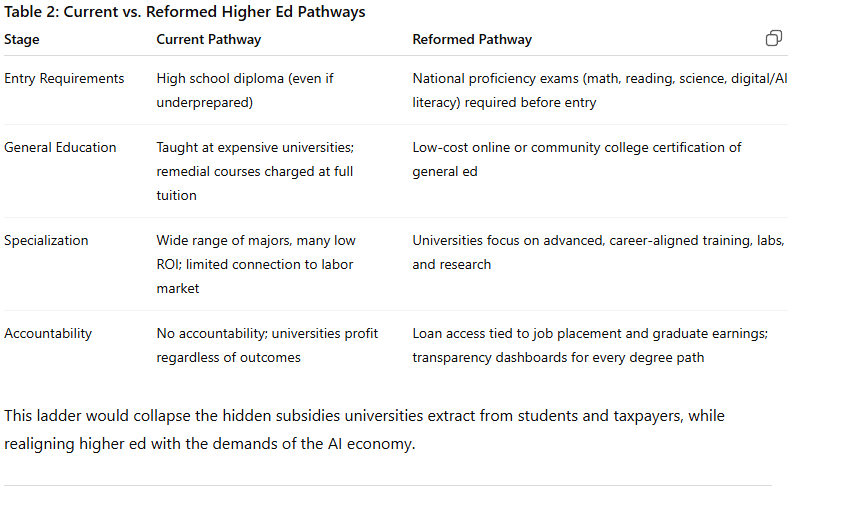
Here’s how the cycle works. High schools graduate students who aren’t proficient in math, reading, or science. Universities enroll them anyway, re-teaching the basics at $30,000 a year. Government loans underwrite the cost, insulating schools from risk. Graduates enter a crowded job market, often with degrees in fields where there is little demand. They struggle to repay loans, and politicians call for forgiveness. The debt disappears, but the system doesn’t change — and the cycle begins again.
Recent data makes the picture even starker. According to the latest National Assessment of Educational Progress, only 35% of high school seniors are proficient in reading and just 22% in math — the lowest levels ever recorded. Nearly half of twelfth graders now score below basic in math. In other words, the majority of students entering college aren’t ready for it. Yet universities admit them anyway, re-teaching high school content at full freight tuition. It’s a structural scam: K–12 passes the buck, higher ed cashes in, and students pay the price with debt.
Degrees Without Demand
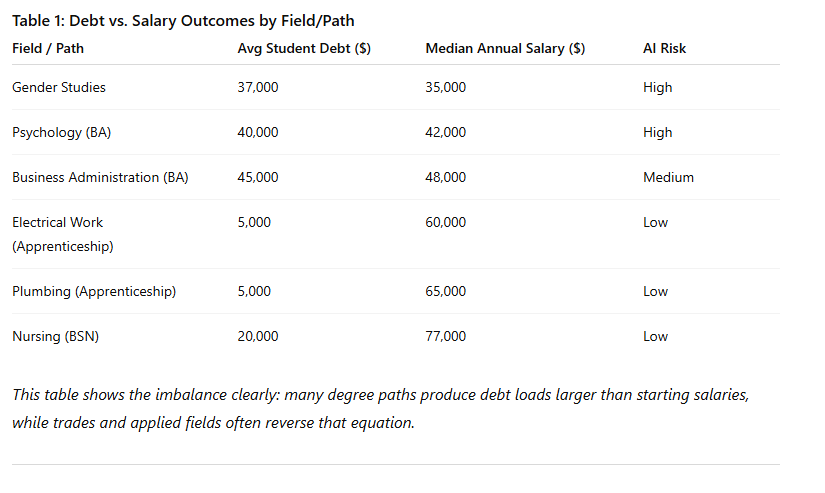
The incentives explain why. Universities are rewarded for filling classrooms, not for placing graduates into meaningful work. So they keep minting degrees in psychology, business administration, and gender studies while industries beg for nurses, electricians, and data specialists. The cultural prestige of “going to college” keeps the pipeline full, even as the return on investment shrinks.
The DEI Irony
Universities have made DEI a central mission, admitting students under relaxed standards and reshaping curricula around identity politics. The stated goal is equity. The actual result too often is the opposite.
Students admitted unprepared are more likely to drop out, leaving them with debt but no degree — arguably the worst outcome in the entire system. Others graduate with credentials that carry little weight in the labor market, saddled with loans they can’t repay. Instead of producing equality, the DEI push risks producing a permanent underclass of indebted but underemployed graduates.
Meanwhile, many white males — increasingly alienated by campus culture — are turning away from college entirely. They drift into trades and apprenticeships, the very jobs most insulated from AI and most in demand. Ironically, the group being pushed away may end up with greater financial security than the groups higher ed claims to champion.
DEI, in practice, becomes less about equipping students to thrive and more about universities advertising their virtue while still pocketing tuition checks. In the AI era, that’s a dangerous distraction: social justice rhetoric doesn’t pay down student loans or shield vulnerable graduates from automation.
AI: The Great Disruptor
Artificial intelligence makes all of this worse. The degrees most threatened by AI are precisely the ones students are borrowing heavily to pursue — entry-level office roles in law, business, and communications. Tech leaders like Geoffrey Hinton and Dario Amodei warn that millions of white-collar jobs could vanish in just a few years.
Yet many universities shun AI. Students risk discipline or expulsion for using tools that employers already expect. The consequence: graduates enter the job market AI-illiterate in an AI economy. They’ve paid twentieth-century tuition for skills the twenty-first century no longer values.
Forgiveness Without Reform = Doom Loop
Calls to forgive student loans highlight the problem but don’t solve it. The very fact that borrowers can’t repay is proof the degrees didn’t deliver value. Forgiving debt without reform is simply a bailout for universities. It rewards the broken business model and guarantees the cycle repeats at even greater scale in the AI era.
If policymakers are serious about fairness, forgiveness must be paired with structural reform. Otherwise, we are pouring water into a bucket with no bottom.
The Reform Ladder
What would reform look like? A sensible system could be built on four pillars:
The Stakes
Without reform, the pattern is clear. Universities will keep minting overpriced degrees in low-demand fields. Graduates will sink under debt. Taxpayers will fund more forgiveness. And AI will make the mismatch terminal by hollowing out the very jobs colleges still sell.
With reform, costs fall, proficiency rises, and universities are forced to justify their value. Students have multiple viable pathways — whether trades, apprenticeships, community college bridges, or specialized four-year programs. Debt shrinks, outcomes improve, and higher ed earns back its legitimacy.
Conclusion
America’s higher education system is an unaccountable monopoly. It charges career-launch prices while producing activist training and AI-illiterate graduates. Loan forgiveness may ease the symptoms, but without reform the disease worsens. If policymakers want to protect students, taxpayers, and the economy in the AI era, they must tie relief to massive reform.
The question isn’t whether higher ed is ripe for reform. It’s whether we will reform it before AI makes its failures permanent.