An Analyst’s Guide to the NCAA Tournament
-March 17, 2026
Anybody who knows me knows I love sports an I love modeling statistics to explain them.
The NCAA Tournament is a unique challenge because it intersects luck and skill to determine a game’s outcome. A game can come down to a shot bouncing around the rim and falling at the buzzer, and your bracket can get instantly busted.
But it’s not all random.
Over the course of a season, teams show you who they are. You can start to see their strengths, their weaknesses, and where they’re vulnerable. And while you can’t predict every result, you can get a much better sense of which teams are actually built to make a run.
You don’t need to be perfect
Winning your office bracket pool isn’t about getting everything right.
You don’t need to call every upset.
Most of the time, it comes down to getting the Final Four — and especially the winner — as close as possible. That’s where the points are.
So instead of trying to predict chaos, I focus on identifying the teams that have the profile to survive it.
The Way I Look at Teams
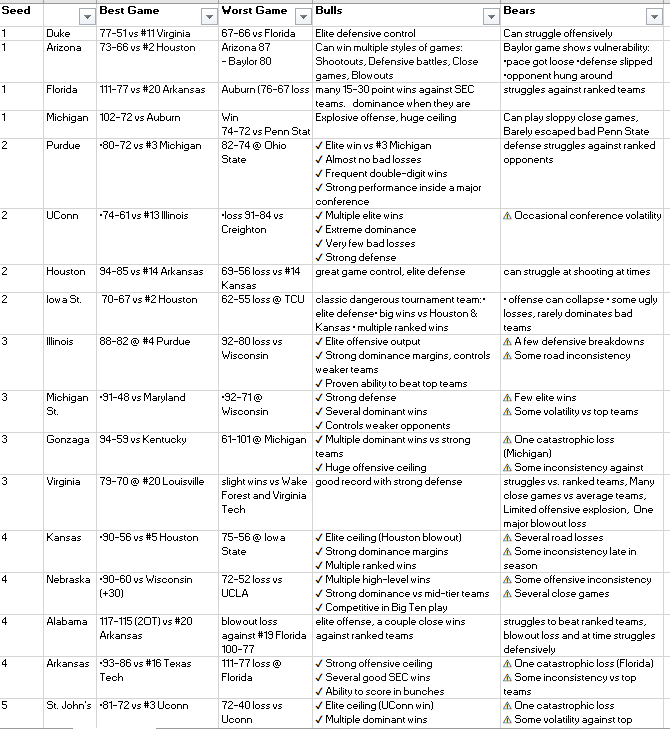
Every year I try to get a little better, but a process that lead to me to pick Florida last year, I am hoping can repeat this year. It’s pretty simple.
I looked at each team through three lenses:
- their best game — what they look like at their peak
- their worst game — how low their floor can drop
- and how consistently they control games
It’s just a way of answering three questions:
How good can they be?
How bad can they be?
And how often are they dictating the game?
That combination tends to separate teams that can win a game… from teams that can win six.
Arizona looks like that team
Arizona’s record is impressive. They can win any type of game: shootouts, defensive battles, close games, blowouts. Most teams need the game to look a certain way. Arizona doesn’t — and that matters in a tournament where every matchup is different.
Their “worst game” actually reinforces the case
For most teams, their worst game shows you how they can lose.
For Arizona, it shows you how hard they are to beat.
Arizona’s worst game is actually a win (87–80) over Baylor. Baylor is not a great team so Arizona should have trounced them, but they didn’t. The game wasn’t clean. They were down, things weren’t working early, and it easily could have slipped.
Yet, they still won.
Even when they don’t have it, they can recover and finish.
The game film
Watching the Big 12 Championship against a very good Houston team — it really comes into focus.
That first half was about as dominant as you’ll see. Arizona jumped out to a 15-point lead, and it wasn’t fluky — it was controlled.
Arizona took quality shots, dictated the tempo, and scored points against one of the best defensive teams in the country.
It didn’t feel like a hot game — it felt repeatable.
What makes them different: the players
This is what really ties it together.
It’s not one guy — it’s a group that all produce.
- Brayden Burries (~16 PPG, 49% FG, 37% 3PT) — lead scorer who can create and impact both ends.
- Koa Peat (~13+ PPG on 53%) — efficient secondary scorer.
- Jaden Bradley (~13 PPG, 4.5 assists, 1.5 steals) — controls tempo and organizes the offense.
- Motiejus Krivas (10+ PPG, 8+ rebounds, 1.8 blocks) — interior presence and rim protection.
- Ivan Kharchenkov (~10 PPG) — another scoring option that keeps pressure on defenses.
- Tobe Awaka (~9.5 rebounds, ~60% FG) — elite rebounder who creates extra possessions.
They don’t rely on one star — they come at you in waves.
The production backs it up
The numbers match what shows up on film.
They’re not relying on one player — they’re balanced:
- 86 points per game
- 50% shooting
- 36% from three
Multiple double-digit scorers, strong efficiency, and interior + perimeter balance.
That’s a profile built to hold up over six games.
They’re not dependent on one thing
They don’t need:
- a hot shooting night
- a certain pace
- or a perfect matchup
They have multiple ways to generate offense and stay in control.
Top First-Round Upsets
VCU over North Carolina
Defense, tempo control, and discipline vs a team that can get loose.
UCF over UCLA
A ceiling play against a team that tends to let games stay close.
Santa Clara over Kentucky
Stability vs volatility in a one-game setting.
Three Teams That Could Go Further Than Expected
Saint Mary’s
Slow, physical, and disruptive — a style that travels.
VCU
Not just an upset team — disciplined enough to carry forward.
Wisconsin
Composed, efficient, and unlikely to beat themselves.
Where I Landed: My Final Four
After working through everything, I kept coming back to four teams:
- Duke
- Arizona
- Michigan
- Illinois
I didn’t get there by trying to predict every game.
I got there by asking:
Which teams can actually win six in a row?
Duke Elite control and defense.
Arizona Flexible, resilient, and built to win in multiple ways.
Michigan High ceiling — can score in bunches.
Illinois Balanced and capable of beating top teams.
Final Thought
I’m not trying to build a perfect bracket.
I’m trying to identify the teams that have the profile to survive it.
These four give me the best combination of:
- ceiling
- stability
- and control
From here, it’s about letting the tournament play out.
Arizona is the team I’m riding with.