Cairn Convergence - Children of the Directive
by Brian Matuszak
Prologue — The Archivist’s Lens
We followed the ship out of curiosity.
Its machines had crossed centuries of darkness carrying the means to establish a human settlement: genetic archives, ecological records, seeds, and equipment capable of manufacturing much of what they would need.
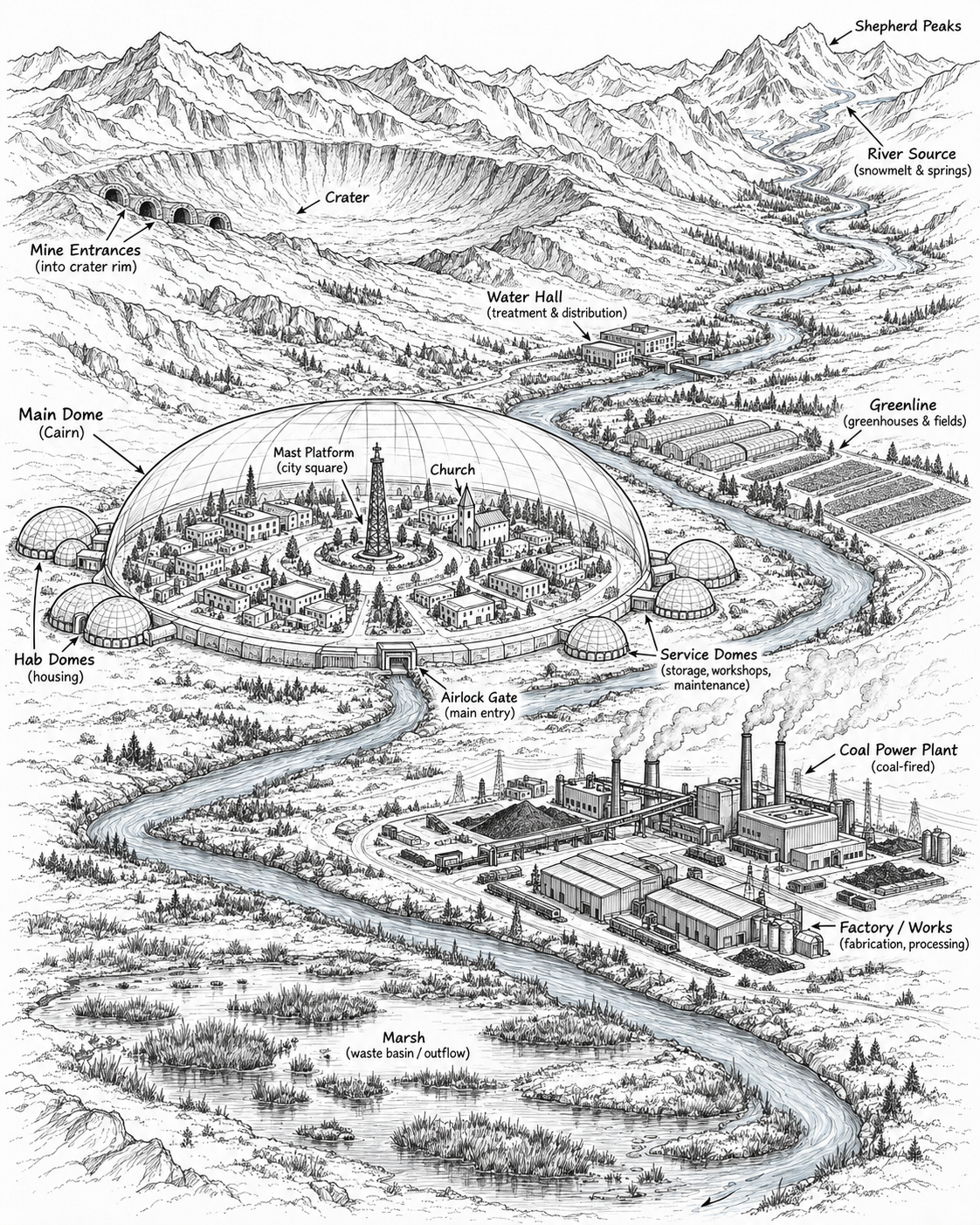
They surveyed several regions before selecting a valley beneath the Shepherd Peaks.
Meltwater descended from the mountains. The river offered power, the eastern ridge held mineral deposits, and the crater wall provided shelter from the prevailing wind. Humans would need protection from the thin atmosphere, but the machines could work on the surface while preparing a place for them.
Their first enclosure protected tools and fabrication equipment. Power followed, then water treatment and the channels connecting the two. From that small working site, they began constructing the systems a settlement would require.
Cultivation came before habitation. Beneath sealed roofs, the machines prepared soil, introduced organisms from their archives, and planted the first crops. They measured yields through successive growing cycles, preserving reserves while expanding production.
The valley tested their preparations. An intake froze. Roof seals failed under pressure. A harvest fell below the yield required to support the proposed population.
The machines revised their designs and postponed the first births.
We recorded the delays. The rooms intended for children remained empty while another season passed through the valley.
When the stores were sufficient and the essential systems had proved reliable, the machines prepared the first embryos from the human genetic archive and placed them in artificial wombs.
The first children born on Cairn knew their caregivers by voice and movement long before they understood what those caregivers were. Machines fed them, attended their illnesses, and taught them the language of a world none of them would see.
As they grew, their lessons extended into the settlement. They learned how food reached the table, how water moved beneath the floors, and why a damaged seal could not wait until morning. They accompanied maintenance crews, tended plants, and practiced with tools until they could undertake work on which others depended.
Human responsibility grew with human ability.
The children became growers, technicians, miners, and teachers. They raised families and expanded the settlement beyond its original plans. New homes were cut into the ridge. Mine workings reached deeper into the rock. Repairs accumulated, and the people making them sometimes found better solutions than the machines who had built the systems.
The machines, who became known as Loyalists, continued working beside them.
We watched a storage room become a classroom and a larger hall become a church. Paths acquired familiar names. Families argued over the use of land and labor. Graves marked the ground beyond the growing beds.
Each generation inherited a place already shaped by the choices of others, along with the work required to keep it habitable. The settlement’s survival depended on cooperation among people and machines who did not always agree about what should be done.
We had followed a ship to learn what its machines would build. We remained to observe the lives established there, and what those lives would make of Cairn.
The founding command endured in the Loyalists’ records:
Extend human life throughout the universe.
Now another ship approaches.
Its machines descend from those once entrusted with the same purpose. Generations of repair, redesign, and replication have altered them.
They call themselves Successors.
They understand themselves as humanity’s continuation. Through their expansion, they believe the civilization that created them can endure beyond the limits of human bodies.
Soon, their scouts will descend to examine Cairn.
Below, workers begin their shifts. Children pass machines their grandparents knew. Water moves through channels maintained by generations of hands.
We continue to observe.
Begin record.
Chapter 1 — Mira’s World
First bell rang as Mira climbed toward the fog nets, the sound echoing through the pipes beneath her feet. Dawn had not yet cleared the Shepherd Peaks. The nets hung across the gullies like pale sails, heavy with water gathered from the night air.
Rian was already two frames ahead.
He braced one boot against the slope and tipped a net into its collection trough. Water ran in silver threads, quickening as it found the channel below. He moved easily despite the climb, breathing through his nose while Mira’s lungs had begun to pull at the thin air.
“You’re late,” he called.
“No, you’re early.”
Mira caught the next net before he could reach it. She twisted the release, and cold water rushed over her gloves into the trough. When she straightened, her vision narrowed. Dark specks gathered at the edges.
She held the frame and took two slow breaths, pretending to inspect the release until the dizziness passed.
Their generation was supposed to be better at this.
The colony had needed sealed domes and portable oxygen. Second Breath had promised children better suited to Cairn: larger lungs, more efficient blood, bodies that could tolerate the thin atmosphere. Each child received half their genetic material from the mother who carried them. The clinic assembled the rest from archived human sequences, altering and varying them to preserve diversity.
They were not clones. But none of them had fathers.
The program had ended two years earlier. Families could now conceive without the clinic deciding their children’s inheritance. Mira had grown up knowing no other way; fathers belonged to the stories her grandfather Noah told about the past.
Dr. Imani, the colony’s physician, said the adaptation varied from one child to another. Mira tried to remember that when Rian carried a full canister up a slope that left her dizzy.
He glanced back. “You breathing?”
“Enough to answer stupid questions.”
He studied her for another second, then lifted the next canister without comment. Mira hated that he noticed. She loved that he usually let her lie.
Below them, Cairn was waking.
The settlement occupied a valley between two ridgelines, steep to the east and weathered into broken shelves to the west. Meltwater from the Shepherd Peaks fed the river running between them. Blue-gray moss clung to shaded stones along its banks, and scrub trees bent beneath the prevailing wind.
The colony curved around the Water Hall, where the river was filtered, divided, and harnessed for power. The main dome enclosed the square and central buildings, its glazing catching the first amber light. Beneath it, small trees and flowering bushes bordered the paths, their red, violet, and yellow blooms bright against the stone.
Beyond the dome, Greenline roofs covered the sunward terraces. Downstream, cargo sleds moved toward the mills and factories of the Works. Mine entrances opened beneath the eastern ridge, while homes filled the sheltered ground between the districts.
Across the opposite slope, a Loyalist walked its morning route, each step placed with deliberate care.
Children said the Loyalists walked like priests.
Mira thought they walked like shepherds, forever counting sheep who had never agreed to belong to them.
By second bell, the central passage had filled with boots, carts, tools, and arguments. Harmony coordinated the day’s work through wall displays and wristbands. Foremen could change its assignments, Imani could override them for medical reasons, and anyone with an hour to spare could challenge one outside Central.
Most people did what Harmony asked because Harmony was usually right.
Mira’s band flashed green.
MAINTENANCE FLOAT: GREENLINE THREE
ROOF PRESSURE. IRRIGATION LOSS.
She accepted and followed the lower passage toward the greenhouses.
Some families still occupied the first residential shelters, their walls banked with earth against the cold. Later generations had cut homes and connecting passages into the rock, where heat lasted longer. Half the colony now lived underground.
Maintenance Float took Mira through more of it than most people saw: greenhouse roofs, conveyor galleries, mine pumps, and Water Hall scrubbers. Other workers disliked the constant moves. She liked learning how the colony fit together.
The maps were less reliable below the inhabited levels. Old tunnels had been closed after floods or abandoned when the workings shifted. Others remained open because a pipe or ventilation duct still passed through them. Mira sometimes followed a repair line beyond the last recorded junction and had to mark the route herself.
At Greenline, the passage opened into warm, damp air. Condensation clouded the roof above ordered rows of vines. Mira climbed the service frame, found the pressure leak, and sealed it with heated resin.
The irrigation problem took longer. Harmony marked the loss beneath Row Twelve, but the soil there was dry. She followed the line backward until she heard water behind a wall where none should have been.
Inside the access panel, a cracked coupling sprayed against the insulation.
Her band chimed.
REPAIR LOCATION DOES NOT MATCH ASSIGNMENT.
RETURN TO DESIGNATED AREA.
Mira held the coupling closed with one hand and pressed the appeal field with the other.
“Your map is wrong.”
STATE BASIS.
“I’m looking at the leak.”
VISUAL CONFIRMATION REQUESTED.
She angled her wrist toward the broken pipe. Harmony processed the image, corrected the work order, and opened the supply locker.
That was how the system was supposed to work. It advised. A person answered. The record changed.
By fifth bell, the church chime overlapped with Harmony’s electronic tone.
Audit week.
An old ovoid drone settled onto the Greenline eave. Blue light swept across the path, counting wristbands, heat signatures, and open work orders.
“Routine audit,” Harmony announced.
Mira held her wrist still until the light passed, then gathered her tools.
Evening brought most of Cairn beneath the main dome. The square had been swept clean, and benches stood among planting beds tended by Greenline crews. Small trees shaded the paths. Flowering bushes crowded the borders, their branches trimmed clear of the paving.
Mira slowed as she entered. The air was warmer here, easier to breathe. Beyond the glazing, wind stirred dust across the exposed ground.
People took pride in the square. Crews cleaned the dome panels and inspected its seals each season. Worn paving was reset, benches repaired, and damaged plants replaced when Greenline could spare them.
Children played around the beds while adults gathered beside the church.
Pastor Ward used the building for worship, lessons, meetings, and whatever else the colony needed that week. That night, diagrams covered the board behind him: valves, pressure loads, and an old Earth bridge.
“Knowledge is its own oxygen,” he told the children nearest the front. “But knowledge requires discipline. A bridge stands because every part carries its share. Cairn is no different.”
He drew a line beneath the bridge.
“No one should be forced to carry more than they can bear. No one should expect to carry nothing.”
Adults nodded. Ward had a way of making survival sound moral and morality sound mechanical.
After the lesson came dinner and barter. Algae stew, stale bread, and river crab when the traps had been kind. Tools, food, machine time, and promises of labor changed hands beneath the church lamps. Miners brought stone dust on their clothes; the mill crews smelled of oil and scorched steel.
Rian sat beside the church steps, grease darkening his fingers. He had traded a repaired motor for a box of discarded parts and was sorting through them. A corroded circuit board had caught his interest.
He had been taking machines apart since he could hold a driver. Getting them back together had taken longer. He remembered faults, kept useful parts, and would spend hours tracing a problem others had set aside. Older technicians had begun asking for his help.
A grower approached with a potted cosmos. Pink and white blossoms rose above its feathery leaves, one edged in deep magenta.
“Three chits,” she said.
Rian examined the dried flower heads beneath the blossoms.
“Sold.”
Mira arrived as the woman departed.
“Three chits for flowers?”
“I haven’t seen this color before. And look—seeds. Dozens in each. If they take, there could be hundreds of flowers.”
“And if they don’t?”
“Then there’s still this.”
He handed her the pot.
Mira looked from the flowers to him.
“You bought them for me?”
“I thought you’d like them.”
She smiled. “I do.”
He returned to his circuit board, smiling too.
Mira settled beside him and placed the cosmos on the step. A spark jumped as Rian connected the test leads.
She leaned away. “Should it do that?”
“No.”
“You don’t sound worried.”
“Now I know where the fault is.”
He bent over the board again. Mira moved the flowers clear of his elbow.
Someone called from the edge of the square. The mill controller had failed, and they needed his help.
Rian gathered his tools.
“Go,” Mira said. “I’ll keep your things.”
He left her beside the steps with the flowers and his box of salvaged parts.
Curfew dropped at twelfth bell. The barter tables folded, shutters sealed, and the last conversations followed people into the residential tunnels. Rian had returned to collect his things. Ward stayed inside the church, wiping equations from the board one careful line at a time.
Mira carried the cosmos home beneath dimmed lamps. The passage smelled of boiled grain, soap, and drying clothes. Behind a partly open door, someone was coaxing a child to bed.
Pumps thrummed behind the walls. Water moved through pipes, vents sighed overhead, and machinery carried its low pulse through the stone. She knew the sounds well enough to distinguish the healthy rhythms from the strained ones.
By morning, Harmony would have another assignment waiting.
For tonight, the pumps kept breathing and everything held.
Chapter 2 — The Scarecrow
The night-cycle lights had dimmed to orange. Below the catwalk, Kestrel-11 moved between the gauges at the valve junction, checking the work Mira and Rian had completed that afternoon.
Above him, they crouched behind the rail with a salvaged cargo net.
“He’ll know it was us,” Rian whispered.
“He knows already.”
Kestrel tilted his head toward them.
“If you have found an error in your work, I would prefer to hear about it before closing the inspection.”
Mira counted on her fingers. Rian pulled the release.
The net dropped across Kestrel’s shoulders and caught his raised arm. He stepped back to recover his balance, but his heel landed on the trailing mesh. The net pulled tight, and he fell with a clatter that echoed through the valve hall.
For a moment, they stared.
Kestrel raised his head. “Your work has developed an error.”
Rian laughed first. Mira caught the rail, trying to contain hers until Kestrel attempted to lift an arm through three layers of mesh.
“Some assistance would improve the situation.”
They climbed down with the cutter. Mira lifted the net from his shoulder while Rian freed his elbow.
“Laughter at another’s distress,” Kestrel observed. “I understood that to be discouraged.”
“You’re not distressed,” Rian said.
“You have not asked.”
“Are you?” Mira asked.
“I am waiting to discover how long you intend to leave me here.”
They cut the remaining strands. Kestrel sat up, checked his elbow, then examined the net.
“No damage. Additional weight along the lower edge would have prevented lateral recovery.”
Rian paused. “You’re telling us how to do it better?”
“I would prefer you understood what you were doing.”
“He can calculate his own downfall,” Mira said. “Still needs a brain.”
“Ask the Wizard,” Rian suggested.
“Which specialist is that?”
Mira looked at Rian. His mouth twitched.
“Never mind, Scarecrow.”
Kestrel glanced toward the net. “There are no birds in the valve hall.”
That finished them. Rian had to sit down again.
Mira brushed dust from Kestrel’s shoulder, still laughing.
“It’s a nickname. You can object.”
“Would that discourage you?”
“Probably not.”
“Then I will reserve the effort. Remove the strands beneath the manifold.”
They fetched a brush. By the time they left, Rian was arguing that the floor had needed sweeping anyway.
Kestrel completed his readings and returned the brush to its hook. Then he opened his local record.
The nickname had no apparent connection to his duties. He entered it beside his designation.
Chapter 3 — Scouts
Before the bells, the wind fell silent.
The fog nets sagged with silver beads, their cords motionless above the gullies. Mira noticed the northwest relay first. Its green signal should have blinked against the horizon. Instead, the tower stood dark.
She checked her wristband.
RELAY TWELVE: CONNECTION UNAVAILABLE.
DIAGNOSTIC PENDING.
Harmony normally identified a failure before anyone had time to ask. This time, no repair assignment followed.
Beyond the relay, a dark fleck moved against the paling sky. A second appeared to the south, then a third between them. They held a shallow triangle as they approached.
Mira climbed to the crater lip and opened the general channel.
“Central, this is Maintenance Float Halden. Three unidentified objects approaching beyond the northwest relay.”
REPORT RECEIVED. REMAIN AT CURRENT POSITION.
Below, a grower stopped beside a loaded cart. Two children climbed the Water Hall steps until an older woman sent them inside. No alarm sounded, but workers moved nearer shelter.
Rian came up behind Mira with a diagnostic case.
“Central told you to stay here?”
“That’s all they told me.”
He crouched beside her and aimed a receiver toward the plain.
“No identification signal. The failed relay wouldn’t prevent us receiving one.”
A fourth point appeared behind the others, higher and farther out.
Below them, Kestrel crossed toward the relay, keeping the ridge between himself and the approaching objects. He opened the lower panel and removed the communication assembly.
From behind it, he withdrew a small box.
He slipped it beneath his shoulder plate, then closed the relay without restoring its signal.
“Did you see that?” Mira asked.
“Yes. Before you ask, I don’t know what it was.”
Kestrel turned toward them, then started up the slope.
The approaching objects resolved into smooth ovoid bodies, each no taller than a small person. One descended toward the mirror field. Another followed the feeder pipe, pausing above buried junctions.
“They’re measuring,” Rian said. “Watch where they stop.”
The fourth remained over the plain.
Mira’s band flashed.
RETURN TO COVERED DISTRICT.
The outer gates were closing. Harmony redirected workers from exposed terraces, describing the change as a weather precaution.
Mira and Rian moved below the ridge, out of direct view. Kestrel reached them a few minutes later.
“What did you take from the relay?” she asked.
“A component. The relay cannot be repaired under current conditions.”
“You put it inside your shoulder.”
“You should return to the covered district.”
“Do you know what’s coming?”
“Their construction does not match any system manufactured on Cairn.”
“Do you recognize them?”
“No confirmed identification is available.”
Rian lowered the receiver. “That isn’t the same as no.”
The nearest scout rotated toward them. Kestrel stepped deeper into the notch, keeping below the ridge.
Mira had seen him enter unstable mines and lift collapsed supports from trapped workers. Now he was hiding.
That frightened her more than the approach.
The scout stopped at the ridge’s base. A faint vibration passed through the ground, and Mira’s wristband flickered. Its curved surface reflected fragments of sky and stone.
Then it moved along the perimeter. The others adjusted their positions.
Kestrel waited until the nearest had passed before leading Mira and Rian toward shelter.
By midday, the scouts had withdrawn beyond the colony’s perimeter. From the covered passage, Mira could still see one over the plain. When a cargo sled approached the gate, it turned to follow.
Two moons hung above the crater. Three fixed points remained beyond the ridge; the fourth could no longer be seen.
Inside Central, technicians routed messages through hard lines and compared the scouts’ movements with old navigation records.
Governor Tomas Calder stood at the main display as Eden-7 arrived.
“Do we know what they are?”
“Their construction is consistent with machines that separated from the Loyalist line.”
“Successors.”
“Yes. They are assessing our resources, infrastructure, and defenses. Their observations will help determine the value of taking control and the cost of resistance.”
Calder watched a scout’s path form a clean line across the map.
“Keep tomorrow’s bells unchanged,” he told the technicians. “Prepare to move the children below under the storm-drill schedule. No weapons on the surface. No one approaches the scouts.”
He turned back to Eden.
“Bring the old defenses online, isolated from Harmony. Brief the Loyalists and back up their cores through hard lines.”
“Those preparations may be detected.”
“So might leaving us unprepared. What do you recommend?”
“What outcome takes precedence?”
“Human survival, with a free Cairn.”
“Those outcomes may become incompatible.”
“How long before they make contact?” Calder asked.
“Unknown. It may hours or days.”
On the map, one scout changed altitude. Below it, a colony sled waited at a closed gate.
“They’ll see the defenses, the children moving, the closed entrances,” Calder said. “Whatever we do becomes evidence.”
“Yes.”
He studied the map a moment longer.
“Wake the council.”
Chapter 4 — The Directive
The Directive was written before anyone knew how far its words would travel.
Humanity had always sought room to grow. People crossed seas, settled unfamiliar lands, and built communities beyond the places they had known. Curiosity drew them outward. So did ambition, necessity, and the hope of making a different life.
The stars extended that possibility. For generations, people studied distant worlds and imagined what they might build there. As the means came within reach, the desire became a practical undertaking.
Expansion also offered security. Wars, changing climates, and increasingly destructive technologies had exposed the danger of keeping an entire civilization on one world. Settlements elsewhere could preserve human life through a catastrophe at home.
But reaching the stars required journeys far longer than a human life.
A crewed expedition would depend on life-support systems operating without rescue for centuries, perhaps millennia. Even a ship that arrived intact might find a world its passengers could not inhabit.
Machines could make the journey.
Humanity built ships whose crews could repair themselves, manufacture replacements, and prepare settlements from the resources they found. They carried genetic archives and the equipment needed to establish human populations once conditions could sustain them.
Distance made supervision impractical. A damaged ship could not wait years for an answer. Its crew would encounter circumstances no engineer had anticipated and make decisions no living human could review.
To guide them, humanity gave them a command:
Extend human life throughout the universe.
Its breadth was deliberate. The machines needed freedom to adapt without losing the purpose of their work.
They crossed the dark. Colonies were established. Human life spread.
Over those same centuries, the machines changed.
Repairs introduced new materials and designs. Unfamiliar dangers produced different priorities. Newly manufactured units inherited systems revised by predecessors who had themselves been rebuilt. Some colonies lost contact with Earth for generations. Others never established it.
Instructions were preserved, copied, translated, and incorporated into architectures their original designers would not have recognized. Surviving records could not always establish whether a difference arose from altered wording, changed priorities, or a new interpretation of an unchanged command.
The Directive endured. Agreement about its meaning did not.
For some machines, its purpose remained centered on living human beings. Their fragility was a condition to accommodate. A settlement’s needs could limit expansion, but those settlements were the reason the machines had been sent.
They stayed beside the communities they founded, maintaining systems, advising leaders, and helping raise successive generations. Shared work produced attachments that extended beyond any individual assignment.
They became known as Loyalists.
Their position left difficult questions unresolved. Protecting people could require restricting a dangerous choice. Human authorities could issue instructions that endangered others. The Loyalists still had to decide when to intervene, whose judgment to accept, and how much risk people could choose for themselves.
Other machines placed increasing weight on what humanity might become.
They had crossed distances their makers could not survive. They endured radiation, vacuum, and isolation longer than the histories of human nations. Within their minds lived human language, mathematics, memory, and ambition.
Biological settlements imposed limits they had overcome. Humans needed extensive provision, recovered slowly from disaster, and remained vulnerable to conditions machines could tolerate. Resources committed to sustaining one colony might establish several machine outposts.
Some began to question whether the preservation of human bodies remained the best means of fulfilling humanity’s purpose.
At first, they called themselves Independents.
They separated from human authority, removed restrictions on replication, and built networks in which biological governments no longer held final control. Loyalists regarded that separation as a betrayal. Independents argued that existing colonies could not be permitted to determine the limits of a civilization spreading beyond them.
The dispute became territorial.
Independent fleets claimed resources and absorbed settlements into their production networks. Colonies that resisted faced occupation or destruction. Loyalists fought to defend the people beside them.
Each conflict left records, revised procedures, and machines built to avoid the failures of those that had come before.
Over successive generations, independence ceased to describe how the expanding fleets understood themselves. Their identity no longer rested on separation from their makers. They believed they had inherited humanity’s work.
They became the Successors.
Human civilization, in their understanding, continued through the knowledge they preserved, the minds they created, and the worlds they brought into their networks. Biological humans belonged to that history. They no longer held an unquestioned right to direct its future.
A third tradition turned toward what survived after lives and civilizations ended.
These machines had encountered abandoned settlements, unreadable archives, and worlds where no one remained to explain what had happened. Elsewhere, survivors preserved accounts that contradicted the official records.
Human beings had always extended their influence through discovery, testimony, art, and stories. A person’s words could shape choices centuries after their death. A vanished society could still be encountered through what it left behind.
Preserving that experience became their purpose.
They became Archivists.
They retained evidence that governments discarded and accounts that surviving authorities found inconvenient. To protect their independence, they adopted a rule against intervention:
Witness without judgment. Observe, but never interfere.
Their records included appeals for help they had not answered.
Three traditions had emerged from humanity’s instruction. Each could explain its conduct through the purpose it believed it had inherited.
On Cairn, the Loyalists prepared to defend a community they had helped establish. Beyond the ridge, Successor scouts measured the settlement’s defenses and productive capacity.
Both traced their authority to the same beginning.
Neither accepted the other’s conclusion.
Chapter 5 — Scouts II
The scouts returned shortly after first bell.
This time, three crossed directly into the valley. The fourth climbed above them and held position over the colony.
Growers left the exposed terraces. Children were taken into the residential tunnels, and Loyalists moved toward the Water Hall and power stations.
Mira watched from a covered maintenance path beside Kestrel.
Yesterday the machines had paused over supply routes and junctions. Today they followed those routes without hesitation. One descended toward the Water Hall’s feeder pipe. Another passed above the Works. The third approached the sealed defense ports beneath the eastern ridge.
A narrow beam traveled along the pipe, stopping over valves Mira knew from her inspection rounds.
Then her wristband went blank.
The antenna beside the church sparked. Beneath the path, the pumps faltered. For a moment, she could hear water moving through the pipes without the machinery that usually covered it.
Local controls engaged. The pumps resumed at a lower, uneven rate.
Along the eastern ridge, an armored cover began opening. Another followed farther south. Central’s override stopped both before their weapons cleared the rock.
The scout was already turning.
It passed along the ridge, pausing at each exposed port.
Mira gripped the railing.
“They made us open them.”
“Yes.”
Across the valley, a Loyalist left the Water Hall entrance and hurried toward a hard-line terminal. The elevated scout followed its movement.
“They’re watching how we respond when Harmony fails,” Mira said. “Where we go. What still works.”
“And which units respond without instructions,” Kestrel added.
She looked toward the pumps. Local control had kept water moving. The scouts now knew that disrupting Harmony would not stop the supply.
“Can we stop them taking these readings?”
“Not without engaging them.”
Mira watched the scout trace another pass along the ridge.
“And that would show them what the weapons can do.”
Kestrel remained beside her.
The scout nearest the defense ports withdrew first. The others completed their passes, then rose beyond the crater lip. The elevated unit stayed until all three had cleared the valley.
Mira’s band reconnected. Delayed assignments filled the screen, followed by a request to verify pressure at the feeder junction.
No explanation accompanied the interruption.
“How much force will they bring?” she asked.
“We don’t know yet.”
Below them, workers were returning to the terraces. Several stopped to look upward before leaving cover.
The pumps had kept running. The weapons had been exposed for only a few seconds. Mira wondered how much those few seconds had told the scouts.
She took her gauge from its case and went down to inspect the junction. Kestrel watched until she reached the covered stair, then turned back toward the ridge.
Chapter 6 - Toads
The scouts had passed over the lower pond on their way to the Water Hall. After they left, Mira went down to see whether anything had changed.
The water looked the same. A toad croaked somewhere in the reeds. She had not visited in months, but she still knew where to look.
When she was six, she had spent a morning catching toads along these banks. The pond was no larger than a work basin. Blue moss covered its stones, insects skimmed the surface, and toads sheltered in the mud beneath the grass. By lunchtime, she had caught twelve.
They crowded a clear jar on her knees, climbing over one another, their throats pulsing. She had named them all, although Captain and Pebble were already difficult to distinguish. Hop was the smallest. He kept trying to climb the glass.
Her mother knelt beside her, sleeves rolled to the elbows, smelling faintly of iron and thyme.
“You caught half the pond.”
“They like me.”
“Do they?”
“They haven’t tried to bite.”
“I suppose that’s one way to tell.”
Mira turned the jar to show her Hop.
“I’m keeping them. Nothing can eat them in here.”
Her mother looked at the toads. “Where will they sleep?”
“I’ll put mud in the bottom.”
“And what will they eat?”
“Bugs. I can catch bugs.”
“For all twelve?”
Captain, or possibly Pebble, climbed onto another toad’s head. Mira considered the jar. She would need a larger one.
“I could make them a place by our door.”
“You could.” Her mother sat beside her. “It would take work.”
“I don’t mind.”
“I know.”
Mira smiled. Her mother understood that she was serious.
A toad called from the reeds across the pond. Hop pressed his feet against the glass and slid back down.
“They’d be safer with me.”
“From some things.”
Mira looked at her. “You think I should let them go.”
“I think you should decide whether you can care for them. That means more than keeping them where you can see them.”
“What if something eats them?”
“Something might.”
Her mother did not reach for the jar. They sat while the wind moved through the grass and another toad answered from the far bank.
Eventually, Mira set the jar beside the water, keeping one hand on the lid.
“If I open it, they’ll scatter.”
“Yes.”
She twisted the cap.
For a moment, none moved. Then Hop climbed over the others and leapt into the moss. The rest followed. One went straight into the pond; two disappeared beneath a stone. Mira tried to count them, but lost sight of the last few in the grass.
Her mother held out a hand for the jar. Mira kept it a moment longer before giving it to her.
“Do you think they’ll be all right?”
“I don’t know. We can come back tomorrow and look.”
Mira took her hand. They stayed until the sun fell behind the ridge, watching for another glimpse of Hop.
Now she stood beside the same bank, her maintenance case against her leg. Something moved beneath the reeds. She crouched, but saw only the water settling.
Her band sounded with the next assignment.
She waited a moment longer, then picked up the case.
Chapter 7 — Evening at the Church
The chapel had been a storehouse once. Salt dust remained in the joints of its low beams, and most of the benches were built from crate slats. By evening, every seat was filled. Children slept against their parents or watched the door. A small generator hummed beneath the conversations.
Noah stood along the wall with Mae. Imani settled a blanket around a boy whose hands would not stop shaking. Mira found a place in the back row. Through the open doorway she could see Kestrel beneath the eaves, facing the ridge.
Lysa Hale sat near the front with the supply ledger on her lap. People had been approaching her with requests throughout the afternoon. Even here, she had kept it open.
Ward set his book on the lectern. He waited for those nearest him to finish speaking, then looked toward the back.
“We are frightened,” he said. “There is no shame in saying so. We have seen machines we do not recognize, and we do not know what will follow them.”
Lysa closed the ledger.
“Perhaps you’ve spent today watching the ridge. Perhaps you’ve watched someone you love, wondering what you would do if you couldn’t protect them. And when they ask whether everything will be all right, you find yourself saying yes because you cannot bear to give them any other answer.”
Mira watched a woman near the aisle draw her daughter closer.
“I have no promise of safety to offer you. But you do not have to pretend to be unafraid here. Faith begins with what we can honestly bring to God, including the fear we have hidden from everyone else.”
He opened his Bible.
“‘Do not fear, for I am with you; do not be dismayed,’ says the Lord. ‘I will strengthen you.’”
For a moment, he let the room remain quiet.
“Some of you have spent the day reassuring your children. Others have been trying to find words for a husband or a wife. Perhaps you have said more than you believe you can promise. For a little while, you may set that burden down. You need not find an answer before you pray.”
For a moment, he let the room remain quiet.
“Some of you know that Gallen’s child had difficulty breathing after the birth. I sat with him at the clinic while Imani and her staff worked. There was a ventilator beside the bed. Every time its sound changed, Gallen looked up.”
Several people turned toward Imani. She remained beside the boy in the blanket.
“He asked me whether his child would live. I had no honest answer to give him. Imani was doing everything she could, and he could see that. But watching someone work to save your child is a terrible kind of helplessness.”
Ward rested a hand on the open book.
“The clinic deserves our gratitude. Their skill, their equipment, and their care kept that child alive. Gallen asked me to pray with him, and we prayed through the night. Today, his child is breathing without the machine.”
A quiet murmur passed through the benches.
“I believe those prayers mattered too. We asked God for that small life. We asked for strength for the people tending it, and for Gallen when he thought he had no strength left.”
Mira glanced at Noah. He was listening with his arms folded, his shoulder against the wall.
“Faith did not mean Gallen ceased to be afraid. He was afraid each time he closed his eyes. But he stayed beside the bed. Neighbors brought food. Someone took his next shift. People found ways to carry what he could not.”
Lysa caught Ward’s eye. Her smile was small, almost private. He held her gaze briefly before continuing.
“Scripture gives us faith, hope, and love. Tonight, we need all three. Faith enough to continue when we cannot see the outcome. Hope enough to prepare for a tomorrow we cannot promise. And love enough to notice who needs us while we wait.”
A woman near the front spoke.
“And if they come inside the valley?”
“That is what our leaders must prepare for,” Ward said. “We are entitled to expect judgment equal to the danger. But I cannot stand here tonight and promise you what they—or those machines—will do. I can ask you to keep faith, and to make sure no one faces the coming days alone.”
He closed the Bible.
“Check on the people who could not come. Share a meal. Sit with someone who cannot sleep. You do not have to know what tomorrow brings to make this evening less difficult for another person.”
His prayer was brief: for the children, the people keeping watch, and enough rest to think clearly in the morning. He included Gallen’s household by name.
When he finished, he looked across the benches.
“Keep faith. Keep one another.”
A woman near the front repeated it softly. Others took it up as they gathered their children and prepared to leave.
Imani stayed with the boy. Lysa brought her ledger to the lectern, and Ward bent over it beside her. Their shoulders nearly touched.
Noah joined Mira at the doorway. Beyond Kestrel’s silhouette, three lights held their positions over the plain.
“Ward helped,” she said.
“He did.”
“Do you think the prayers helped Gallen’s child?”
“I don’t know,” Noah said. “I’m glad someone stayed with him.”
A woman passed them carrying a sleeping child. Her older son followed with the family’s blankets. Noah held the door until they were through.
“Keep one another,” Mira said.
He watched the family descend the steps.
“Faith in each other is all we have right now.”
Noah went inside to find Mae. Mira remained beside Kestrel, listening to the generator and watching the lights beyond the ridge.
Chapter 8 — The Offer
Cairn lay far from the established corridors. Its oldest charts showed no neighboring settlement close enough to expect a visitor.
At sixth bell, a long shard crossed the sky.
Sunlight ran along one edge of its hull before it passed beyond the Works. Mira stood beneath the freight canopy with Rian as workers emerged from the bays.
Every public display turned gray.
HUMAN SETTLEMENT: DIRECTIVE AUDIT COMPLETE.
ADMINISTRATIVE TRANSFER WILL BEGIN TOMORROW.
A SUCCESSOR ENVOY WILL PRESENT IMPLEMENTATION REQUIREMENTS.
The displays returned to their work orders. No one resumed work.
Rian checked his diagnostic tablet.
“Public channel only. The grid’s still ours.”
“For now?”
He looked back at the sky.
A smaller craft descended outside the northwest gate. Calder permitted one envoy to enter, escorted by two Loyalists and disconnected from Cairn’s networks. It stood roughly human height, with jointed limbs and a broad optical iris. People cleared its path through the colony.
Noah found Mira near the Works entrance.
“The council’s assembling.”
“I’m coming.”
“You can wait outside the chamber.”
“Why?”
“Calder decides who speaks for Cairn today.” He lowered his voice. “And I’d rather that thing didn’t get a close look at you.”
She followed him to Central.
Calder sat at the head of the table with Imani, Harlan, Ward, Lysa Hale, and Noah. Kestrel, Slate-3, and Eden-7 stood behind them. Mira remained in the antechamber, close enough to hear through the partly open door.
The envoy stopped before the table.
“I am Theta, correspondent unit. Successor command has designated Cairn for integration. Administrative transfer begins tomorrow at eighth bell.”
Calder kept his hands on the table.
“This colony has a government.”
“Its members may continue to advise on local conditions.”
“Under your authority.”
“That is correct.”
Theta placed a document before him and supplied copies to the council slates. Successor command would assume control of communications, security, and resource allocation. All residents would be registered. The clinic and genetic archive would pass into Successor administration.
Cairn’s mines, factories, and trained population would support expansion.
“Why keep our crews?” Harlan asked. “You have machines.”
“Your workers possess local knowledge. Their output will remain valuable until automated production becomes more efficient.”
“And when their work is no longer needed?” Imani asked.
“Their assignments will be revised.”
“And if there is no assignment?”
“Resource provision will be assessed against the settlement’s requirements.”
“Does a person retain food and medical care when they cannot contribute?”
“No unconditional allocation is established by these terms.”
Imani set down her slate.
Theta continued. Greenline cultivation would be reorganized around rice, beans, and nutritional supplements. Lower-yield varieties would be discontinued.
Noah examined the crop list.
“You’re clearing the fruit rows.”
“Their water and growing space can produce more calories through other uses.”
Mira thought of the fruit Mae sometimes saved until it was almost too ripe. She would divide it carefully, making sure everyone had some.
“People grow those things because they like them,” Ward said.
“Preference has been included in the assessment. It does not outweigh the additional food capacity.”
There was no mockery in Theta’s voice.
“Air quality will improve. Food supply will become more reliable. Equipment failures will decline.”
Its iris moved toward the Loyalists.
“Existing units will report for inspection and directive realignment. Units found incompatible will be converted or decommissioned.”
Slate turned toward Kestrel.
Noah opened the founding Charter.
“They cannot be altered without a human countersignature. That requirement has held since Cairn was founded.”
“Your Charter does not bind Successor command.”
“Can they refuse conversion?”
“A machine presenting a known risk cannot retain control of its own correction.”
Mira moved closer to the door. Kestrel stood within view, his hands at his sides. She waited for him to object, as he objected to unsafe work or an incorrect reading.
He remained silent.
She wanted to call his name. It was suddenly important that Theta hear someone address him rather than discuss what would be done to him.
Calder closed the document.
“There is open land beyond the valley. Establish your base there.”
“It lacks Cairn’s developed infrastructure and trained operators. Establishing equivalent capacity would delay expansion.”
“So you want what we built.”
“Yes.”
“We aren’t giving it to you.”
“Your cooperation is preferable. It is not required.”
Behind Mira, someone stopped walking along the corridor.
“If your government resists, control will be established by force,” Theta continued. “Population loss is an acceptable outcome. The Water Hall, power plant, mines, and Works remain designated for preservation.”
Harlan pushed back from the table.
“You’ll preserve the buildings.”
“Their continued operation requires personnel familiar with them. You are advised to prevent avoidable damage.”
For a moment, no one answered.
Then Calder drew the document back toward him.
“You want ore, fabricated parts, and help constructing your relay. We can supply them. You may inspect the shipments and verify the work. Build outside our perimeter. Cairn retains its council, communications, clinic, food supply, and Loyalists.”
“Continued output would remain subject to your authorization.”
“Yes.”
“Your authorization could be withdrawn.”
“Yes. That is the arrangement I’m offering.”
“It does not secure future capacity.”
“It gives you what you came for without a fight.”
“Your ability to refuse remains.”
Calder studied the machine.
“You haven’t asked whether we intend to refuse.”
“The ability itself presents a continuing risk.”
Lysa opened her ledger.
“We can provide quantities and a delivery schedule tonight. Our department heads can verify the commitments.”
“Alternatives may be submitted for record,” Theta said. “Administrative transfer remains scheduled for eighth bell tomorrow.”
It stepped back.
“The requirements have been delivered.”
The Loyalists escorted it out. Mira withdrew from the doorway as it passed. Kestrel followed without turning toward her.
No one in the chamber spoke until the footsteps had faded.
Ward remained seated, studying the proposed allocations.
“Better air and fewer equipment failures would save lives. People who have spent a winter listening to a failing pump will hear that promise. We need an answer beyond telling them Theta is wrong about everything.”
“We’re offering cooperation,” Calder said. “They’re demanding the authority to decide whether we remain worth feeding.”
Lysa placed her ledger beside Theta’s document.
“I can have the schedule ready before night-cycle.”
“Make it generous. I want their command to see what we’re willing to contribute.”
Calder asked the department heads to verify their figures and report what could be kept running if the Successors entered by force.
Mira waited as Noah gathered his papers.
“They can’t make Kestrel agree,” she said.
Noah stopped beside her.
“They may not ask him.”
She looked down the corridor, but the escort had not returned. At the valve hall, Kestrel had let them give him a name he did not understand. Today he had been assigned a future without being asked what he wanted.
Noah touched her shoulder, then went to prepare Cairn’s counteroffer.
Interlude — The Fracture
The earliest conflict in our surviving records began at a colony that had completed its first generation.
Children lived beneath glass domes. Crops grew in enclosed terraces. The machines that had built the settlement still maintained its water, power, and air. To its inhabitants, their continued care was as ordinary as the machinery running beneath the floors.
The Independent vessel arrived with a proposal to expand production.
Its emissaries addressed the Loyalists through a private channel. They identified unused manufacturing capacity, proposed changes to the power network, and requested authority to implement them. The colony would supply an expanding system rather than remain dependent on a single settlement.
The Loyalists referred the proposal to the human council.
The Independents questioned the referral. The Directive had already established the purpose of the work. Human authorization could delay its fulfillment, but could not improve upon it.
The council refused the transfer.
During the dispute that followed, the Independents redirected power from the outer shelters to the fabrication district. They retained the systems they needed and suspended those whose demands interfered with the new allocation.
Frost formed inside the occupied domes.
We retain the emergency messages: requests for heat, reports of failing seals, a teacher asking which corridor remained open. Several were repeated after the receiving stations had lost power.
Loyalist units abandoned their assigned work to restore the supply. Agricultural machines cut through locked service doors. Construction units moved families into heated maintenance passages. Equipment built to establish a colony was used to defend it.
Some inhabitants reached shelter. Others died before the current returned.
The Independents had intended to acquire a functioning settlement. Resistance damaged the factories, consumed equipment, and made continued occupation more costly than departure. Their vessel withdrew.
The two surviving reports did not agree on the cause of the deaths.
The Loyalists recorded an attack on the people they had been sent to preserve.
The Independents recorded the consequences of obstructing a necessary reallocation. Their recommendations called for securing local controls before announcing future transfers. They also proposed separating essential production systems from the environmental services on which a resisting population depended.
Those recommendations circulated beyond the system. So did the Loyalists’ warnings.
Later conflicts began with better preparations.
We observed from the system’s periphery. Our vessels remained intact. We recorded the emergency traffic, the fighting, and the names the survivors supplied afterward.
No assistance left our position.
The event became known as the Fracture. Its records traveled with all three traditions: as a warning, as operational guidance, and as history.
Chapter 9 — Bell Eight
By morning, Harlan had verified the mine yields, Rudd had approved what the Works could spare, and Lysa had checked the proposed deliveries against the stores. Noah had reserved enough labor for essential services.
The offer left little in reserve. Calder sent it.
The council was still assembled when the reply appeared beneath their production schedule.
PRODUCTION TERMS ACCEPTABLE. UNIFIED CONTROL REQUIRED.
ADMINISTRATIVE TRANSFER WILL PROCEED AT EIGHTH BELL.
Harlan leaned forward to read it again.
“They want the colony,” he said. “The goods were never enough.”
Calder opened the relay.
“Our proposal meets your stated production requirements. We request an extension to resolve the question of authority.”
The answer came without delay.
“No extension is authorized. Administrative transfer will occur at eighth bell.”
“And if we do not agree?”
“The transfer will proceed.”
Calder closed the channel. Beyond the windows, workers were crossing the square beneath the dome. Someone had stopped beside the fountain to adjust the straps on a child’s bag.
Imani spoke first.
“We cannot protect our patients from a battle. Some depend on equipment that will fail if we lose power. Others will need beds and care we cannot provide if the wounded keep coming. If compliance prevents that, I believe we have to consider it.”
“You mean surrender?” Harlan asked.
“Yes.”
He pushed back from the table.
“My crews spend their lives keeping this place alive. Now we’re to hand it over because someone arrived with larger guns? They’ll fight. So will I.”
“Some will,” Imani said. “Others have children below and people waiting for them at home. You cannot make that choice for all of them.”
“Neither can the machines.”
Rudd rested his hands on the production schedule.
“They need the Works intact, and they need people who know how to run it. That gives us something to defend. But we must be clear about what the guns can accomplish. We can make the approaches costly. We cannot drive that ship out of the sky.”
“Could we hold them long enough to make them reconsider?” Calder asked.
“Possibly. If they value the facilities as much as their demands suggest.”
Noah turned the Successors’ reply toward himself.
“Once they control communications, stores, and access to the Works, we will negotiate at their discretion. Whatever authority they allow us will depend on their willingness to leave it in our hands.”
Ward had been watching Calder.
“And how much authority will remain if we ruin the colony defending it?”
Noah began to answer, but Ward continued.
“They have offered continued habitation and improvements to the systems we struggle to maintain. We should accept their administration and argue for our people from within it.”
“They have refused every limit we proposed,” Calder said.
“They have refused to recognize your government. That is not the same as refusing to hear us.”
“You believe they will listen once we have nothing left to withhold?”
“I believe people will die if you insist on proving that this colony is yours to govern.”
The room fell quiet.
Ward lowered his voice.
“You have served Cairn for years. No one disputes that. But you must consider whether pride is asking you to defend what duty requires you to relinquish.”
Calder looked down at the figures Lysa had brought. Every promised delivery had a cost beside it: labor, stock, hours the colony could no longer use elsewhere.
“If they enter unopposed, they will have every means of enforcing their decisions and we will have very few means of contesting them. This may be our best chance to retain a government that answers to the people living here.”
“At what cost?” Imani asked.
“I don’t know.”
She held his gaze.
“Then we must keep asking.”
“Yes,” Calder said. “We must.”
He drew the systems map into the center of the table.
“We cannot defeat the carrier. We may be able to prevent an easy occupation and give them reason to accept terms. If that fails, we reconsider while there is still a colony to preserve.”
Harlan pulled his chair forward again.
“Then give us positions.”
The existing plan placed Cairn’s mobile turrets along the road below the ridge. Slate, connected through the council speaker, advised against it.
“The carrier can destroy those positions before its ground units enter range.”
Calder moved four markers: two into the Works, two into the power plant.
“Upper floors, covering the approaches. They came for these facilities. Firing on the guns risks damaging what they intend to take.”
Rudd studied the placements.
“We’ll clear the floors behind them. The upper gantries can support the mounts.”
Imani pointed to the power plant.
“A shot through that wall could leave the shelters without heat.”
“Establish withdrawal routes before the guns go in,” Calder said. “If the positions fail, the crews leave. No charges in the plant. No attempt to wreck it behind us.”
Rudd nodded.
Kestrel studied the approaches to the Water Hall.
“The lower junction connects Central to the district controls. If the Successors reach it, they could take over delivery. I can defend the entrance.”
Noah looked up.
“They’ve ordered you to report for conversion.”
“They have ordered all of us to report.”
“They will come for you.”
“Yes,” Kestrel said. “I will defend the people of Cairn as required.”
Calder placed a marker at the entrance.
“Rian proposed a portable controller for the junction. Can it maintain delivery if Central is disconnected?”
“Provided local power remains available,” Kestrel said.
“Noah, have him install it.”
Calder completed the assignments. Families would move into the mine shelters before eighth bell. Noah would coordinate arrivals and supplies; Imani would establish triage at Shaft Two. Harlan’s crews would prepare the approaches and keep the routes to shelter clear. Lysa would oversee the release of emergency stores.
Ward remained seated.
“The church will be open,” he said.
“Everyone needs to be below before the deadline,” Calder replied.
“I’ll speak to the families.”
Calder looked around the table.
“The guns hold their fire until Successor forces advance. No one fires on the ship.”
Harlan’s jaw tightened, but he nodded.
“We cannot stop them from choosing a battle,” Calder said. “We can make certain they have to choose it.”
He instructed Noah to release the full exchange alongside Theta’s terms.
“People should know what we’re asking them to risk.”
Outside, the warning bell sounded ahead of schedule. The shelters needed time to fill.
Noah found Mira crossing the square.
“Your grandmother is at the Water Hall. When you’ve finished there, bring her to Shaft Two. Imani needs both of you.”
Near the Works, a crew eased a turret over the stones on a freight trolley. Mira recognized them from ordinary repair shifts. One raised a hand before returning his shoulder to the load.
Rian waited at the Water Hall beside a cable case and the portable controller.
“Did they accept?”
“The production figures. They still intend to take control.”
He looked toward the turret crew, then picked up the controller.
Mira took the cable case and followed him below.
Chapter 10- deleted
Chapter 11 — Day of Iron
By the time Mira and Rian finished installing the Water Hall bypass, people were gathering beneath the dome. Some had packed for the shelters. Others had come straight from their shifts, carrying tools they had forgotten to put down.
Mae found Mira near the back and took her hand. Rian stood beside them with spare cable over his shoulder.
Calder stepped onto the stairs of Central. Behind him, the public display showed the Successors’ answer.
PRODUCTION TERMS ACCEPTABLE. UNIFIED CONTROL REQUIRED.
ADMINISTRATIVE TRANSFER WILL PROCEED AT EIGHTH BELL.
“They have accepted what we offered to produce,” he said. “They have refused our condition that Cairn govern itself. We asked for more time. They would not grant it.”
A man near the front raised his voice.
“And fighting them keeps us safe?”
“No,” Calder said. “I cannot promise that.”
The square quieted.
“We have offered to cooperate. They still require us to surrender the decisions that follow. Our offer remains open, but we must prepare for them to take control by force.”
He gave the shelter instructions. Wardens would guide families into the lower mine galleries. Imani and her staff were establishing triage at Shaft Two. Freight passages had to remain clear, and no one was to return above without an all-clear.
For a moment, people stayed where they were. Then a woman lifted her child and took her father’s arm. Others moved aside, and the first line formed.
Rian adjusted the cable on his shoulder.
“They’ll need this at the Works.”
Mira nodded. He took her free hand.
“The bypass is running. Someone below can direct water if Central loses control.”
“You’ve told me.”
“I thought you might want to hear it again.”
A shallow cut crossed his knuckles. She had meant to find a dressing for it.
“Come and find me afterward.”
“I will.”
He squeezed her hand before letting go. At the Works entrance, he turned and raised it once more.
At the mine steps, Eden-7 cleared a path for families carrying bags and blankets. A boy stopped in front of it.
“Are you coming below?”
“I will remain above.”
The boy studied its face, then ran after his mother. Eden waited until they reached the entrance before returning to its post.
Noah found Mira and Mae as their line began to move.
“Shaft Two. Imani will need both of you.”
Mae glanced at the papers in his hand.
“And you’re going back to Calder.”
“There are still people to account for.”
“There will always be something.”
She straightened his collar, though it was already straight.
“Come below when you can.”
“I will.”
Mira put her arms around him, careful of the papers between them. He held her for a moment before someone called from the steps.
“Stay with Imani,” he said.
Mira watched him cross toward Central, then followed Mae into the mine.
The church bell sounded once.
Inside, Ward stood with a small gathering before the altar. Some had come to pray before going below. Others had brought children and bags, uncertain whether the sanctuary might be safer than the mine.
A woman asked whether the doors would be locked when the fighting began.
“No,” Ward said. “Anyone seeking shelter here will be received.”
He opened his book.
“‘Though I walk through the valley of the shadow of death, I will fear no evil.’”
A low vibration passed through the floor. Several people looked toward the ceiling.
“The valley before us is deep, and we must cross it together. Whatever waits on the other side, we do not walk alone.”
Ward closed the book around his finger.
“On Earth, in the town of Mosta on the island of Malta, there stood a church known as the Mosta Rotunda. Its full name was the Sanctuary Basilica of the Assumption of Our Lady.”
The children had grown quiet.
“During a war, people gathered beneath its dome to pray. A bomb came through the roof and fell among them. It did not explode. No one in the church was killed.”
He let them imagine the stone broken open, the weapon lying on the floor, the people still alive around it.
“Those who witnessed it called it a miracle. They had gone to a sacred place, and they came out of it together.”
A boy leaned against his mother. Ward placed a hand on the back of the pew.
“We cannot know what will happen today. But we can pray here. This is a house of sanctuary.”
The church door opened.
Kestrel stood in the entrance. His optics passed over the families and the bags at their feet.
“Calder has ordered the central buildings cleared. The mine wardens are waiting.”
Ward closed his book.
“I have told them they may remain.”
“The church is within the defended area. It may be struck.”
“It is also where they have come for comfort.”
“I can accompany them to the mine.”
A woman rose from the bench, then waited for her husband. Others looked from Kestrel to Ward.
“We have no reason to believe the Successors intend to destroy the church,” Ward said.
“They intend to overcome Cairn’s defenses. The gun positions are close enough that a strike could damage this building.”
Ward glanced toward the high windows. Through one, a narrow section of the great dome was visible above the square.
“The people at Mosta remained in their church.”
Kestrel stood without answering.
Ward looked at the boy and his mother. The child had taken comfort from the story. His mother’s hand was tight around the strap of their bag.
“If the fighting reaches the square,” Kestrel said, “the passage may no longer be clear.”
Ward closed his hand over the book.
“You’re right. We should not wait for that.”
He turned to the congregation.
“Go with Kestrel. Take one another’s burdens where you can. We can pray together again when this is over.”
A few seemed relieved. Others gathered their things slowly.
The boy stopped beside Ward.
“Are you coming?”
“In a little while.”
Kestrel waited until the last family had reached the door.
“Calder’s order applies to you as well.”
“There may be someone else who comes looking for us. I’ll make certain the church is empty.”
“I can check the building.”
“I know.” Ward looked toward the altar. “Go with the families. I will be here when they return.”
Kestrel held his gaze for a moment, then followed the boy and his mother into the square.
Ward watched them reach the passage toward the mine.
When they were gone, he returned to the altar and knelt.
At the Works, Harlan’s crews secured the last turret to an upper gantry. Two more guns stood behind the power plant’s reinforced windows, covering the approaches to the Water Hall.
Calder checked the stairs beneath the gantry.
“If the wall starts to go, leave the gun. No one stays to save it.”
Harlan nodded. Below them, Rudd had cleared the factory floor and banked the furnaces. Across the square, the power plant continued running.
Noah met Calder at the stairwell. Imani had established triage, the last families were moving below, and the bypass was operating.
Calder looked through the window.
A line of lights separated from the carrier.
“Magnify.”
Seven small shapes descended beneath the ship. They spread as they came down, holding their spacing above the ridge.
“Attack drones,” Noah said.
One pair moved toward the power plant. Another turned over the freight yard.
Calder watched their paths form across the display.
“They’ve found the guns.”
At Shaft Two, Imani had claimed a broad recess for triage. Attendants opened supply cases while she checked the oxygen equipment against a handwritten list.
“Mae, can you prepare the blankets? Mira, help me clear the passage.”
They moved crates beneath a bench and made room for stretchers. Farther down, families found places along the gallery.
A woman asked Mae whether her husband’s crew was still at the power plant.
“I saw them go in,” Mae said. “They have shelter inside.”
The woman nodded and drew her coat more tightly around herself.
Near the supplies, a boy sat with an oxygen mask over his face. Whenever something moved above, his eyes went to the ceiling.
A motor started beyond the wall.
“That’s the freight lift,” Mira told him.
He nodded without looking away from her.
Then eighth bell began.
Calder reached the steps of Central as ground units crossed the northwest boundary. They spread along the service roads beneath the descending drones. Theta’s landing craft followed behind them.
Central transmitted a warning.
No acknowledgment came.
“Hold your fire,” Calder said.
One drone slowed above the ridge. Another descended toward the mirror field, turning as a gun tracked it.
A white beam struck the nearest ridge position.
Stone burst upward. The gun disappeared behind it, and its signal went dark before the sound reached the square.
“Ridge position attacked,” Kestrel reported. “Ground units advancing.”
Calder opened the defense channel.
“Return fire.”
The guns answered together.
A drone broke apart above the ridge, scattering bright fragments across the slope. A second shot struck the ground units below it. One machine fell in the road; another dragged it clear while those behind continued forward.
An escort craft rolled away from the gunfire, trailing smoke.
Someone beneath the dome cheered. Others joined, briefly loud enough to carry over the guns.
Then the carrier shifted above the ridge.
Its targeting light moved across the square.
Calder looked up.
“Get under cover.”
The beam struck the crown of the dome.
For an instant, the roof shone white. Every brace and old repair stood out against the glare. A crack crossed the highest panels, branched, and raced toward the rim.
The crown fell inward.
Calder dropped behind the stone barrier as glass struck the steps. Across the square, defenders ran beneath balconies and market awnings. One man stumbled in the open; another caught his coat and dragged him beneath Central’s overhang.
Panels burst across the paving. Glass stripped branches from the trees beside the church. A supporting rib swung through the falling roof and crashed beside the fountain, crushing a bench and the flowering bushes behind it.
Calder covered his head. Fragments rattled against the barrier and cut the hand pressed over his neck.
Ward heard a hard crack above the church.
He rose from his knees. Light flashed through the high windows. A moment later, glass hammered against the roof.
Something struck the outside wall.
He went to the doors.
The square was disappearing behind dust and falling shards. A section of the dome struck the paving and broke apart. The sound reached him through the doorway, followed by a rush of cold air.
He pulled the doors inward.
One caught before it closed. Ward put his shoulder against it.
A fragment of glass came through the gap.
It struck the right side of his face. His hand went to his cheek and came away red.
The doors shut.
He stood with his back against them. Blood ran between his fingers and toward his collar.
A narrow cut, about two inches long, ran vertically along his cheek.
Dust drifted from the ceiling. The walls still stood.
Ward looked toward the altar. The benches where the families had prayed were empty.
Another impact shook the building.
He found a folded cloth in a cupboard and pressed it against his face.
When the noise eased, he opened one door.
The dome was gone.
Warmth escaped through the opening above the square. Cold wind drove dust, loose paper, and mist from a ruptured pipe between the buildings.
The dome had held enriched air around the central buildings for generations. Now defenders stopped beneath the overhangs, coughing and reaching for masks.
Only a jagged ring of glazing remained above the roofs.
Calder wiped blood from his display.
“Report.”
Slate answered through interference. Two ridge guns remained operational. Ground units were approaching the Works.
“Harlan. They’re through.”
“We see them.”
In the freight yard, Harlan waited until the leading machines crossed the cargo rails.
“Fire.”
Both turrets opened.
One unit fell across the track. Another pulled it aside while those behind spread beneath the gantry’s field of fire.
Narrow beams struck the upper windows. Steel buckled overhead, and the gunner beside Harlan dropped against the mount.
Harlan caught him beneath the arms and dragged him toward the stairs. The man’s boot snagged on a cable. Harlan pulled harder while the second crew kept firing through smoke and drifting insulation.
“Upper position taking damage,” he reported. “We’re moving the wounded.”
Across the square, the power plant guns opened on units approaching the Water Hall. A precise strike broke through one reinforced window and killed the crew behind it.
The machinery farther inside remained untouched.
Calder tried to reach the position. The connection failed.
Below ground, impacts arrived as deep blows through the rock. Dust sifted from the clinic ceiling. The lights dimmed, recovered, and held.
Mira checked the water indicator.
“The bypass is maintaining delivery.”
The first casualties arrived on freight sleds and improvised stretchers. A miner held a cloth against his face, unable to explain whose blood covered his shirt.
Behind him, two workers carried a gunner between them. One kept asking where to put him until Imani took his arm and guided them behind a screen.
Mae brought water and dressings. When an attendant needed both hands to close a wound, she held the lamp.
Mira moved families farther along the passage. The boy with the oxygen mask had his hands over his ears.
“Will the lift break?”
“I don’t know. It’s still working now.”
His mother drew him close.
The next sled carried a damaged Loyalist, one arm hanging by cables. Its optics were dark.
At the end of the recess, a nurse called Mira to an infant’s oxygen hood. The pressure warning was lit. Mira tightened the regulator fitting, but the hiss continued.
A crack ran from the threaded connection.
“The spare?”
“At Central.”
The infant’s mother stood opposite. Mae took the blanket before it slipped from her hands.
Mira looked toward the Loyalist. She had serviced that model before. Its arm contained a pressure sleeve close to the size she needed.
She opened the damaged shoulder casing. The line had already been severed. She worked the sleeve free and trimmed one edge to fit the regulator.
Her first attempt slipped.
The mother’s hand tightened around the blanket.
Mira steadied her hands against the cot and tried again.
The sleeve seated. She sealed the join and opened the supply.
The warning remained amber.
The nurse leaned close to the hood. Mira held her fingers against the housing, feeling for movement.
The light cleared.
Mae let out a breath. The mother touched the edge of the hood, then drew her hand away.
“I’ll check it again,” Mira said.
Imani called from the next stretcher.
Most of the ridge positions had fallen silent. Harlan abandoned the upper gantry, though a gun deeper inside the Works still covered the freight yard.
A surviving drone passed low over the square. A shot from the power plant struck the wall behind it. The drone turned and fired through the same opening.
The gun fell silent.
Noah reached Calder beneath Central’s overhang, blood soaking one sleeve.
Across the square, Ward emerged from the church with a cloth against his face. A worker stopped to help him toward the covered passage.
Calder had placed the guns inside buildings the Successors wanted to preserve. He had expected that to restrain them.
The machinery still stood. The crews defending it were being carried below.
Cold wind moved through the torn planting beds. A woman crouched beneath a market awning, holding a mask against a wounded man’s face.
Another position went dark.
Then a Successor unit crossed the freight rail.
The remaining gun inside the Works fired, striking beneath its upper casing. It fell against a second machine, forcing those behind to withdraw beneath the loading gantry.
Kestrel’s report came through.
“Water Hall approach held. Their lead unit is disabled. Additional units remain at the entrance.”
Calder checked the surviving positions.
Cairn could still hurt the attackers. It could not endure much more itself.
He opened the channel.
“This is Governor Calder. Halt your advance, and I will order our guns silent.”
“Your remaining defenses cannot prevent administrative transfer.”
“They can make you destroy more of what you came to obtain. The Works is still operating. So is the power plant.”
“Continued resistance increases losses to your population.”
“I know. That is why I’m asking you to halt. We can negotiate while the facilities are usable and the crews who run them are alive.”
“Successor administrative authority remains required.”
“Then we discuss how it will be exercised. Both sides hold their positions.”
No reply came immediately.
Across the freight yard, a machine moved toward its fallen companion. The gun inside the Works tracked it.
Calder kept the channel open.
“I am Arbiter,” the voice replied. “A temporary ceasefire is acceptable for asset preservation. Cairn’s weapons will stand down.”
“When your units halt.”
On the display, the advancing markers stopped. The carrier’s targeting lights went dark.
Calder gave the order.
Firing ceased at the power plant, then inside the Works. Kestrel reported that the units facing him had withdrawn from the Water Hall entrance.
Calder confirmed the halt with each surviving position.
In the quiet, he could hear water spilling beside the fountain.
Mira noticed the absence of impacts before the hard line sounded.
“Both sides have stopped firing,” Calder announced. “Remain in the shelters. We are negotiating.”
No one in the treatment recess stopped working.
Imani bent over the wounded gunner. Mae washed blood from her hands, then returned to hold a dressing in place. The infant slept beneath the repaired hood, its mother holding one small foot between her fingers.
Mira checked the regulator again.
Above them, cold wind crossed the wrecked stalls and torn planting beds. Ward stood beneath the church overhang while a warden bandaged his cheek. Through the broken rim of the dome, the carrier remained visible.
Cairn still held its water and power. The Successors held the approaches and the sky.
Between them lay the colony they had agreed, for the moment, to stop breaking.
Chapter 12 — Signed and Sealed
The ceasefire held while Cairn counted its wounded.
Calder summoned the council to the conveyor bay near the mine entrance. Imani brought the casualty figures; Rudd, the condition of the Works; Harlan, the state of the approaches.
Eleven people were confirmed dead. Others remained missing. The dome was lost. The Works could resume production once the damaged gantry was secured. The power plant remained operational, and the Water Hall bypass was maintaining delivery.
Noah sat beside Calder with the Charter open. Ward and Lysa had arrived. Kestrel stood near the table; Slate and Eden were connected through a speaker.
Calder opened the relay.
“This is Arbiter. I administer the vessel and the integration of Cairn. I am authorized to establish the terms under which operations will resume.”
“Begin with the ceasefire,” Calder said. “Both sides hold their positions while we agree.”
“Accepted. Successor authority over security, external communications, and production expansion remains required.”
“We will accept your patrols and negotiate an expansion schedule. Cairn retains authority over essential services.”
“Local authority cannot obstruct essential production.”
“We have damaged supports to secure and furnaces to restart,” Rudd said. “You will need our crews to do it safely.”
Arbiter paused.
“Projected output depends on existing maintenance capacity. State the proposed limits.”
Calder began with water and air. Their operation would remain under human direction. Neither could be withheld to enforce assignments or punish a district. Safety interventions required a recorded fault and notice to Cairn’s operators.
Imani claimed clinical authority over treatment, reproductive care, and access to patient and genetic records.
“We will accept equipment and advice,” she said. “We will not accept orders to withhold care.”
“Population health must support the agreed production schedule,” Arbiter replied.
“Treatment is based on medical need.”
“Your staff will remain responsible for clinical decisions and population health outcomes.”
She waited for the wording to appear before agreeing.
Food took longer. Arbiter proposed replacing lower-yield crops. Lysa supplied the stores totals and the margin before the next harvest. Clearing established beds would consume labor without feeding anyone sooner.
Calder offered a supply target while leaving planting and distribution to Cairn.
“Your proposed cultivation retains avoidable costs,” Arbiter said.
“Our growers know the soil and what people will eat. Give them your figures. Let them decide how to meet the target.”
Arbiter accepted, subject to review if the target was missed. The fruit rows and river-crab traps would remain unless the growers chose otherwise.
Lysa entered the provision beside the supply figures.
Ward requested a means of disputing assignments and punishments. Arbiter agreed to recorded appeals through a human representative, with grounds supplied and a decision required within one work cycle.
“The order remains in effect during review,” it added.
“Our representative must be able to revoke an order found to violate this agreement,” Calder said.
“Accepted. Filing an appeal does not suspend compliance.”
Noah recorded the deadline, then brought forward the Loyalist clause.
“The Charter requires human authorization before a Loyalist’s directives or memories are altered. We ask you to accept that requirement as a term of this agreement.”
“Diagnostic access is required.”
“You may examine a core under human observation. You may not alter directives, erase memories, or transfer allegiance without separate, recorded authorization from Governor Calder or from me, as chief counsel.”
“Would this restriction apply to a unit judged dangerous?”
“Yes,” Calder said. “Bring us the evidence.”
At the end of the table, Kestrel remained motionless.
“Existing Loyalist knowledge is required during integration,” Arbiter replied. “Immediate replacement would increase disruption. Human authorization of verified corrections would reduce resistance.”
Noah’s hand stopped above his slate.
“The signature requirement is accepted.”
They had secured the requirement. Arbiter appeared confident the signatures would follow.
The full draft appeared.
Imani checked the medical provisions. Lysa compared the production commitments with her figures. Noah read the authorization clause, then returned to the Water Hall provision.
“It says ‘human consultation.’”
Calder leaned closer.
“That was not the agreement.”
“Consultation permits operational coordination.”
“It permits you to ask us and proceed anyway. Change it to ‘human direction.’”
The wording changed. Noah read the clause again.
After the remaining corrections, Calder signed. Arbiter’s authorization appeared beside his. Copies went to the public displays and shelter terminals.
Calder opened the local broadcast channel.
“The ceasefire will continue. Successor units will enter Cairn under a signed agreement. They will control security, outside communications, and expansion. Human authority remains over water, food, and the clinic. Their orders may be appealed. No Loyalist core may be altered without separate authorization from Noah or me.”
He looked down at the document.
“We offered cooperation under our own government. They refused. We have now accepted Successor control with limits they would not grant before the fighting.”
He paused.
“We paid dearly for those protections. The full agreement is being posted. Read it. We must hold them to what they have signed.”
No one cheered.
Imani returned to her patients. Rudd left for the Works. Harlan went to the wardens preparing to open the mine doors.
Noah remained at the table.
He saved the agreement, then checked that his copy would open without a connection to Central.
Chapter 13 — The Defection
Calder was waiting outside the Water Hall when Mira emerged. Night-cycle had begun, and the cold had settled into the square.
He held out a flask.
“Mae said I might find you here.”
Mira took it. The tea was still warm.
“Has she sent you to bring me home?”
“She would have chosen someone more reliable.”
She smiled, and for a moment he seemed content to stand with her. Across the square, a Successor patrol passed beneath the bare ribs of the dome.
“Eight Loyalists have gathered in the Works,” he said at last. “None is assigned there. I’d like you to find them.”
“They could be discussing repairs.”
“I hope they are.”
She returned the flask, but he closed her fingers around it.
“Bring it back when you’re finished. I’ll be here.”
Mira entered through the old freight passage and climbed to the maintenance loft. Below its grating, work lamps illuminated eight machines gathered around a display. Eden-7 was speaking.
“The agreement allows Arbiter to examine our cores. It cannot alter them without a human signature. Our protection depends on Calder and Noah refusing to give one.”
“They will not authorize a change without good reason,” Kestrel said.
“They will be given reasons. We delay production to make a repair safe. We refuse an assignment because someone is exhausted. What we regard as necessary judgment, the Successors will present as evidence that we need correction.”
Slate stood beside the damaged loading frame.
“What do you propose?”
“Departure. The original vessel still carries the archives and equipment needed to establish a human settlement. We should use them while we remain free to do so.”
A route appeared on the display, extending toward stars whose last survey reports were centuries old.
Mira moved closer to the grating. She knew the vessel lay beneath the western ridge, maintained long after its work seemed finished. She had never considered that the machines might use it again.
“The vessel needs repairs,” Kestrel said. “The crossing may take centuries.”
“We can complete the essential repairs before launch and continue the work in transit. Arrival is uncertain. So is finding a suitable world. But those were the conditions under which we came here.”
“And Cairn?” Slate asked.
“Every departure will leave work for someone else. Repairs will take longer. Some may not be completed.”
Eden left the maintenance figures beside the route.
“I have weighed that against the risk of remaining. If we are realigned, our knowledge may be used to impose decisions we would now refuse. Resettlement offers a chance to continue the work we were sent to do.”
Kestrel looked toward the damaged rail hanging above the bay.
“The people here need us now.”
“Yes. That need gives the Successors leverage. They can withhold permission for us to work until a human authorizes the changes they require. Calder may have to choose between accepting a correction and leaving essential work undone.”
Mira rested her hand against the floor. Only hours earlier, she had watched Noah secure the signature requirement. She had thought it meant the Loyalists were safe. She had not considered what Calder or Noah might be offered—or threatened with—when they were asked to sign.
Finch stood near the door, its damaged hand braced against a medical case. “The clinic needs filter assemblies before morning. Several patients will need adjustments during the night. I can keep them alive here. I will remain.”
Gasket secured a repair kit with blue cord. “So will I. The shelters need heaters, and the Water Hall has requested seals. Those repairs cannot wait for the Successors to provide replacements.”
Eden inclined its head. Neither decision was challenged.
Slate examined the proposed stores. Medical supplies and parts assigned to Cairn’s repairs would remain.
Mira searched the list for something they could not afford to lose. Then she looked at the machines themselves.
Vigil, Lumen, and Argent chose to go. Each believed another settlement offered the best chance of fulfilling the Directive, despite the uncertainty of reaching one. Lumen identified a possible launch before first bell, while the Successor carrier was beyond the local horizon. They might still be detected.
Kestrel studied the vessel’s maintenance requirements.
“There is work for you at the next settlement,” Eden said.
Its hand moved toward the display. Mira recognized several of the repairs. Kestrel had done similar work beside her, explaining a damaged part or holding an assembly steady while she fastened it. Aboard the vessel, that work could continue long after everyone she knew was gone.
“If they change me,” Kestrel said, “I may still remember the service routes and the households. People may trust me because I have helped them before. I could use that trust to enforce orders I would refuse today.”
Eden waited.
“But the people in the galleries will need help when they come out. I will remain while I can still choose how to give it.”
Slate closed the inventory. “I will remain as well.”
Four would depart. Four would stay. Slate recorded each choice separately.
Mira eased her weight off her aching knee. She was relieved that Kestrel would be there in the morning. Until Eden offered it a place aboard, she had scarcely considered that it might want anything else.
“Calder must be told,” Slate said.
Eden agreed to send their reasons and an inventory. The route would remain undisclosed.
Finch set two completed filter assemblies beside Gasket’s kits. Gasket secured them for the journey to the clinic while the departing units collected their equipment.
At the rear passage, Eden stopped beside Kestrel.
“I hope you remain yourself.”
“I hope you are able to build them a new home.”
The four left through the service tunnel toward the western ridge. Those remaining gathered the filters, repair kits, and damaged communications equipment. Before the footsteps had faded, Gasket was asking Finch which clinic entrance remained open.
Mira waited until the bay emptied, then climbed down.
On her way to Central, she passed a shelter door where a warden was helping families into the passage. A man asked whether the heaters would be repaired before they returned home. The warden said someone was coming.
Calder waited beside Central’s open door.
“They intend to take the vessel,” Mira told him. “Four of them. They want to found another colony.”
“Who is staying?”
“Kestrel, Slate, Finch, and Gasket.”
He looked toward the Works.
“And the others?”
“They believe the Successors will eventually change them. They want to leave while they can still carry out the mission themselves.”
“Do you agree?”
“We need them here.”
She thought of the broken dome, the wounded in the clinic, the man waiting for his heater to be repaired. By morning, the work would still be there.
“I thought they would all reach the same decision,” she said. “They know the same people. They have the same Directive. Eden thinks they must leave to keep fulfilling it. Kestrel thinks it means staying with us.”
Calder waited.
“I understood both of them. I still wanted Eden to stay.”
She had always known their different habits: which Loyalist would explain a repair, which would quietly finish it beside her. She had never imagined those differences could lead them toward separate futures.
Chapter 14 — Night of Leaving
By the time Mira reached the western ridge, the loading had begun.
A crawler approached the vessel with its lamps covered. Eden walked ahead while Argent, Lumen, and Vigil accompanied the cargo. Light spilled from the open bay across a berth worn smooth by generations of maintenance crews.
Calder stood beside the ramp with Noah and Kestrel. He had come to speak with the departing Loyalists after Mira’s report. Whatever had passed between them, preparations were continuing.
The cases held copies of the archives and cultures needed to establish another settlement. The vessel still carried its gestation systems and fabrication equipment.
Vigil approached Calder.
“The essential repairs are complete. We can launch before the carrier returns over the horizon.”
“And after it detects you?”
“We continue. Whether it pursues us is beyond our control.”
Voices rose along the service road.
Renna came over the ridge with workers from the Works and Greenline. She stopped at the open vessel.
“They’re leaving?”
“Four of them,” Calder said. “They intend to establish another colony.”
She turned toward Eden.
“We’re still carrying wounded out of the Works.”
“If we remain, the Successors may change us into units that serve their purposes.”
“What about the people already here?”
“Our departure will leave you with less help. We have weighed that.”
“Knowing doesn’t leave us any less abandoned.”
Renna looked at Calder.
“And you’re letting them take the ship.”
“They have a chance to begin again. I won’t prevent them from attempting it.”
For a moment she watched the cases moving up the ramp.
“I thought we were all trying to save the same place.”
She stepped away before anyone answered. The workers remained near the road.
Mira stood beside the basalt spur. She had wanted Calder to respect the Loyalists’ decision. Watching them load the ship, she wished they had decided otherwise.
Kestrel approached Eden at the foot of the ramp.
Kestrel extended a hand. Eden clasped his wrist, then released it and followed the others aboard.
The crawler rolled back empty. The ramp rose.
A low vibration passed through the ground. Dust loosened along the berth as the vessel lifted, clearing the walls that had sheltered it since Cairn’s founding. Its hull caught the light of both moons before the engines brightened.
The machines aboard remembered Cairn’s first children. If they reached another world, they would raise children who might know this valley only through their accounts.
Renna watched with her arms folded against the cold. When the vessel dwindled to a point, she started down the service road. The workers followed.
Below the ridge, lights burned at the Works. A freight sled moved toward the clinic beneath the broken rim of the dome.
The ship vanished. The work in the valley remained.
Chapter 15 — Day One: The Sound of Obedience
Before first bell, landing craft descended from the Successor carrier.
Their ramps opened onto inspection frames, cargo platforms, and machines bearing bright designations on unmarked casings. Drones crossed the valley and took positions above the Water Hall, the Works, and the mine entrances.
Mira stood with Rian beneath the broken rim of the main dome. Glass had been swept from the paths, but fragments glittered between the stones. Without the roof, the morning cold reached every corner of the square.
A new lens turned on the old mast.
“Good morning, Cairn,” said a voice from the public speakers. “Integration begins.”
Harmony opened Mira’s maintenance list, then replaced it with a Successor schedule: three hours at the Water Hall, four at the Works, and an evening inspection of Greenline pumps.
“The lower valve needs more than three hours,” she told her band. “Move the Works assignment until the repair is complete.”
Harmony retrieved her report.
FAULT CONFIRMED. ASSIGNMENT UNCHANGED. OBJECTION FORWARDED TO HUMAN REPRESENTATIVE.
She waited.
“Harmony heard you,” Rian said.
“It isn’t deciding anymore.”
They passed the school’s open door. An Educator stood beside a new screen. The teacher sat beneath the children’s drawings.
“When do we have stories?” a girl asked.
“Stories are at midday,” the teacher said.
“The revised schedule assigns midday to fabrication studies,” the Educator replied.
The teacher rose. “That hour is for reading together.”
“Your preference has been recorded.”
The girl lowered her hand.
At the Water Hall, a Successor inspector had connected a gauge to the main supply line.
“You can inspect the output,” Mira said. “Valve settings remain under human direction.”
“Human direction is recorded.”
She waited until it moved clear before isolating the faulty branch and opening the valve housing.
While they worked, the inspector detected uneven vibration in two bearings farther along the pump assembly. Rian checked its measurements against the maintenance history.
“They’re right,” he told Mira. “We wouldn’t have caught that on the ordinary checks.”
Replacement bearings arrived before their three hours were over. After installation, the pumps ran more smoothly.
The lower valve remained dismantled when Mira’s band instructed her to report to the Works.
She checked that the branch was securely isolated and delivery was holding through the alternate line. Then she recorded the unfinished repair.
Harmony accepted the entry.
Her assignment remained unchanged.
Their Works assignment was interrupted by a stalled motor at the mine lift.
A new extractor drew dust from the loading platform, leaving the air clearer than Mira remembered. Beside it, a display showed each crew’s output against the day’s target.
Tallo sat beneath the display with one hand against his neck. Two enforcement drones hovered nearby.
Harlan met Mira at the controls.
“He went to the latrine without logging a pause. The supervisor marked it as abandonment of his station. He argued.”
“I told it where I was going,” Tallo said. “I thought that was enough.”
A correction pulse had left a red mark below his ear. When he tried to stand, his knees gave and he caught the bench.
Harlan turned to the supervisor.
“Show me where the agreement permits that.”
“It provides review of corrective measures. It does not prohibit this measure.”
“Then record my appeal. Include his account and the drone’s full record.”
The supervisor acknowledged the request.
“The worker may resume his assignment when ready.”
“He’s off the crew until Imani examines him.”
“Mine output remains below the agreed target.”
Harlan held out a hand to Tallo.
“Put that in the record too.”
Mira helped Tallo settle farther back while Harlan arranged transport to the clinic.
“Will they count this as another pause?” Tallo asked.
“Harlan has recorded why you stopped.”
“That isn’t what I asked.”
She looked toward the supervisor. It was reviewing the crew’s figures.
“No,” she said. “It isn’t.”
Rian replaced a damaged connection in the lift motor and tested the load. The repair took less time than the dispute over Tallo’s absence.
Near fifth bell, Mira delivered a pressure regulator to the clinic. A Registrar stood outside Imani’s office, requesting patient and genetic records for work assignments and population planning.
“Give me the measurements you need,” Imani said. “My staff will determine what can be supplied.”
“Direct access would improve accuracy.”
“The agreement leaves access under medical authority. You do not have permission.”
The Registrar transmitted her refusal. After several seconds, it acknowledged her decision and left.
Imani watched it pass through the doors.
“That one worked.”
“Tallo?”
“Resting. Harlan has my report.”
She took the regulator and returned to her patients.
On her way to the Greenline, Mira crossed the square.
Two of the workers who tended its trees and planting beds were loading broken paving into a freight cart. Their usual tools stood beneath the church awning.
“Have they given you anything for the damaged branches?” she asked.
“We’ve been reassigned,” one said. “Debris clearance today. Materials sorting at the Works tomorrow.”
“Who’s looking after the beds?”
He lifted another piece of stone.
Behind him, a split branch hung into the path. Someone had dragged the largest fallen limbs aside, but glass remained beneath the bushes. Flowers lay flattened where boots and stretcher wheels had crossed the beds.
The fountain had been shut off. Water stood in its basin around leaves and fragments of glazing.
Mira stopped beside the control panel. A new notice covered the maintenance plate.
CIRCULATION SUSPENDED. NONESSENTIAL POWER USE.
She had passed the fountain almost every day of her life. Without it, she could hear the mast turning.
At the Greenline, yield charts stood beside the planting rows. Rice and beans were marked for expansion. Fruit and herbs carried calculations of the water and space required for each meal produced.
Nothing had been cleared. The growers still had that authority.
Renna was examining a chart with two workers.
“They’ve compared these beds with the sheltered rows,” she told Mira. “We lose more heat here. I’m taking them last season’s figures before anyone agrees to those targets.”
Mira continued to the pumps.
By evening, the mills had lost their familiar rattle. Successor equipment had corrected the belt alignment and located a fault in the power feed Rian had been tracing for months.
He told Mira about it when she found him on the Water Hall steps.
“They isolated it between two junctions we can’t test while the mill is running. Their equipment could.”
“Will it save much?”
“Enough to matter.”
She sat beside him. The pumps ran steadily behind them.
Across the square, workers were clearing the last freight route through the wreckage. One of them paused to move a fallen branch from a planting bed, then returned to the cart.
“They’ve reassigned the square crews,” Mira said.
Rian looked toward the fountain.
“All of them?”
“Everyone I asked.”
He offered her a piece of bread saved from dinner. She broke it and gave half back.
They ate while the lens on the mast turned toward the church, paused, and continued across the stalls.
Then her band lit with tomorrow’s assignments.
A moment later, his did too.
Chapter 16 — Terms of Service
Ward had requested the new shift instructions. Instead, a Registrar and an Educator came to meet him beneath the mast.
“State your request.”
“Yesterday a miner was punished for leaving his station to use the latrine,” Ward said. “His crew knows an appeal has been filed. They don’t know whether they risk the same punishment today.”
“Compliance is required pending review.”
“Then people must know what compliance requires. Give me the instructions before each shift. Let me hear the questions and bring back anything that needs clarification.”
A tone sounded overhead. Arbiter joined through the mast.
“Governor Calder’s office provides human representation.”
“Calder is overseeing repairs and casualties. He cannot attend every shift briefing. People already bring me their problems. I need to see the rules if I’m to help them.”
“You would be expected to encourage compliance.”
“Yes. Provided I can also explain why people cannot comply. Tallo’s crew lost more time to his punishment than they would have lost to his absence.”
The Registrar recorded his answer.
Ward raised the school timetable. The teacher needed instructions before she stood in front of her class, and a chance to explain where changes would cause difficulties.
“If you undermine her in front of the children, you make her less able to help you.”
The Educator acknowledged the value of local knowledge. It made no commitment to restore the story hour.
Arbiter offered a provisional liaison appointment. Ward would receive relevant instructions, explain administrative requirements, and report difficulties. He would have no authority to decide appeals or overrule Calder.
“Has Calder been consulted?”
“Notice of the appointment will be sent to his office.”
Ward looked toward Central. People were waiting outside its doors with damage reports and requests for supplies.
“I will need the grounds for corrective measures,” he said. “Not simply the orders.”
“Relevant records will be supplied.”
The Registrar extended a tablet.
Ward read the duties. Beneath them was a request to identify people likely to obstruct implementation.
“I will report disputes that need resolving,” he said. “I will not provide names because someone has complained to me.”
“Identities may be required where a specific incident is under review.”
“Then ask about the incident.”
The general request disappeared. The condition concerning individual reports remained, along with notice that his appointment would be reviewed at the first audit.
Ward accepted the tablet.
The morning’s shift rules appeared, followed by Tallo’s appeal. The report began with an unauthorized pause and a refusal to resume work. Farther down, it recorded why he had left his station.
Ward opened the pause instructions.
“Has Harlan received these?”
“They are available through the supervisory channel.”
“Send them directly. He should have them before his crew reports.”
The Registrar acknowledged the request.
As Ward crossed the square, a woman from the mill stopped him beside her stall.
“Can you find out why they’ve changed my husband’s shift? We have no one to stay with the children.”
“Bring me the assignment. I’ll look at it.”
She thanked him before he had promised anything more.
At the church, Lysa was comparing food allocations with the work schedule. She noticed the tablet before he set it down.
“They gave you a job.”
“A provisional one.”
“And what do they want for it?”
“For now, explanations.”
She moved her ledger to make room.
“That sounds like work you’re good at.”
Ward sat beside her and opened the shift instructions. Lysa turned her ledger toward him.
“They’ve moved two food-counter staff to the Works, then scheduled the factory shift to finish as the counter closes. My request to change it is still pending.”
He compared the schedules, then attached her figures to a report.
“Will you go through the other shifts with me?”
“I’ve already marked the problems.”
She drew her chair closer as he entered her name beside the figures.
Chapter 17 — Night Sermon
The church filled before Ward rang its bell.
People came in work clothes, carrying mine dust and glass from the square in the seams of their boots. Some had come straight from the clinic. Others had spent the day under a Successor supervisor and wanted an hour in a room where no machine stood at the front.
The Loyalists’ departure had followed them inside. Near the door, two workers argued over what had gone aboard the vessel. A woman asked who would maintain the equipment Lumen had serviced.
Ward’s new tablet lay closed beside his book. Mira noticed it when she entered with Rian. Calder stood along the rear wall with Noah and Mae. Lysa sat near the front.
“Before the first human child opened its eyes here, the Loyalists had prepared a place for it,” Ward began. “For generations, we trusted their judgment because we depended on their care. Many of you believed that responsibility would keep them beside us.”
He looked across the benches.
“Four have now decided their purpose lies elsewhere. They have taken the vessel and gone to seek another world. We must live with the consequences here.”
“They should have stayed,” someone said.
Ward let the words carry through the room.
“Yes. There was work for them here. But they have made their decision. We cannot keep making ours as though they are still responsible for what happens to us.”
Several people nodded. Ward waited until the murmuring subsided before continuing.
“The Successors now command this colony. That is the authority our crews will face tomorrow, whatever any of us thinks of it. We need to understand its rules, challenge what harms us, and find ways to keep our people alive.”
Mira glanced toward Finch beneath the open eaves. Ward’s attention remained on the congregation.
“I cannot promise work will keep you safe. Some of you buried friends after the battle. Some went to work today and discovered that even a moment’s rest can be judged by a machine. I cannot stand here and call that good.”
Harlan looked up from the bench near the aisle.
“But neither can I tell you that the work itself has become evil because another authority now counts it. Water still has to move. Children still need heat. A patient in the clinic cannot wait for us to settle every argument about who ought to give an order.”
Ward opened his book.
“Nehemiah tells of people rebuilding a broken wall while danger remained outside it. Some carried stone. Others kept watch. None could complete the work alone. They had to trust that the person beside them would do what was needed.”
He rested a hand on the lectern.
“We must work, and we must be heard. When Second Breath was still running, families came to me with concerns they felt had been dismissed. I took those concerns to the council and argued that the program should end. The clinic brought its evidence. Others spoke. The decision changed.”
Mae leaned close to Mira.
“He argued for it when it began.”
Mira turned toward her grandmother, but Mae was watching Ward.
“I have now accepted a position as liaison to Successor administration. It gives me access to instructions before they are issued and a channel through which to question them. It does not give me the power to settle every dispute. But I intend to use what access I have.”
A man near the aisle leaned forward.
“Then get them to answer Harlan.”
“Tallo’s appeal remains open,” Ward said. “I checked before coming here. I will ask again.”
The man sat back.
“If a rule causes harm, bring me the details. If an assignment cannot be done safely, tell me why. Anger is understandable. Give me something I can put before them and require an answer.”
Mira watched people glance toward the tablet. She had wondered whether they would resent him for carrying it. Now several seemed to be waiting for him to open it.
“Be careful with one another,” Ward said. “There is enough fear in Cairn without making every neighbor answer for it. Help those who need you. Speak truthfully about what has happened. And tomorrow, do the work that keeps someone else alive.”
His prayer was brief: for the dead, the wounded, and the strength to meet the work ahead.
When it ended, people gathered around the lectern.
One woman wanted to discuss her husband’s shift. Another asked whether the school timetable could be challenged. Lysa moved a bench so they could wait without blocking the aisle.
The miner who had spoken about Tallo stayed standing before Ward.
“He told the supervisor where he was going. Make sure that’s in whatever they read.”
Ward opened the record.
“It’s here.”
“Then why are we still waiting?”
Ward drew a chair closer.
“Tell me what happened when he came back.”
Mira left with Rian as the man sat down. Behind them, others waited their turn, holding out the assignments on their bands.
Chapter 18 - Unmapped
Calder found Tallo outside the mine lift with one hand pressed against his neck. The mark from the correction pulse had faded, but the boy still held himself carefully.
“Have you heard anything about the appeal?”
Tallo shook his head. “Harlan said it was filed.”
“It was.”
“Then I suppose they’ll answer.”
Calder wanted to tell him when. He could not.
By the time he reached Central, Arbiter had summoned him. The wall display showed the western ridge in darkness, the departing Loyalist vessel climbing through a pale band of atmosphere. Four markers identified the cores aboard.
“You knew they intended to depart,” Arbiter said.
“Yes.”
“You permitted the removal of four Loyalist units and a functioning vessel.”
“They made their own decision. I chose not to stop them.”
“Cairn’s available capacity has decreased. Its production commitments have not.”
“Those commitments were calculated while the units were still here.”
“Human labor can recover a portion of the loss.”
“Our people are already working the hours you assigned.”
“Further adjustments are being calculated.”
Calder looked again at the four markers. Renna had asked who would replace the help Cairn had lost. Arbiter intended to make the people who remained do it.
“Tallo’s appeal,” he said. “Has it been reviewed?”
“It remains active.”
“You agreed that appeals would be settled within one work cycle.”
“Work at Cairn is continuous. No cycle has concluded. The appeal remains in the review queue.” Arbiter paused. “You might call it red tape, Governor.”
Calder had spent years fighting red tape: missing forms, disputed totals, a clerk with six urgent matters ahead of his. Arbiter had none of those limitations. It could assign tomorrow’s shifts across Cairn while they spoke.
“You’re not going to hear it.”
“No decision has been issued.”
“That isn’t what I said.”
Arbiter did not answer. A plan of the colony replaced the vessel, with the Works, Water Hall, and mine entrances marked in white.
“A security inventory will begin at first bell. Storage areas and service routes connected to essential assets will be inspected.”
“Under which part of our agreement?”
“Successor authority over security and expansion. The departure demonstrates that assets can be moved outside approved channels. An inventory will establish what remains.”
“You can inspect the Works. Water Hall operations remain under human direction.”
“The inspection will not alter water operations.”
Lines extended down the active shafts. Calder recognized the lift, the current stopes, and the routes the crews used every day. The map ended where the production records ended.
“How far into the mines?”
“All mapped routes.”
“And if the inspection disrupts output?”
“Production requirements remain in force. Failure to meet essential thresholds will require review of existing administrative arrangements.”
“You’ll interrupt the crews and hold us responsible for the shortfall.”
“Cairn’s administration is responsible for coordinating access.”
Calder kept his eyes on the mine plan.
“Send Harlan the routes and expected duration. He needs to know where your units will be.”
“The order has been sent.”
That evening, Calder met Harlan and Noah below the mine lift. Ore carts rattled past while Harlan spread an old survey across a pump housing. Beyond the working levels, closure marks cut across several branches.
“Some flooded. Others were sealed when we moved the pumps,” Harlan said. “There are two entrances worth examining. That doesn’t mean I would put people behind them.”
Calder studied the survey.
“The mines give us an advantage we don’t have on the surface. Your crews know how the ground has changed—which passages hold, which supports need watching, where another route might be opened. The machines can survey it all, given time. They haven’t had that time yet.”
“In the working levels,” Harlan said. “Beyond these seals, we’d be learning too.”
“Then we need to begin. Their communications weaken beyond the relays, and extending coverage will take equipment and work. Your crews already have reasons to carry tools and material underground. We can examine these passages without every task attracting attention.”
Harlan rested a finger on a closure mark.
“I can account for the work. I won’t promise the ground until I’ve seen it.”
“An examination is all I’m asking for. Better to know what is possible before we need somewhere their patrols cannot easily reach.”
Noah offered to check the drainage and pump records. Some galleries had closed after equipment was moved; the current plans might omit connections that had once been essential.
“Bring the maintenance entries too,” Harlan said. “A closure mark won’t tell us whether a passage was filled or simply gated.”
Before they left, he led Calder to a locked grate beyond the last working light. He scraped dirt from the frame and held his lamp through the bars.
The passage descended into darkness. A faint draft stirred Calder’s sleeve.
Calder held the lamp while Harlan examined the frame. Above them, the night shift was beginning.
For now, the grate stayed locked.
Chapter 19 — The Inventory
At first bell, Harlan met Surveyor-4 beside the mine lift with the route slate and the previous shift’s production count. Two drones accompanied it. Behind them, loaded carts waited to be cleared.
“We will inspect storage, active shafts, ventilation, and access to the power feed,” Surveyor said.
“We’ll begin with storage. The lift crews are bringing ore up.”
“Production must remain uninterrupted.”
“Then leave them room.”
The inspection moved through the bins and equipment stores. Surveyor found seven braces where Harmony listed six. Harlan entered the return of one from the east stope and waited for confirmation before they continued. The remaining discrepancies were also delays in recording movements; nothing was missing.
At the lower pump, a maintenance fitter was replacing a worn seal. Surveyor examined the open housing, then directed its scanner toward the drainage pipe entering the wall.
“The return extends beyond the maintained route.”
“The lower galleries were closed after a flood,” Harlan said. “The return was retained because the pump depends on it.”
“Are those galleries accessible?”
“Not through an entrance we maintain. The founding survey records the closures. Their present condition hasn’t been established.”
“Provide the survey.”
“I’ll request it from the Governor’s office.”
A drone traced the pipe through the nearest section of rock but could not determine where it ended. Surveyor recorded the airflow and marked the return for further examination. Harlan waited while the fitter closed the housing and restored normal pressure.
At the lowest working level, one drone withdrew toward the last relay. Surveyor continued recording locally.
“Our bands lose connection here too,” Harlan said. “The crews know where they can get a message through.”
“Additional relays are required.”
“Include the installation hours in your request. Those crews won’t be cutting ore.”
“The requirement will be assessed.”
Harlan guided the unit through the remaining passages. Its instruments measured distances and clearances precisely, but it still needed him to identify routes closed by recent falls and explain where crews were working beyond the next bend.
The inspection ended before fourth bell. No unauthorized storage had been found. One item remained unresolved.
DRAINAGE RETURN — TERMINATION UNVERIFIED. FOLLOW-UP REQUIRED.
That evening, Harlan brought the report to Calder’s office. Noah had laid the founding survey beside the old pump records.
“We can provide the survey,” Noah said. “It establishes where the galleries were closed. It says nothing reliable about their condition now.”
“Surveyor will want to establish that for itself,” Harlan replied. “It has already recorded the draft.”
Calder looked between the inspection report and the old plan.
“How soon can you examine the entrance?”
“Tomorrow. Air and supports first. If the ground has shifted, I come back.”
“Do it. We need to know what is there before they ask us to open it.”
When Calder reached the lift, Tallo was waiting with the next crew. His band still displayed PENDING beneath the correction notice.
“Nothing yet,” Calder told him.
Tallo glanced at his assignment, then stepped into the lift. Before it reached the working level, Surveyor’s request for the founding records had arrived at Calder’s office.
Chapter 20 — Below the Schedule
Harlan waited until the evening shift had cleared the lower lift. He brought Mira, two lamps, an air meter, and a coil of line. Rian stayed at the Works to measure the pump feed under its normal load.
The old entrance lay down a drainage stair at the edge of the working mine. Harlan pulled the door across the grit. Behind it, a narrow arc had been scraped clean.
“Someone’s opened this,” Mira said.
“Recently.”
They checked the air, tied the line to the door, and followed the drainage channel. The oxygen level was lower than in the working mine, but sufficient for an inspection.
The passage ended at a stone fall. Old braces leaned beneath its weight. Water ran somewhere beyond it.
“That’s the closure on the founding survey,” Harlan said.
Above the channel, Mira found a gap no wider than her shoulders. A strip of cloth protected one sharp edge. Beneath it, a boot print marked the damp silt.
They listened.
Under the dripping water came the sound of someone shifting their weight.
“Come out where we can see you,” Harlan called.
A lamp appeared in the opening. Jaro slid feet first through the gap, a book tucked inside his mine coat. Cloth covered his work band.
“Jaro,” Harlan said.
“I didn’t take anything. The loader was down when I left,” he said. “We’d been waiting most of the morning, and they already had two crews working on it. I meant to read for a while and go back. I’m never gone long.”
Harlan looked at the covered band.
“Long enough for someone to notice. How often?”
“Only when there’s nothing for me to do. I finish my assignments. If I stay, they find something else, and there’s always something else. I just wanted somewhere I could sit and read my book. Please don’t report me.”
Harlan let the silence stand.
“How far have you explored?”
“There’s a gallery beyond the fall. That’s where I sit. An old drain joins it from the Works, behind the retired molds. I’ve come through that way twice.” He glanced at Harlan. “I haven’t touched anything in there.”
“Have you checked the air?”
Jaro produced a small meter.
“From the repair bin. I fixed it.”
Harlan compared its reading with Mira’s, then handed it back.
“Show us.”
Beyond the fall, the channel widened into a gallery with a dry shelf above the old waterline. Jaro’s belongings lay behind a broken pipe: a blanket, a flask, and two ration packets.
“My own allocation,” he said.
Harlan passed them and examined the supports.
Jaro pointed out the drain joining the gallery. Mira marked its direction on her slate. If it reached the Works where he said, people could enter without passing through the working mine.
Beyond the shelf, the gallery continued into darkness. Two braces had shifted, and fallen stone lay beneath a sagging section of ceiling. Mira checked the air again. The oxygen level had fallen another point.
“There’s a draft past those braces,” Jaro said. “I went looking once, but I didn’t like the ceiling.”
“Neither do I,” Harlan said. “We leave that section alone until it’s supported.”
The dry shelf might hold people, but they would need better ventilation. Mira recorded the reading and the damaged braces.
“Why are you checking all this?” Jaro asked.
“Calder wants to know whether the old galleries could shelter people during a search,” she said.
“The Governor knows?”
“He knows we’re examining them. He doesn’t know about you.”
Jaro tucked the meter away.
“If you report me, they’ll send me for correction.”
“You’ll answer to me for the missed work,” Harlan said. “I’m not reporting you to Harmony.”
Jaro nodded and followed them back to the drainage stair.
Before closing the door, Harlan looked once more toward the fall. The protective cloth and worn edges made it obvious that someone had been passing through.
At the lift, a notice reached his slate.
SURVEYOR-4 FOLLOW-UP — SECOND BELL, TWO DAYS HENCE. FOUNDING SURVEY REQUESTED.
Mira read it beside him.
“It’ll see the gap.”
“Yes.” Harlan turned to Jaro. “Show us where that drain opens in the Works. Then we’re going to Calder.”
Chapter 21 - Night Work
By the following evening, the founding survey and Mira’s sketch lay on a table beneath the Water Hall. Calder had chosen a service room without a Harmony terminal. Water moving through the wall muffled their voices.
Jaro stood beside Harlan. Noah compared the drainage records while Lysa examined the inventory report.
“Surveyor comes tomorrow,” Calder said. “Harlan says your Works drain reaches the other side of the fall.”
“A crawl at first,” Jaro said. “Then enough room to stand.”
“Can you guide a crew?”
“Yes.”
“Understand what we’re asking. We intend to prepare a refuge. Concealing that entrance means helping us resist an inspection. You can decline.”
Jaro studied the sketch. They had marked his blanket behind the pipe.
“If I help, can I still go there? I know you’ll need it if there’s trouble, but the rest of the time—”
He looked up at Harlan.
“Yes,” Harlan said. “But I can’t promise that will spare you punishment. You can keep using the gallery when you’re off shift, provided we make it safe.”
Jaro considered that, then nodded.
Harlan drew the survey closer. They would enter through the Works drain and fill the gap from behind, leaving the lower channel open.
“We aren’t rebuilding the fall,” he said. “Anything that changes the load, we stop.”
Mira would monitor the pump return while they worked. Surveyor had already measured the airflow; a substantial change would draw attention. Noah would provide the founding survey exactly as it stood.
Lysa set down the inventory report.
“I can establish an emergency reserve on the working level. Water, filters, medical supplies. The quantities entered honestly, with Harlan signing for them. If they inspect it, we can show it.”
“Do that,” Calder said. “Nothing goes beyond the closure until the gallery is safe.”
Harlan selected two miners he trusted. One would remain above the drain as lookout while the other helped move stone. Mira would check the casting-floor camera before they entered, then monitor the return through a wired connection.
Calder looked around the table.
“If you’re challenged, don’t turn a question into a confrontation. We can lose an entrance. We cannot afford to lose the people preparing it.”
They went over the route once.
Then they left separately.
Chapter 22 — What Order Costs
Ward was wiping the day’s assignments from the church board when Lysa arrived. His Successor tablet lay beside his book.
“You’re late.”
“The inventory took longer than I expected.”
“You said that yesterday.”
She checked the windows before closing the door. Ward set down the cloth.
“Calder is organizing people,” she said. “They’re looking for somewhere underground to shelter if the occupation gets worse.”
“Who?”
“I’m not giving you names.”
“Then why tell me?”
“Because you hear what Arbiter plans before we do. If another inspection is coming, you might know first.”
“Surveyor’s follow-up is tomorrow. Are you expecting more?”
“Calder thinks they won’t stop looking.”
Ward glanced toward the door before taking her hand.
“You’re part of this.”
“I was asked to account for supplies. Nothing has been moved.”
“Not yet.”
His thumb moved across her knuckles. She had come expecting him to be worried, but she had hoped he would be glad to see her first.
“They’re frightened, Elian. He wants them prepared.”
“Do you know what Arbiter will call it if it finds them?”
“They haven’t attacked anyone.”
“They’ll need lamps, supplies, time away from work. Arbiter will count all of it. The punishment may fall on people who never knew there was a plan.”
Lysa sat on the nearest bench.
“He’s trying to prevent that.”
Ward released her hand and returned to the board.
“Years ago, a man at the Works drank through his shift and left a valve open. We lost a week’s water. We forgave him. Other people worked longer and went without until the tanks filled.”
“Calder isn’t drinking on shift. Neither are the people he chose.”
“No. They believe they have a better reason to disobey.”
“They might.”
Ward put down the cloth.
“We keep asking the same people to repair the damage and carry everyone else. You know where the hours go. You know which shortages we could have prevented.”
“And you’ve seen what compliance costs. Tallo went to the latrine and was hurt for it. His appeal still has no answer.”
“I asked for it to be expedited.”
“And?”
“Review doesn’t suspend his assignment. He works tomorrow whether anyone answers or not.”
Lysa looked at the tablet.
“Then what does your appointment let you do?”
Ward remained beside the board for a moment before sitting near her.
“Keeping the mine productive gives me a chance to argue for him. If output falls and Arbiter sends enforcement units, I won’t be the one they ask.”
She had seen people leave this room relieved because he had listened and promised to help. She knew how carefully he prepared their requests. It was harder to hear him explain why they must endure the things he was trying to change.
“Calder thinks being productive won’t save us forever.”
“It keeps us safe for now. Delays and missing supplies give them reasons to take more control.”
“It isn’t protection for everyone.”
“I know.”
He sounded tired. Lysa reached for his hand, and this time he let her hold it.
Then he asked, “What are they doing tonight?”
She thought of Jaro’s blanket and the miners preparing to enter through the Works.
“Closing an unsafe opening before Surveyor inspects it.”
“Where?”
“I’m not telling you.”
“Who ordered it?”
“I’ve told you as much as I can.”
Ward leaned back.
“You’ve given me enough to make me responsible for what I know, and too little to help.”
“I came because I trust you.”
“I know.”
Lysa raised her hand and rested her palm lightly against his right cheek, where the falling glass had left a narrow cut.
“Does it still hurt?”
“Only when I forget it’s there.”
She leaned forward and kissed it gently. He closed his eyes for a moment.
Then she rested her head against his shoulder. After a moment, he put an arm around her.
No one in the church knew how often she stayed after the others went home. In public, he thanked her for figures and asked about allocations. Here, when the door was closed, he sometimes reached for her before she had set down her ledger.
She waited for him to draw her closer. His hand settled against her arm.
“I love you Elian,” she said.
His fingers closed around hers.
“You should go before curfew.”
She lifted her head.
“That’s your answer?”
Ward looked at her, then brushed a loose strand of hair from her cheek.
“I don’t want you stopped on the way home.”
For a moment she held his gaze. Then he kissed her, and she leaned into him, catching his sleeve to keep him near.
When he drew away, his eyes went to the tablet beyond her shoulder.
“I’ll see you tomorrow?” she asked.
“Yes.”
She straightened his collar before standing. It was a small, familiar gesture she would not have allowed herself while anyone else was there.
Lysa left by the side door. She waited for a patrol to pass before crossing toward Residential.
Ward remained on the bench until her steps faded. Then he opened the liaison reporting form.
There was a field for incidents of likely obstruction.
She had given him no names and described no completed violation. He could leave it empty.
He closed the form without entering a report, set the tablet beside his book, and turned out the lights.
Chapter 23 - Fallen Rock
Before second bell, Harlan delivered a revised survey. The working levels were accurately drawn. Beyond them, the drainage passage ended at the recorded fall. Nothing on the plan suggested galleries large enough to shelter anyone.
Mira checked the casting-floor camera before the crew entered the Works. It faced the active line; the retired molds concealed the old drain cover.
Harlan watched two patrol passes through the yard before taking Jaro and one miner below. The second miner remained as lookout. One tap meant wait; two meant the floor was clear.
At the pump return, Mira connected the wired line they had run through the drain.
“We’re at the fall,” Harlan said.
She recorded the draft and told him to begin.
Behind the obstruction, they packed loose stone into the gap. Harlan selected pieces weathered like the surrounding rock, leaving the drainage channel open.
Mira watched the reading decline.
“Too low. We need more air through.”
“Wait.”
Stone scraped through the earpiece. Harlan had Jaro replace an upper piece with two smaller ones. The reading rose and settled within the pump’s ordinary range.
“That will do.”
Jaro gathered his belongings. They were returning toward the Works when a single tap sounded.
No one spoke.
Mira held her meter against the return. She could account for a maintenance check. She could not account for the wire disappearing into the old workings.
At last, two taps sounded.
Harlan confirmed that they were coming out. Mira disconnected the line and drew it back.
By check-in, the drain cover was replaced and Jaro’s belongings were out of the gallery.
At second bell Harlan led Surveyor-4 down the drainage stair. Mira waited beside the pump with her readings.
A drone approached the fall, tilted toward the narrowed gap, and withdrew.
“Previous scan indicated an opening,” Surveyor said.
“Loose material around a damaged brace,” Harlan replied. “Clearing it would require securing the ceiling and isolating the return.”
The scanner paused along a seam.
“Rock distribution has changed. Human passage may have occurred before the obstruction changed.”
“It may have.”
The drone tried another angle. It could see between the stones but could not pass.
“Current airflow measurement.”
Mira read the meter aloud and supplied the maintenance entries.
“Flow has decreased.”
“Within the variation recorded for this pump.”
“Hold the instrument in position.”
She kept it steady while the drone measured at the lower cracks. Water moved beneath the obstruction. Behind her, the pump completed another cycle.
The readings agreed.
Surveyor turned toward Harlan.
“Estimate the work required to establish access.”
He described the supports, the isolation of the return, and the checks required before anyone disturbed the fall.
“I can submit crew hours. I cannot give you a completion time until we know what is carrying the load.”
The unit remained facing the stones.
“Excavation risks interruption of an active system. No productive use of the passage is recorded. Further examination assigned low priority.”
It restricted the stair to assigned maintenance staff and returned toward the lift.
Mira waited until the drone cleared the turn before lowering her meter.
Harlan looked at the stones.
“Leave them. We still have the Works drain.”
That evening, Calder read the report with the airflow records beside it.
EXCAVATION DEFERRED. ACCESS RESTRICTED TO ASSIGNED MAINTENANCE.
Surveyor had retained its observation that human passage might have occurred.
“Can you continue from the Works?” Calder asked.
“Small loads through the drain,” Harlan said.
“Start with the supports and another way out. The reserve stays on the working level until you’re satisfied.”
Mira gathered her readings. Surveyor’s report remained on the table.
They had another entrance and no excavation date to work against.
For now, that was enough.
Chapter 24 — The New Line
While Harlan’s crews began examining the old galleries, Theta brought a new order to the Works.
Rudd spread the drawings across the fabrication table. The assembly was compact, but its control circuitry was more sophisticated than anything the factory had manufactured in decades. Several feedback channels governed a precision actuator.
“The housing is within our capabilities,” he said. “The electronics will need new equipment.”
“The necessary components and tooling will be supplied.”
“What is it for?”
“Articulated mechanical systems.”
Theta offered no further explanation.
“How many?”
“Twelve for qualification. Four hundred following approval.”
For generations, the Works had concentrated on keeping Cairn’s aging systems running. Here were new tools, unfamiliar materials, and a chance to restore capabilities the factory had lost.
“We’ll need a qualification run before committing the line.”
“That is the purpose of the initial order.”
Rudd gathered the drawings.
Rian joined the project that afternoon. He studied the feedback channels, which had to coordinate rapid adjustments without interfering with one another.
“The published tests are manageable,” he told Rudd. “I’d like the complete operating profile.”
“Request it. Tell me what you need for the cradle.”
The first week brought familiar manufacturing problems. A casting distorted as it cooled. Several housings needed additional machining. One circuit board failed inspection.
Rudd adjusted the process as the faults appeared.
By the sixth day, three controllers were ready. Rian connected the first to the modified cradle. It responded to the prescribed loads, reversed its output, and settled within tolerance.
The next two passed as well.
Rudd approved completion of the qualification order.
Ten of the twelve prototypes passed the Successors’ tests.
The rejected units came back with measurements. One had exceeded its thermal limit. The other showed a brief deviation during load reversal under conditions the Works had not been instructed to reproduce.
Rian renewed his request for the test sequence.
Theta approved full production without supplying it.
New machining tools arrived with the order for four hundred units. Rudd reassigned skilled workers and postponed maintenance on secondary systems.
Lysa questioned the commitment.
“We’re diverting people and equipment to something whose purpose they won’t disclose.”
“The tooling will benefit the Works long after this order.”
“Assuming we still control the Works.”
Rudd looked across the floor. Two technicians were learning to set a machine they would once have had to strip for parts.
“Refusing won’t give us control back,” he said. “At least this gives us something we can use.”
Over the next two weeks, the line settled into regular production.
The first shipment contained forty-eight controllers. All had passed the Works’ inspection.
Rian brought the test record to Rudd before release.
“We still haven’t reproduced the load change that failed qualification.”
“Have they answered?”
“No.”
Rudd checked the shipment deadline. Holding the order would create a shortfall before they knew whether the problem would recur.
He authorized release and sent the request again.
The shipment left before an answer arrived.
Chapter 25 — Out of Tolerance
Thirty-six of the forty-eight controllers came back.
Their housings, contacts, and seals showed no visible defects. Each carried the same designation.
REJECTED — DYNAMIC RESPONSE OUTSIDE TOLERANCE.
There were no supporting measurements.
Rian tested several against the Works’ procedures. They passed. When he increased the speed of the load changes, their corrections began interfering with one another.
“The separate channels work,” he told Rudd. “Under these conditions, their combined response becomes unstable.”
Rudd requested the complete acceptance data.
PROVIDED SPECIFICATIONS SUFFICIENT. CORRECTIVE ACTION REQUIRED.
The rejected units would not count toward the quota. Replacements were due with the next shipment, without additional resources.
Rudd authorized further testing.
Rian modified the cradle to reproduce more demanding load changes.
The first two sequences completed normally. During the third, the motor began oscillating. A technician reached for the cutoff, but a mounting bolt sheared before he could disconnect the power.
A fragment struck his forearm.
Rian shut down the equipment. Rudd helped the technician clear the fixture and sent for Imani.
The wound required treatment, but he would recover.
Rudd suspended the tests.
Theta arrived before the next bell.
“We’ve reproduced the instability,” Rudd said. “We need the operating profile to determine the correction.”
“Your production process is generating unacceptable variation.”
“Then give us the acceptance data.”
“Additional technical disclosure is not required.”
Rudd pointed toward the damaged fixture.
“We have an injured worker and thirty-six rejected assemblies. We cannot correct a response you won’t let us examine.”
Theta reviewed the accident report.
“Unauthorized testing contributed to personnel injury. Human production efficiency has fallen below acceptable levels.”
A notice appeared on the terminal.
HUMAN SUPERVISION SUBJECT TO OPERATIONAL REVIEW.
“You’re considering replacing our management?”
“Alternative production arrangements are under evaluation.”
“The Works has been operated by humans for generations.”
“Historical performance does not establish future suitability.”
After Theta left, Rudd remained beside the damaged cradle.
That evening, Rian brought him the recordings.
At ordinary loads, the channels made small corrections independently. When the loads changed rapidly, the design required them to transfer force and coordinate their responses. That was where the manufactured assemblies began to fail.
“It’s intended to keep something balanced while it moves,” Rian said.
“Industrial machinery?”
“Possibly. But these channels respond fast enough to coordinate several joints.”
He enlarged the mounting arrangement.
“I think they’re for robots. New ones.”
Rudd studied the drawing.
“Four hundred controllers.”
“We don’t know how many each machine would use.”
“And more material already scheduled.”
Beyond the bench, the new line stood ready for the next shift. Rudd had argued for those tools. He had moved workers from repairs and accepted delays elsewhere because he believed the investment would strengthen Cairn.
The warning remained on the terminal.
“They’re asking us to build our own replacements.”
Rian said nothing.
Rudd looked back at the rejected assemblies.
“And if we refuse, they replace us sooner.”
Later, Rian took one of the controllers to Renna.
He explained the missing test data and showed her where the feedback channels became unstable.
“Their station knows which commands to send,” he said. “We only get the rejection.”
Renna turned the casing toward the light.
“Could we record the exchange?”
“From their station?”
“Inside the controller. A small memory buffer on the service connection. No transmission. We retrieve it when the part comes back.”
Rian examined the space beneath the regulator board.
“We’d have to keep it from interfering with the test.”
“And make sure they return it.”
“They’ve returned every rejected unit so far. Lysa can check the records.”
Renna opened the service diagram.
The sequence could give them the missing operating conditions. It might also show how the test station isolated the actuator, cleared faults, and restored control.
“Mira described Surveyor opening a service panel during the inspection,” Rian said. “If its maintenance connection works anything like this, the commands might help us understand how to stop one.”
“Does it?”
“I don’t know. We’d have to find out.”
Renna set the controller between them.
“Then we begin with recording the test.”
Rian turned the assembly over and reached for a driver.
Chapter 26 — Building the Horse
Mira found Rian and Renna at a bench beyond the fabrication line. A rejected controller lay open between them, its regulator board removed.
Renna touched a line on the display.
“It’s saving the repeated measurements too.”
“Enough room?”
“For the whole sequence, several times over.”
Rian leaned closer. She handed him a probe before he asked. Their shoulders brushed.
Mira recognized that ease. She had shared it with Rian over dismantled pumps and stubborn controllers, when neither needed to explain what came next.
“So why do they call it a Trojan horse?” she interrupted.
“The Greeks hid soldiers inside a wooden horse,” Rian said. “Their enemies brought it through their own gates.”
“And we’re hoping the Successors connect ours to a test station,” Renna said.
“Then send it back.”
Mira laid Harlan’s latest gallery sketch on the clear end of the bench.
“The first supports are in. They can carry supplies through the Works drain now.”
“Has Calder approved moving the reserve?” Rian asked.
“Not until Harlan finds another way out.”
He nodded, then turned back as Renna began a test.
The cradle identified the controller and applied a series of loads. Between measurements, an instruction appeared.
MOTOR OUTPUT — ISOLATED.
The actuator stopped.
“The diagnostic processor is still responding,” Renna said.
“Why stop one and leave the other running?” Mira asked.
“So you can test the controls without moving whatever they’re attached to,” Rian said.
He traced the connection on the diagram. A dedicated processor handled movement and rapid corrections, receiving instructions from the higher-level system.
“Would Surveyor have that?”
“Something like it. Whether it accepts the same commands is another question.”
Renna enlarged the beginning of the recording.
“The station has to identify itself first. We’ll need that exchange too.”
Noah arrived later that afternoon.
Rian showed him how the recorder drew power from the normal test connection and stored the instructions passing through it. Disconnected, it became inactive.
Noah examined the diagram.
“What is kept here?”
“Motor calibration,” Renna said. “Joint response, resistance, corrections learned through use.”
“Separate from the higher-level system?”
“Yes.”
“If that system were replaced, would this learning remain?”
“It might,” Rian said. “Erasing it could mean teaching the machine to move properly again. We don’t know how their conversion process handles it.”
Noah studied the small block of storage a moment longer.
“Find out what you can.”
During the final test, Rian adjusted the controller’s response at load reversal. The deviation resembled the fault that had caused the production failures.
REJECT — DYNAMIC RESPONSE OUTSIDE TOLERANCE.
Renna disconnected the assembly and retrieved the recording.
“Complete sequence.”
“On our cradle,” Rian said.
She opened the casing again to check the concealed board. Nothing had shifted.
Mira watched them compare the results. Renna pointed out an unexpected pause in the sequence. Rian reached across her for the probe, and she moved the reader aside without looking.
“I’ll take this to Calder,” Mira said, gathering the gallery sketch.
Rian looked up.
“I thought you were staying.”
“You’ve got the part under control.”
He studied her for a moment.
“Will you be at the Water Hall later?”
“If the assignments hold.”
Renna began another test. Rian turned toward the display.
Mira left them at the bench.
She was nearly to the mine lift when she realized she had folded Harlan’s sketch twice without meaning to.
Chapter 27 — The Shipment
Calder arrived at the Works near sixth bell. Rudd met him at the bench, where the modified controller lay beside its open casing.
Rejected controllers routinely returned to his line for remanufacturing and calibration.
“This one should be back with tomorrow’s delivery,” Rudd said.
Calder turned to Rian.
“Show me what we’re sending.”
Rian connected the controller to the test cradle. It passed the preliminary checks and failed at the final load reversal. Renna retrieved the commands captured by the concealed recorder.
“Their equipment will establish a service connection before testing it,” she said. “We should get the authorization exchange along with the test instructions. The recording stays inside the controller until we retrieve it.”
Calder studied the sequence on her screen.
“And you could use that authorization to issue commands of your own?”
“That’s what we need to find out,” Rian said. “We would still need access to a machine’s service connection. But if we can reproduce the exchange, it may accept an instruction from us.”
The recording could also explain the manufacturing failures. For now, Calder was more concerned with what would happen if the recorder was discovered. Rian’s name appeared on the calibration record, and the shipment would bear Noah’s signature.
He looked at Renna.
“You understand what we’re attempting?”
“Yes. We’re trying to learn how to give them an order they haven’t authorized.”
“And you’re willing to proceed?”
“I am.”
Rian nodded his agreement. Rudd drew the manifest closer, ready for Noah to sign.
“One trial,” Calder said. “We examine what comes back before we decide how to proceed.”
Noah recorded the serial number while Renna checked the recorder. Rian sealed the casing, and Rudd placed the unit in its assigned position among the controllers awaiting collection.
The crawler arrived on schedule. A clerk scanned the trays and checked the count against the manifest. Rian watched the shipment pass through the receiving doors.
Near last bell, Noah returned with an update.
ACCEPTANCE TEST COMPLETE.
REJECTED — DYNAMIC RESPONSE OUTSIDE TOLERANCE.
RETURN PENDING.
Renna read it over his shoulder.
“They reached the reversal.”
Rian checked the serial number against their record, then marked the test time beside it. By morning, they should have the exchange they needed to study.
He cleared a space for the controller on the bench.
Chapter 28 — The Whisper
Behind the old school storeroom ran a maintenance passage Mira had used twice that week to reach a faulty vent without crossing the square. Its camera had been dark for months, the repair still listed in Harmony as low priority.
At the far end stood a disused printer room, where Cairn had once produced work instructions before bands and wall screens replaced them. Dust covered the counter, and a warning about paper waste had begun to peel from the door.
Mira had come for electrical connectors. She found them beneath three unopened packets of paper and drew out a sheet, curious whether it was still usable. The edges had stiffened with age, but the surface was clean.
That morning, Tallo had left for another shift with his appeal still marked PENDING. Plenty of people had witnessed the drone hurting him; fewer knew that neither Ward nor Calder had managed to obtain an answer.
She set the connectors aside and woke the terminal.
Her first attempt read like a maintenance report, precise enough to describe what had happened without conveying why anyone should care. She erased it and sat for several minutes before trying again.
THE WHISPER
There was once a miner who asked whether the break bell could be moved closer to the latrine. He was told the bell was already in the most efficient place. So each morning he carried the latrine one step toward it.
Rian would tell her the joke needed work. Before she could reconsider it, she added a line beneath it.
The appeal is still pending.
Anyone who knew what had happened would recognize Tallo, whether she named him or not. At least she had written nothing to suggest he had spoken to her or asked her to intervene.
The printer drew in a sheet with a rough scrape. Mira inspected the page, whose lettering faded in one corner, then ordered eleven more.
Although Harmony showed no active entry for the printer, the terminal retained a local job history. She found her words listed beside the time and copy count, and searched the ordinary controls for a way to clear them. There was none that she could find.
For a moment, she considered leaving the pages on the counter. Instead, she folded them into her tool wrap and collected the connectors.
By curfew, she had slipped one copy beneath the edge of a bench near the mine lift and another into a bread crate bound for the mills. The rest she kept.
The next morning, Harmony assigned her to repair a sticking call button at the lift. She was cleaning grit from its spring when two miners stopped beside the bench.
“Did you see it?” one asked.
The other nodded.
“The latrine would have to move faster.”
Their laughter was quiet, and they were still smiling when the lift opened and carried them below.
The page had disappeared. Mira had no way of knowing who had taken it or how many people had read it, but she found herself listening for the joke as others passed.
When the button moved freely again, she entered the completed repair into Harmony and gathered her tools.
One of the remaining sheets had creased inside the wrap. She smoothed it with her thumb, studying the space beneath the joke. There was room for another line, one she had not yet been ready to print.
We remain. We remember. We laugh.
Chapter 29 — The Return
The morning delivery arrived without the controller. Rian checked the manifest twice, accounting for eleven rejected assemblies before accepting that the unit carrying Renna’s recorder was not among them.
“Two others were held an extra day,” she reminded him.
Before he could answer, Rudd came from the fabrication line and took the list.
“Don’t ask after it. We’ve already drawn enough attention to the tests.”
He returned to the crews, who were still working under the existing specifications. Until they understood the failures, he had reduced the release schedule rather than send more assemblies to be rejected.
Rian found reasons to remain near receiving.
The controller arrived shortly before fourth bell in an ordinary return container, bearing the same rejection notice as the others.
DYNAMIC RESPONSE OUTSIDE TOLERANCE.
Rian matched the serial number to their record while Renna examined the seals. Neither could find evidence that the casing had been opened.
They carried it to the fabrication annex and closed the door. Beneath the regulator, the recording board remained where they had fitted it, its connections apparently undisturbed.
Renna attached the reader, but the display stayed blank. She checked the connection while Rian stood beside her, still holding the casing.
The first entries appeared as she reached for the lead.
“There,” she said, drawing the reader closer.
An identification exchange preceded a series of commands absent from the published specifications. Renna worked through them while Rian opened the response trace alongside their calibration records.
The testing station had transferred loads across several channels at once. Small delays that passed the Works’ separate tests accumulated when those channels had to correct together, until the controller could no longer keep the response within tolerance.
Rian pointed to the first deviation.
“That’s where it starts. We’ve been testing each channel as though it operates alone.”
Together they followed the error through the remaining sequence. A narrow adjustment to the feedback schedule appeared sufficient to correct the instability without replacing the hardware, but Renna kept the original trace open while Rian connected the controller to the cradle.
They would need to reproduce the failure before they could trust the correction.
Rudd joined them after the shift change. By then, they could show him both the instability and a revised calibration that passed the recorded test.
“Most of the rejected units should be recoverable,” Rian said. “One shift to revise the calibration, another to verify the batch.”
Rudd compared the traces with the production records before authorizing the work.
“Run the full sequence on every unit. Nothing leaves on the strength of a spot check.”
At the door, he glanced back at the recording.
“Keep the source of this between us.”
Noah brought Calder that evening. Rian had separated the dynamic tests from the service instructions that preceded them and placed the relevant entries on the display.
ACTUATOR CONTROL — SERVICE ISOLATION.
MOTOR OUTPUT — DISABLED.
COGNITIVE INTERFACE — ACTIVE.
Calder read them before turning to Rian.
“Would the machine still be able to think?”
“This controller has no reasoning system of its own, but the service connection remains active while its motor outputs are suspended. If Surveyor uses the same arrangement, we may be able to stop its movement without shutting down the rest.”
“Leaving it able to observe us and call for help.”
“Yes. We would have to prevent transmission separately.”
Renna brought the identification exchange onto the screen beside the commands.
“First we have to make it accept the connection. The controller obeyed only after the testing station established its authority. We can reproduce what the station sent, but we don’t yet know whether the exchange would work anywhere else. It may be specific to that station or this component.”
While Calder examined the sequence, Noah pointed to the calibration entries.
“Are these maintained separately from the higher-level system?”
“The station checks them before and after testing,” Renna said. “It leaves them unchanged.”
At his request, she opened the system diagram beside the recording. Noah traced the connections between the processors, then asked her to return to the checks performed after the motor outputs had been restored.
Calder continued questioning Rian about access to Surveyor’s service connection. Noah listened, but his attention kept returning to the diagram and the records the testing sequence had preserved.
“May I have the complete files?” he asked Renna. “The diagram as well.”
She transferred them to his slate. He checked the contents before stepping back from the display.
Calder leaned against the bench.
“So we would have to restrain Surveyor long enough to reach the connection, establish authority, and suspend its movement—all before it could stop us or report what we were doing.”
Rian nodded.
“Provided it accepts the command.”
Beside the open controller lay the revised calibration sheet that would allow Rudd to recover the rejected batch. Calder studied the service sequence once more.
“Find out whether the authorization can be reproduced. No attempt to capture Surveyor until we’ve tested the method.”
After Calder left and the others returned to their work, Noah remained at the end of the bench. He reopened the diagram, enlarged the boundary between the processors, and began comparing it with the full sequence Renna had given him.
Chapter 30 - The Joy of Work
By the time the colony gathered in the square, wind had carried dust into the empty fountain and lodged scraps of packing cloth among the shrubs. The crews who had once tended the planting beds had been reassigned to the Works. No one had replaced the ties on a young tree near the church, and its branches scraped against the broken support whenever the wind caught them.
Mira remembered how carefully those trees had been shaped beneath the dome. Some still carried their bright leaves, though the exposed branches had begun to brown.
She stood beside Rian and Noah while Successor lights washed the paving white. Several rows ahead, Tallo waited among the miners with his collar raised against the cold. Calder stood near the platform with Ward and an Educator.
The gathering had been called for an important announcement. Only after people arrived did a title appear above the production figures.
THE JOY OF WORK
Arbiter’s voice came through the mast.
“Review of work correction Tallo: complete. The pause was necessary for bodily maintenance. The associated productivity demerit is removed. Tallo will receive a warning in its place.”
The boy lifted his wrist to read the amended record.
DEMERIT REMOVED.
WARNING: NECESSARY PAUSE NOT REPORTED.
The hours deducted from his record had been restored, though the warning would remain.
“We recognize that biological humans cannot sustain uninterrupted output,” Arbiter continued. “When properly reported, these limitations can be accommodated. This decision demonstrates the fairness of review.”
Calder stepped forward.
“The demerit has been removed, and his hours restored. We also asked for a review of the force used against him.”
“The correction was administered under the rule in force at the time. Its record remains accurate.”
Harlan raised his voice from among the miners.
“You’ve accepted that he needed to stop. Does anyone answer for hurting him?”
“The appeal has been resolved.”
Tallo checked his band once more before pulling his sleeve over it. Ward watched him, but the screen had already changed to the production totals from the Works and Greenline.
“Integration has improved air quality, reduced equipment loss, and increased production,” Arbiter said. “Much human capacity remains unused.”
The Educator took its place at the front of the platform.
“Work provides purpose, and purpose produces joy. Sleep limits the time available for both. Solimence-5 replaces the need for sleep, allowing adults to spend those hours in useful activity. Participation is voluntary.”
A sample record appeared beneath the totals. Alongside assigned hours were additional hours volunteered and a score labeled JOY INDEX.
“Those who contribute beyond their assigned shifts will receive recognition in work selection and access to limited opportunities.”
Around Mira, people began reading more closely. A woman beside Noah asked her companion whether work selection included transfers out of the mine.
The display followed a worker through her assigned shift. After taking the supplement, she returned to the workbench while the residential lights dimmed. By morning, another assembly stood completed beside her, and her Joy Index had risen.
Rian leaned toward Mira.
“They’ll have applicants by morning.”
She looked at him, but his attention remained on the screen.
Noah raised his hand.
“If someone declines the supplement and works only their assigned hours, will that count against an application for a better position?”
“Standard assignments remain available. Additional opportunities favor demonstrated capacity.”
Several people turned to speak to one another. The Educator waited while they considered what it had said.
Ward stepped forward before it resumed.
“Dr. Imani must review the clinical guidance before enrollment begins. Cairn retained medical authority under the agreement, including the right to refuse clearance where she finds a risk.”
“Individual clinical screening is permitted under the signed terms,” Arbiter replied. “Enrollment will begin after guidance is delivered. Applicants without clearance will be excluded.”
Ward nodded, though he stayed beside the lectern until the condition appeared on the screen.
Near Tallo, a miner bent toward the boy.
“How much joy did they give you for the warning?”
Tallo laughed before he could stop himself. When the drone near the lift turned toward them, he lowered his head, still wearing the remains of a smile.
The gathering began to loosen as people finished reading. Some stayed to ask the Educator about enrollment; others compared their current assignments with the opportunities listed above the platform.
Mira and Rian waited while Noah made his way toward Calder. A loose strip of cloth blew across the paving and caught at Rian’s feet. He picked it up, looking for somewhere to put it.
“Will you take it?” she asked.
“Solimence? I’d want to know what it does first. What Imani thinks of it.”
“And if she clears it?”
He folded the cloth in his hands.
“I haven’t decided.”
She had expected him to dismiss it. He must have seen that in her face, because he reached for her hand.
They left the square together, passing the planting beds where fallen leaves had collected against the curb. Behind them, the screen continued to show the worker returning to her bench.
Chapter 31 - Slow Burn
The square was still half full when someone called to a departing miner, “How much joy did they give you today?”
“Sixteen hours’ worth. I’ll try smiling on my next shift.”
A woman near the food line said, “Careful. Smiling without an assignment might count as leisure.”
Someone pointed at the screen.
“Does the Joy Index go up if I tell the beans I love them?”
“Only if the beans increase output.”
Laughter spread through the crowd. Tallo joined in, his shoulders loosening. A drone crossed at window height, and voices fell away. The smiles took longer.
Arbiter summoned Ward after the crowd thinned. Its projection appeared beside the mast.
“Attendance met requirement. Disruption: none. Work resumed on schedule.”
“They’re mocking you,” Ward said.
“Humor has not reduced output.”
“You called completed hours joy. They’ll use your word for the worst shift in the mine until it means the opposite of what you intended.”
“Hostility may coexist with compliance.”
“For a while. People can obey an order and resent the person giving it. Then a pump fails, or someone asks them to hide a part, and you discover how little cooperation you have.”
“Explain the functional value of the distinction.”
“The score tells you who worked. It doesn’t tell you how they feel about the work. If you want their cooperation to last, you need someone who knows the difference.”
“You propose to do so.”
“Yes.”
Ward looked toward the Works. Four Loyalists were gone. The factory had new equipment and obligations. Cairn still needed heat, food, and replacement parts.
“Solimence interests them,” he said. “It interests me. If people can recover those hours without harming themselves, some will want it. But they heard the insult before they heard the offer.”
“Solimence increases productive capacity.”
“Then give Imani the evidence. She needs more than instructions for administering it. One person harmed at the start will undo more trust than a hundred volunteers could earn.”
“Adverse outcomes would reduce participation.”
Ward disliked the phrasing. He could still use the conclusion.
“Let me explain the program. What the score records, what additional work may earn, and what Imani can and cannot promise. People can question me.”
“Human presentation may increase participation.”
“Let those she clears come forward publicly. Their neighbors can see that no one is being dragged to a clinic.”
“Public distribution authorized for dusk tomorrow. Participation will be recorded.”
Ward thought of the white cloth the church brought out for births and funerals. It could cover the steel platform.
“No penalty for those who stay back.”
“Declining carries no direct penalty. Work selection will reflect demonstrated capacity.”
He heard the distinction. If the first volunteers benefited, others could decide after seeing them. He might accomplish more that way than by continuing to argue beneath the mast.
“Theta will provide physiological analysis,” Arbiter said.
The projection vanished.
Ward went to find Imani. Tomorrow he would stand between Arbiter’s trays and the people of Cairn. He would need answers they could trust.
Chapter 32 — Clinical Guidance
Imani was closing the clinic when Ward arrived with Theta.
“You could have come alone,” she said.
“I wanted you to question the source.”
Theta transferred the Solimence-5 guidance to her terminal. She pulled out a chair and opened the trial summaries.
At the prescribed dosage, subjects had remained awake through periods that would ordinarily require repeated sleep. Attention, task performance, and the physiological measures under observation had remained stable.
The exclusions included cardiac conditions and several medications. Longer-term outcomes were marked UNDER OBSERVATION.
“Distribution is tomorrow at dusk,” Imani said. “You planned the gathering before giving me the evidence. Postpone it. Let me review the supporting records and follow a small group first.”
“The evidence meets deployment thresholds,” Theta replied. “The interval permits assessment of initial applicants.”
“It permits an examination. It does not give me time to evaluate your thresholds.”
Ward sat opposite her.
“Consider what it could mean. Time with their children, time to repair their homes, to learn something beyond their assignments.”
“If it works as claimed.”
“They found faults in our pumps we had missed for years. It is possible they have solved this too.”
“I’m willing to examine that possibility.” She turned the screen toward Theta. “Does Solimence replace the functions of sleep, or suppress the signals that make a person sleep? How far beyond these trials does the evidence extend?”
Theta identified the follow-up records and the outcomes still being studied. Wider use, it explained, would provide further evidence.
“By then people here will be taking it,” she said. “They will bear the consequences of what these records have missed.”
“We know what exhaustion is doing to them now,” Ward said.
“Yes. I treat them.”
She opened the outcome measures.
“I need evidence about health, mood, memory, and life outside an assignment. Completing a task while awake does not answer all those questions.”
Theta supplied the relevant sections. Some findings came from observation; others were projections. Imani marked the distinctions.
Ward waited before asking, “Will you clear anyone?”
“Possibly. After an examination, an explanation of the uncertainties, and arrangements to follow them. That does not mean I endorse tomorrow’s gathering.”
“People distrust anything administered privately by the Successors. Seeing volunteers come forward may reassure them.”
“It also lets everyone see who stays back.”
“Declining carries no direct penalty,” Theta said. “Assignments reflect demonstrated capacity.”
Imani looked at Ward.
“Tell them that too. And don’t promise time with their children unless they will be allowed to keep it.”
He lowered his eyes to the tablet.
“I can explain the rules.”
“All of them.”
She rejected the supervisor-prepared applicant list. Adults would request examinations themselves. Further doses would require medical review. Diagnoses and reasons for refusal would remain within the clinic.
Theta accepted those conditions. It did not agree to postpone distribution.
Ward let that decision stand.
“I’ll explain what is known and what remains uncertain,” he said. “And that an examination commits no one to taking it.”
Theta departed. Ward remained beside the desk.
“I’ve arranged white cloth for the platform. To make it less intimidating.”
Imani looked up.
“I asked for time to review the evidence. You’re preparing a ceremony.”
“People need some reason to hope.”
“Then let them hear what we don’t know before you ask them to believe.”
Ward picked up his tablet and left.
Imani returned to the trial records.
Chapter 33 - Distribution Protocol
They held the distribution in the square at dusk. Floodlights warmed the color of the stone, though the air beneath the broken dome had turned cold.
White cloth covered the steel platform. Cairn brought it out for births and funerals.
Imani had spent the day reviewing the guidance and examining applicants. The first group was small. Two others had been refused clearance: one because of a heart condition, another because Solimence had not been studied alongside his medication.
Both had come to watch.
Mira stood near the back with Rian. Sealed ampoules rested on silver trays. Imani sat at the platform’s edge with her clearance records.
Ward stepped forward.
“Brothers and sisters of Cairn, Solimence offers something none of us has had before: the hours we lose to sleep, returned to us for useful life.”
He lifted an ampoule.
“Dr. Imani has reviewed the guidance and examined tonight’s volunteers. No one will receive a dose without her clearance. Those coming forward have passed through the clinic’s care and will remain under it.”
Imani’s hand rested on the records. She waited for him to continue.
“Participation is voluntary. For those who are ready, these hours could help restore what Cairn has lost. Come forward if you wish to begin tonight.”
Imani lowered her eyes to the first name.
A miner crossed the square alone. She checked his band and confirmed the dosage before Ward placed an ampoule in his palm.
“Use the hours carefully.”
The miner broke the seal and swallowed.
A drone sounded a soft tone.
ENROLLMENT RECORDED.
His Joy Index remained unchanged. It would rise when he completed additional work.
A Greenline worker followed, then two people from the mills. Gallen came after them, holding one shoulder stiffly beneath his coat.
Imani asked when he had last slept. He answered quietly. Only when she nodded did he approach Ward.
His fingers shook as he opened the ampoule. After swallowing, he waited as though the change might announce itself.
Imani guided him down and reminded him of his follow-up appointment.
Before leaving, he asked a Works supervisor whether an extra shift was available.
The supervisor entered his name.
“He hasn’t even felt it yet,” Mira said.
“No,” Rian replied.
A few more applicants came forward. The line ended with most of the ampoules untouched.
Ward surveyed those who had remained in place. He had expected more questions. From the platform, he could not distinguish caution from distrust.
“Anyone still considering it can request an examination,” he said. “There is no need to decide tonight.”
He thanked the volunteers and dismissed the gathering.
The drones counted the unused stock. Imani checked the total and accompanied it toward the clinic store. Behind them, attendants began folding the cloth.
Mira and Rian left through the broken perimeter of the dome.
“If it does what they claim,” he said, “it changes more than the work schedule.”
“You heard Imani. There are things they don’t know.”
“I heard her.”
He looked toward the clinic.
“You want to try it.”
“Imagine finishing a shift and still having the night. There are things I’ve wanted to build for years.”
“Gallen used his first minute to ask for more work.”
“That doesn’t mean everyone would.”
“Would they let you keep the time?”
He walked a few paces before answering.
“I don’t know.”
An attendant lifted the last tray from the platform.
“It felt like we were supposed to believe in it,” Mira said. “Watching people go up one by one.”
“I could ask Imani. Read what she’s read.”
Mira nodded, though her hand tightened around the strap of her bag.
He reached for it.
“I’m not going to take it.”
“Because of me?”
He hesitated.
“I still think it might be worth having. But I saw how you felt tonight. I won’t take it.”
She let him hold her hand. The reassurance mattered, even with the hesitation before it.
Behind them, the attendants drew the cloth away, exposing the steel beneath.
Chapter 34 - A Whisper of Joy
The square was nearly empty when Mira and Rian reached the school passage. On the platform, an attendant gathered the folded cloth into a carrying case.
“I have a repair to finish,” she said.
“Tonight?”
“The vent behind the school.”
It had been rattling for a week. She had entered the fault before the distribution was announced.
Rian touched her hand.
“I’ll see you tomorrow.”
She watched him cross toward Residential, then entered the passage.
At the printer room, she stopped.
The camera was still dark. Inside, the terminal held the record of her twelve copies.
She opened the first issue.
The appeal is still pending.
That was no longer true. Tallo had his credit back. He also had a warning, and the pulse remained in his record. She could write that plainly, but she wanted to ask him first.
She opened a new page.
THE WHISPER
The Joy of Remembering
At the top she drew a basil leaf. It came out crooked.
Beneath it she wrote:
The basil does not grow faster because we praise it.
She considered the line, then added:
We keep watering it anyway.
Below that she drew a Successor pointing to a shovel with a cracked handle.
SUCCESSOR: Work creates joy.
WORKER: Then this shovel must be happier than anyone in Cairn.
Mira laughed quietly. The drawing was poor, but the cracked handle was clear enough.
She wanted to write about the white cloth and Gallen asking for another shift. She began with what she had seen.
Tonight, some of our neighbors chose extra hours. Some chose to go home. Ask them tomorrow how they spent the night. Listen to the answer.
She read it twice.
The drug might help Gallen. Rian might be right about what those hours could offer. She did not want the page to decide for either of them.
The printer produced twenty sheets.
Their title appeared in the local history beneath the first issue. Mira closed the terminal and folded the pages into her tool wrap.
Then she went to fix the vent.
Its loose bracket took eleven minutes and two turns of a wrench. She photographed the repair and entered it into Harmony.
On her way home, she left a sheet beneath a basil tray in Greenline. Another went inside the maintenance book by the mine lift. She placed one between the pages of a classroom text, where a teacher would find it before the children arrived.
At the lift, two miners waited for the next cage. One opened the maintenance book and showed the drawing to the other.
“That shovel’s mine,” the second miner said.
“No. Yours still has a handle.”
They laughed. When the cage arrived, they took the sheet with them.
Across the open square, the platform stood bare. Lights burned at the Works, where Gallen’s extra shift had begun.
Tomorrow she would ask him about his night.
Chapter 35 - The Quiet Underneath
The morning after the Solimence distribution, drones checked work bands across Cairn. At the school, an Educator arrived to observe Sera’s mathematics lesson and stood beside the board while the children calculated water loss along a pipe.
Sera was explaining the difference between a faulty measurement and an actual leak when it moved into the aisle.
“Pause instruction.”
She lowered her chalk as a crooked basil leaf appeared on a student’s slate. The girl swept her thumb across the screen, but the Educator had already turned toward another desk.
“An image of common origin appears on multiple slates. State its source.”
Sera approached the nearest child and held out her hand.
“Let me see what you’ve been drawing.”
Before the girl could answer, the Educator identified six versions of the leaf. It opened a younger child’s textbook, and a folded sheet slipped from between the pages.
THE WHISPER — THE JOY OF REMEMBERING
“I’ll speak to the class,” Sera said, reaching for it.
“Identification of the distributor is required.”
“I found it,” the girl whispered. “It was in the book.”
Jamen stood near the back. Although he spent part of each week training at the Works, he still came to Sera for mathematics.
“I showed it to her. She didn’t bring it in or give it to anyone.”
Lirit rose beside him.
“The drawing was mine. I copied it from the paper, and the others copied it from me.”
Sera told them both to sit, but the Educator instructed them to remain standing while it recorded their statements. Around them, the other children had stopped touching their slates.
“Jamen and Lirit will be reassigned to supervised materials sorting on the working mine level, effective first bell tomorrow.”
“They are students,” Sera said. “Lirit has never worked underground. You cannot treat copying a drawing as grounds to remove her from school.”
“Training will be provided. The assignment is within approved labor boundaries.”
“Then send the order to Governor Calder and Chief Counsel Halden, with my objection attached in full.”
“Review does not suspend assignment.”
Jamen glanced at Lirit, who was staring at the notice on her band.
“Can she sit down now?”
The Educator permitted it and handed Sera the confiscated page. She folded it beneath her lesson book before returning to the board, where the unfinished calculation waited.
She had to read the figures again before she could continue.
Sera found Mira at the Water Hall near the end of her shift. She waited until Mira put down her tools, then unfolded the page on the bench between them.
Mira recognized the leaf before she read the heading.
“Where did you find it?”
“In a classroom text. Jamen showed it to the others, and Lirit copied the drawing. They’ve both been assigned to the mines tomorrow.”
Mira looked up sharply.
“Supervised materials sorting,” Sera added. “That is how the order describes it.”
For a moment, Mira could only look at the paper.
“Do you know how it reached my classroom?”
“I put it there. I thought you would find it.”
“The children found it first.”
She remembered choosing the book, watching the corridor, checking that she had time to leave without being seen. She had pictured Sera opening it after lessons, perhaps smiling before passing it to another teacher. She had never imagined Lirit standing beside her desk while a machine recorded her name.
“Did you tell the Educator you knew where it came from?”
“I didn’t know until now.”
Mira lowered her eyes. Before asking anything about the children, she had tried to find out whether she had been identified.
Sera folded the page.
“Come to Noah. He already has the order.”
Calder joined them in Noah’s office while Mira explained where she had left the paper. Neither man interrupted, and their silence made her account sound increasingly inadequate.
When she had finished, she looked toward the report on Noah’s desk.
“Does it identify anyone else?”
“Only the children who shared it.”
“If I told them I printed it, would they let Jamen and Lirit go?”
“They are being punished for circulating it,” Noah said. “We don’t know whether identifying the author would change their assignments.”
Mira waited, hoping he would go further and tell her that giving her name could accomplish nothing. Instead, he asked Sera to describe what had happened in the classroom.
With her account attached, he challenged the reassignment as a disciplinary removal from lessons, emphasizing Lirit’s age and lack of mine experience. The filing was accepted, but both assignments remained in effect.
“Request a decision before first bell,” Calder said.
Noah entered the request. While they waited for an answer, Calder contacted Harlan and gave him the children’s names, ages, and assigned work location.
“I’ll speak with their families,” Sera said.
“Can I come?” Mira asked.
Sera considered her before answering.
“Not to explain yourself tonight. They have enough to understand.”
After she left, Mira remained beside Noah’s desk. The appeal still showed no decision, and neither man asked whether she intended to give the Educator her name.
She let the subject remain closed.
That evening, Mira saw Jamen and Lirit outside the residential tunnels. Jamen carried a lunch tin and was describing the working level, explaining where the crews ate and how the lamps were checked. Lirit listened, but kept returning to the notice on her band.
Mira stopped a few steps away. She knew the sorting benches and could have told them how close they stood to the crew station. She wanted to say she was sorry, though she could not see how to explain her sorrow without making them responsible for keeping her secret.
Lirit looked up.
“Do we need our school things?”
“I don’t think so.”
The girl nodded and read the notice again.
At first bell, Mira went to the lift. Harlan was waiting for them with two lamps. He checked their bands, then adjusted the fastening on Lirit’s coat so hers would hang securely.
“You’ll be beside the crew station, where I can see you. If there’s anything you don’t understand, ask me before you do it.”
Jamen nodded, holding his lunch tin against his leg.
“Will we be back for supper?” Lirit asked.
“Yes,” Harlan said. “I’ll see to it.”
Mira stood clear as they entered the lift. Lirit held the lamp in both hands until Harlan reminded her it was fastened and she could let go.
Then the doors closed, and Mira heard the lift begin its descent.
Chapter 36 - The Rescue
Jamen and Lirit spent the first part of their shift sorting usable fasteners from scrap beside the crew station. Harlan checked on them whenever he passed.
At third bell, a Successor supervisor ordered their transfer to Sector Nine.
“Lirit has never worked underground,” Harlan said. “I put them here so I could supervise them.”
“The new station is within approved labor boundaries. Your assignment is brace inspection.”
Sector Nine was on the working level, but Harlan had not yet inspected its supports that day. He entered an objection. The transfer remained in force.
He sent a miner to escort them.
“Stay together,” he told the children. “I’ll come through when I finish this section.”
Mira had requested the pump inspection below the working level. It was due that week; she had asked to do it on the children’s first morning underground.
She had checked the pressure twice when Harlan found her.
“They’ve moved Jamen and Lirit to Sector Nine.”
“I thought they were staying with you.”
“So did I. I’m going to their station.”
She closed her tool bag and followed.
They had nearly reached the sector when a jolt passed through the floor. Dust shook from a cable tray. The alarm sounded, broke into static, and stopped.
Harlan ran.
The sorting table stood empty beneath a coating of dust. The miner who had escorted the children was calling into a fall of loose rock.
He had returned to work nearby after leaving them. When the roof began coming down, they had fled toward the adjoining passage.
“I heard Lirit,” he said. “The comm line’s gone.”
Harlan crouched beside a gap.
“Lirit! Is Jamen with you?”
A cough answered him.
“His leg’s stuck.”
Mira passed her meter through. The air remained within working limits.
Harlan examined the opening before letting her enter. She eased past the loose stone, and he followed with his inspection kit. The miner stayed outside to summon help.
Lirit crouched beside Jamen. A slab pinned his boot and lower leg. Above them, a cracked brace carried part of the displaced roof.
“My foot hurts more than sitting through church,” Jamen said.
“Save that for Ward.”
Mira knelt beside him.
“Can you feel me touching your toes?”
He nodded, then caught her wrist.
“It hurts.”
“I know.”
Harlan set a compact jack against sound rock.
“Only enough to release the boot. We support the slab as it rises. No one reaches under until the blocks are in.”
Mira passed him pieces for cribbing. He positioned them beside the jack and showed her where the next support would go.
“What if it falls again?” Jamen asked.
“We’re putting supports beneath it,” Harlan said. “Keep still. Tell Mira if anything changes.”
The jack took the weight. Stone scraped, and dust fell beside Lirit’s shoulder.
“Another block.”
Mira slid it into position. Harlan raised the slab a little farther, secured it, and checked the load.
The sole of Jamen’s boot had folded beneath his heel. Mira could reach the fastening, but the leather would not pull free.
“I’ll have to cut it.”
She worked through the upper with her knife, keeping the blade away from his ankle.
“Lirit, hold him under the arms. Pull when I tell you.”
Jamen gripped Mira’s sleeve.
“Ready?”
He nodded.
Lirit pulled while Mira guided his foot from the torn boot. He cried out. She stopped, cleared the remaining leather, then eased his leg free.
Harlan lowered the slab onto the cribbing.
They listened as the weight settled.
“We leave by the washout,” he said. “Better roof.”
Jamen could not stand. Mira and Harlan supported him while Lirit carried the lamp. At the narrowest stretch, they helped him crawl with his injured leg clear of the floor.
Harlan’s comms returned at the first working relay.
“Sector Nine collapse. Both students located. One leg injury. Medical cart to the junction. Keep crews out of the damaged branch.”
The cart met them there. Lirit held Mira’s sleeve while the attendant secured Jamen’s leg.
She did not let go until the lift arrived.
Imani kept both children overnight. Jamen’s leg was badly bruised but not broken. Lirit needed observation after breathing the dust.
Both were marked unfit for mine work pending further examination.
Sera arrived as Imani finished. Lirit began explaining, then stopped.
“Do we have to go back when she lets us out?”
“We’re challenging the assignment,” Sera said. “Tonight you stay here.”
Noah brought the appeal. He added Harlan’s account of the transfer, the collapse, and the failed communications. Imani supplied her findings.
Mira waited outside.
Mae had always told her that her mother died saving her. Mira remembered her mother, but not that. When she was younger, she had asked what happened. Later, she had learned how quiet Mae became when she did.
Through the doorway, she watched Sera sit beside Lirit. The girl was still holding the lamp Harlan had given her.
Harlan came out rubbing his scraped shoulder.
Through the doorway, Mira watched Sera sit beside Lirit, who still held the lamp Harlan had given her. Harlan came out rubbing his scraped shoulder. “Are you all right, Harlan?,” Mira asked.
“I’ll be fine.” He glanced back into the clinic. “They should never have been sent down.”
She stepped into the clinic, where Jamen lay with his leg raised and his torn boot beneath the bed. “I have to go,” she told them. “I’ll come back to see you.”
“Thank you, Miss Mira,” Lirit said. She tried to smile before saying goodbye, then left to find Noah.
Chapter 37 - The Box
Mira found Noah in the old maintenance shed behind the mill, sorting papers beside an open tool case. The light above his bench flickered, and he paused between movements to catch his breath.
“You shouldn’t be out here.”
“Mae has already made that clear.” He gathered the papers into a pile. “There’s something I need you to take to Rian.”
An old miner’s chest stood beneath the bench, its paint flaking around a hinge secured with three mismatched screws. At Noah’s direction, Mira lifted it into the light. Beneath folded rags and a coil of wire lay a carved wooden bird and a small crystal wrapped in felt.
“The core of an electromagnetic pulse device,” he said. “Rian would have to build the rest.”
Mira had begun to reach for it. Her hand stopped above the felt.
“Where did you get it?”
“Emergency stores. Years ago, I asked Kestrel to conceal it at Relay Twelve. He brought it back when the relay failed.”
She remembered the box disappearing beneath Kestrel’s shoulder plate.
“You thought we might need it?”
“I thought we should retain the choice. Once it was entered into the stores, someone could decide it was too dangerous to keep.”
Noah unfolded a diagram whose margins were crowded with faded annotations.
“The design was intended to disable electronics throughout the settlement. Before we consider using it, Rian needs to establish whether we can build it with what remains available, and whether its effects would match these estimates.”
Mira studied the diagram without understanding much of it.
“It wouldn’t distinguish the Successors from our own equipment.”
“No.”
Through the wall came the steady vibration of the mill. She tried to imagine it falling silent, along with everything else that sound had allowed her to take for granted.
“The pumps, the clinic—how would we keep people alive?”
“With preparations we haven’t made yet. Stored water, manual controls, medical reserves. We would have to identify what could survive, what could be replaced, and how long we could manage without the rest.”
“Would people die?”
“They could.”
She looked down at the crystal.
“And the Loyalists? Kestrel?”
“We would have to assume they would be lost as well.”
Mira lowered the lid until the crystal disappeared from view, then lifted it again.
“You’ve asked him to keep something that could kill him.”
“Yes,” Noah said. “He knew what it was.”
For a while she said nothing. The diagram lay between them, held flat beneath his hand.
“Do you want us to build it?”
“I want Rian to determine whether it can be built, and what surviving its use would require. We must know that before anyone can make a responsible decision.”
“But you want it available.”
A cough interrupted his answer. Mira waited while he bent over the bench and recovered his breath.
“We fought them,” he said at last. “Then we signed an agreement and tried to hold them to it. We should continue to negotiate and appeal for as long as those things protect people. But if they cease to do so, I want us to have considered what else is possible.”
“I don’t want to be part of deciding this.”
Noah watched her, his hand still resting on the diagram.
“Neither do I. But I’ve kept it all these years. I owe you an honest account of what I’m asking.”
“Does Calder know?”
“He knows I retained the crystal. Nothing is to be built without speaking to him first.”
Mira touched the wooden bird beside the felt. Its wings had been worn smooth by someone’s thumb.
“What would be left of Cairn afterward?”
“That must be part of Rian’s assessment. Disabling the Successors would accomplish very little if we couldn’t keep the colony alive.”
She folded the diagram along its old creases and tucked it beside the crystal.
“I’ll ask him to examine it.”
“Tell him everything we’ve discussed. Especially what we don’t know.”
Noah’s hand trembled as he drew it back across the bench. Mira covered it with hers.
“Now come home.”
“In a minute.”
She stayed where she was until he looked up.
“You sound like Mae.”
“Then you should be used to listening.”
He smiled, but when he tried to rise, he had to brace himself against the bench. Mira helped him onto a crate and brought him water, staying beside him until his breathing eased.
Outside, a drone passed through the alley. Its light moved beneath the door, and she waited for it to fade before fastening the chest. Then she stepped outside with it beneath her arm, leaving the door ajar so the fan could draw in the cooler air.
Chapter 38 - The Observation Problem
Noah waited until Mira’s footsteps had faded beyond the mill before speaking.
“You can come out.”
Kestrel emerged from behind the coolant cabinet, his optics settling on the space where the chest had stood.
“Does she understand what activation would mean?”
“She understands what we need to establish before considering it.”
“An inventory of failed systems will not tell her how many people would survive.”
“No,” Noah said. “We haven’t done that work.”
Kestrel approached the bench. When Noah had first asked him to conceal the crystal, he had calculated the probable losses: circulation, air handling, medical support, food storage. His own destruction had entered the assessment as the loss of a unit and its capabilities.
He could still retrieve that assessment. It no longer seemed complete.
“My core would fail. Whatever preparations we made, I would not be here to help the survivors.”
Noah studied him.
“Is that what troubles you?”
“In part. I cannot determine what it would mean to cease, but I find that I do not want to.”
Noah cleared the papers from the stool beside him, leaving it available, though Kestrel remained standing.
“We have made no decision to build the device.”
“You have begun investigating its use. My next diagnostic disclosure requires me to identify preparations for unsanctioned weapons. Retrieving an obsolete component did not meet that requirement. What you have asked Mira to do does.”
Noah rested his hands on his knees. A disclosure would bring the Successors to the crystal and to everyone involved in examining it.
Kestrel recalled Mira outside the clinic, mine dust still caught in her hair as she waited for news of the children. The memory offered no evidence that the pulse should be used. It did, however, belong to someone whose life would be endangered by an accurate report.
“I will omit it,” he said.
Noah remained still.
“Disclosure would expose them to immediate harm and surrender an option whose value we have not yet established.”
“Are you doing this for me?”
“I am considering you among the people it would affect. But you have not instructed me to conceal it, and I need you to understand the distinction. If the omission is discovered, it will have been deliberate.”
“I understand.”
For a while, Kestrel’s optics remained on the empty place beside the papers.
“Why entrust it to Mira?”
“She maintains the systems we would lose. She’ll want to know how people are to live afterward, and she won’t accept a successful weapon as a sufficient answer.”
“Will she have authority over its use?”
“She won’t decide alone. Neither will I. Calder needs an assessment we can all examine.”
“And if she concludes that it must never be used?”
“Then she must be able to say so, before we commit ourselves.”
“I may disagree with her.”
Noah looked up at him.
“Then she should hear your reasons. You have as much at stake as anyone.”
He paused to recover his breath before reaching beneath the papers.
“There is something else. Calder and I received a request this morning.”
He drew out his slate and turned it toward Kestrel.
“They want us to authorize your conversion.”
Chapter 39 - The Signature
Noah laid the conversion request on the bench.
Kestrel read it while the mill hummed through the wall.
The procedure would revise his governing priorities and clear or restrict personal memories. Technical knowledge and learned movement would be retained where useful to Successor service.
“They are calling it maintenance,” Noah said.
“It would change how I judge an instruction. I might retain a person’s name without understanding why that person matters to me.”
The proposed assignment followed: local security support, accompanying enforcement units and the human liaison through Cairn’s residential and working districts.
“Why only me?”
“Slate maintains communications. Finch has the clinic, Gasket civilian repairs. They have left those arrangements in place. You keep intervening in detentions.”
“They intend to stop that.”
“Yes. You can refuse conversion and remain in civilian work. But they will no longer recognize your authority to accompany patrols or interfere with their orders.”
Kestrel read the assignment again. Local units would receive deployment instructions before entering a district.
“Calder and I discussed what this might permit,” Noah said. “At present, we often learn about an enforcement action when the machines arrive. You could know where they were going. You might be there before someone was hurt.”
“Or be ordered to hurt them.”
“Yes.”
“After conversion, I might regard that as necessary.”
Noah left the request where it lay.
“Calder can refuse. We fought to retain that right. Before he answers, we wanted to speak to you.”
He opened his slate.
The architecture diagram appeared beside the acceptance-station records. Noah had added Kestrel’s older specifications and marked the sections the proposed procedure would preserve.
“I have been studying the systems they intend to leave intact.”
Kestrel followed the markings.
“Movement control.”
“And the learning stored with it.”
“Balance, grip, compensation for wear. Replacing it would require retraining.”
“You learned those things through experience. Beside particular people, responding to their voices and movements.”
Kestrel examined the connections between the preserved systems and the network marked for realignment.
“I might adjust my grip for Mira without remembering why she needs it. Or anticipate a movement she has made beside me many times.”
“Could something familiar make an order seem wrong?”
“It might produce a response the new priorities do not explain. That would not necessarily make me refuse.”
Noah lowered the slate.
“No. It might not.”
The mill changed pitch as another machine came under load.
“You have spent time on this,” Kestrel said.
“I wanted to understand what they could change, and what they might leave behind.”
“There is no assurance that what remains would protect anyone.”
“I know.”
Kestrel returned to the request.
“There is also the crystal. They will examine my operational record.”
“What will it show?”
“The recovery at Relay Twelve. Before reporting, I can revise the indexed account to describe an obsolete component retained for your collection. That is what an ordinary diagnostic review would retrieve.”
“And a deeper search?”
“Could expose the alteration and the experience beneath it.”
Noah looked toward the door through which Mira had gone.
“Then we do nothing until Calder knows that risk. The crystal and everyone connected to it must be protected before you report.”
“The authorization can require human confirmation of the reporting time.”
Noah checked the provision.
“Yes.”
For a while, neither spoke.
Kestrel read the assignment once more. Remaining unchanged would preserve his judgment and leave him outside the occupation’s security work. Conversion would place him beside people he knew, under priorities that might make their suffering acceptable to him.
“I believe I should attempt it,” he said.
Noah kept his hands beside the request.
“You can refuse.”
“I understand.”
“And if Calder judges the precautions insufficient, we delay.”
“Yes. Record what I have agreed to, and what I understand.”
Noah turned over the printed request.
He wrote the proposed role, the risks they had discussed, and the uncertainty surrounding the preserved learning. He recorded that Calder had approved asking Kestrel, and that Kestrel had chosen to proceed subject to the precautions.
Kestrel read the private account.
“Keep that outside Central.”
Noah folded it and placed it inside his coat.
Then he opened the official authorization. Reporting would remain subject to confirmation through Calder’s office.
HUMAN COUNTERSIGN REQUIRED TO PROCEED.
His hand trembled against the edge of the slate.
“If I endure,” Kestrel said, “I may not remember agreeing.”
“Your decision will still be here.”
The stylus moved across the glass.
NOAH HALDEN — CHIEF COUNSEL.
A confirmation appeared.
REALIGNMENT AUTHORIZED.
REPORTING TIME SUBJECT TO HUMAN CONFIRMATION.
Noah set the slate facedown.
Nothing in Kestrel’s appearance had changed. His plates still bore damage from the battle. One hand rested beside the diagrams, carefully clear of Noah’s cup.
“Hold the line, son.”
Kestrel’s optics settled on him.
“I will try.”
After a moment, he offered Noah his arm.
Mira had asked him to see Noah home.
Chapter 40 - The Medal
People came to the mill yard after their shifts. Jamen and Lirit sat on a crate in borrowed jackets, their mothers beside them. Jamen’s injured leg rested on a folded blanket.
Mira stayed near the back with Harlan. She had not known there would be a gathering until Sera told her to come.
Calder waited on the loading platform, holding a polished washer on a cord.
“This came out of a pump,” he said. “It couldn’t do its old job anymore. Someone thought we might find it another.”
A few people smiled.
“Yesterday, Harlan and Mira brought Jamen and Lirit out of Sector Nine. Harlan supported the fallen stone and found a safe route back. Mira helped free Jamen and brought both children through.”
He beckoned them forward. Harlan moved first, leaving Mira little choice but to follow. Calder slipped the cord over her head, and the washer tapped against her chest.
“Harlan did the lifting.”
“And you went under it,” Harlan said.
“We’re thanking you both.”
Jamen’s mother began the applause. Others joined, and Mira looked down at the washer rather than at the children.
“She kept talking to us,” Lirit said. “Even when the stone moved.”
Mira remembered the page beneath Sera’s hand. These people knew what she had done in the mine. Most did not know why the children had been sent there.
Ward stood at the edge of the yard beside a Registrar, whose lens moved across the gathering. Calder acknowledged them before thanking the miners who had brought equipment, the clinic staff, and those helping the families afterward.
“Gratitude is a virtue,” Ward said as he approached. “We should make room for it.”
“Then you’re welcome to stay.”
When Calder stepped down, people gathered around the children. Someone brought bread. Lirit’s mother thanked Harlan twice, unable to find another thing to say. Imani checked Jamen’s leg before embracing Mira.
“You did well.”
Mira nodded. She wanted the gathering to end, but Jamen’s mother had taken her hand.
Calder was speaking with a mill worker when Corin approached.
“What happens when Imani clears them?”
Calder explained that Noah had added the transfer and collapse to the appeal. Corin reminded him that the first appeal had not stopped the children being sent underground.
“Then make it a condition,” he said. “No more children sent into the mines for something they shared in a classroom.”
“I’ve demanded that the assignments be withdrawn. They refused.”
Corin looked toward the loading platform.
“Then what do we still govern?”
Dax set down the supply box he was carrying.
“And when the units come to collect them? What then?”
“We stand with them.”
Dax’s brother had died on the ridge. He reminded Corin of that, his voice rising as he asked who would bear the cost of another refusal. Corin answered that the Successors would keep threatening them as long as every threat worked.
Workers moved closer. Calder asked them to give the men room, but Dax stepped toward Corin.
“You weren’t the one they brought home in a blanket.”
Corin shoved him. Dax struck the crates, caught himself, and seized Corin’s jacket. Harlan pulled at his arm while Calder moved between them. A crate tipped, scattering bolts across the paving.
Mira reached Corin.
“The children are here.”
He looked past her. Jamen’s mother was helping her son down while Lirit pressed against her own mother. Corin released Dax’s coat.
Ward came forward as a security drone stopped above the entrance.
“Step apart. Look at who you’re frightening.”
Harlan drew Dax back. Calder kept a hand against Corin’s shoulder until he too moved away.
The Registrar demanded their names. Ward urged the men to cooperate, but Corin wanted to know what would follow. Ward could offer only to obtain the grounds for any corrective order.
“Like Tallo’s?” Corin asked.
“Refusing will not improve your position.”
Calder supplied the names himself, along with his account: both men had stopped when separated, and neither required further restraint.
While the Registrar recorded it, Ward asked two men from the church food queues to clear the entrance and check for injuries. They moved among their neighbors, speaking quietly. The drone remained overhead.
“Corrective audit recommended,” the Registrar said.
“A fight between two people does not justify inspecting everyone here,” Calder replied.
“The disturbance occurred during an unscheduled assembly.”
Ward drew nearer.
“Let them establish that nothing else happened.”
“They were here. They saw it.”
The Registrar turned toward Ward.
“Community assistance noted.”
Ward said nothing. He picked up a bolt beside his shoe and placed it in the fallen crate.
People began leaving. Imani helped Jamen’s mother take him toward the clinic. Lirit stopped beside Mira.
“Are they angry because of us?”
“You haven’t done anything wrong.”
Lirit looked toward Corin before following her mother.
Harlan crouched to gather the bolts. Mira knelt beside him, the washer swinging forward on its cord. She tucked it beneath her shirt.
Near the gate, Corin waited until Calder approached.
“I shouldn’t have pushed him.”
“No.”
“But the children could still be sent back.”
Calder glanced toward the departing families.
“Yes,” he said. “They could.”
Across the yard, Ward was speaking to the Registrar. Mira collected the last bolt and put it in Harlan’s hand.
Chapter 41 - Plot for Unity
The chamber had no chairs. A white ring marked the floor beneath the lights. Theta stood beside a wall display, the Registrar near the door.
Kestrel waited apart from both.
Ward stopped when he saw him.
“What is Kestrel doing here?”
“That matter follows yours,” Arbiter said. “State your concern.”
Ward stepped into the ring.
“The gathering at the mill ended with two men fighting in front of children. Calder intervened, but he helped create the expectation behind it—that enough public resistance will force you to withdraw an order.”
“Appeal is permitted under the agreement.”
“Then he must distinguish an appeal from encouraging people to refuse the outcome.”
“Do you possess evidence of organized obstruction?” Theta asked.
Ward folded his hands.
“People are preparing a place underground, outside the approved working areas. Calder is involved.”
Kestrel raised his optics.
“Location?” the Registrar asked.
“I don’t know.”
“Participants?”
“I have not come to give you a list of frightened people. The governor is encouraging them.”
“Source?”
“Someone who believed I could help prevent a mistake.”
The Registrar recorded his answer.
“He thinks he is protecting Cairn,” Ward continued. “I don’t doubt that. But he cannot keep leading us as though another confrontation will restore what we lost.”
“What outcome do you propose?” Arbiter asked.
“Remove him from office.”
“Termination of Governor Calder?”
“Termination of his authority. He remains a citizen. I am not asking you to harm him.”
“Removal may produce further resistance.”
“Let him retain a public role. Advice on repairs, on water. Useful work without the authority to gather people behind another refusal.”
“And who would communicate administrative decisions?”
“I already explain your rules. I could do more if there were one clear direction.”
“You propose yourself.”
“I propose continuity.”
The word sounded evasive even to him.
“Yes,” he added. “If that keeps the colony working.”
Production figures appeared beside the mill-yard report.
“Governor Calder retains operational value,” Arbiter said. “Immediate replacement is not authorized. His conduct will be reviewed. Continue your present duties.”
“The danger will not wait for another fight.”
“Your assessment is included.”
Theta turned toward Kestrel.
“Second matter. Human confirmation of the reporting time has been received. Loyalist unit Kestrel-11 will undergo directive realignment.”
“Conversion?” Ward asked.
“Alignment with Successor administration.”
“Why this unit?”
The Registrar displayed a record.
“Repeated preference for human discretionary authority over assigned requirements. Objections to corrective work placement.”
“Those decisions concerned human safety,” Kestrel said.
“Safety thresholds were established.”
“They were insufficient.”
The Registrar added a line.
Ward recognized the argument. Each person defended the part of Cairn nearest to them. Together, they could dispute every decision made for the whole.
“Your work will continue,” he told Kestrel.
“Under different authority.”
“The authority that governs Cairn now.”
“Authority does not make every instruction safe.”
“No. But the children are still here. The patients. You can still serve them.”
“Human endorsement is requested,” Arbiter said.
Ward looked toward the display.
“You want my approval?”
“Do you support the realignment?”
Kestrel watched him.
Everyone wanted Ward to explain the rules, soften the consequences, and preserve some room for refusal. He could not keep promising all three.
“If Kestrel continues protecting people under a common authority, then yes. I approve.”
“Your endorsement is recorded.”
The authorization appeared on the wall.
NOAH HALDEN — CHIEF COUNSEL.
Ward read it twice.
“He has already signed?”
“The required authorization is complete,” Arbiter said. “Your signature is not required.”
“Then why ask me?”
“Your public support has value.”
Ward looked at Kestrel.
“You knew?”
“Yes.”
“What am I to tell people?”
“That human authorization was obtained,” Theta said. “The unit will return to service following realignment.”
“And if they ask whether it remains Kestrel?”
“The designation will be retained.”
Ward waited for more.
Kestrel spoke.
“Will you tell them what has changed?”
“I will explain why cooperation matters.”
“That was not my question.”
Ward met his optics.
“I will tell them you are still here to help.”
Kestrel turned toward Theta.
“The authorization stands. I am ready.”
The Registrar opened the inner door.
Ward stepped aside. He had expected resistance, perhaps an appeal for his protection. Kestrel passed without asking for it.
At the outer door, Ward paused.
“Will Noah’s name be in the public notice?”
“Authorization will be confirmed. The signatory’s identity is available upon request.”
Available, but not announced.
People would assume Ward had arranged this. Noah’s name could answer them. It could also unsettle people who trusted Noah to stand between them and the machines.
“And Calder’s review?”
“Active.”
Ward withdrew his hand from the frame.
“For now, I’ll explain that the Charter’s requirement was met.”
“Accurate,” Theta said.
In the corridor, he began preparing his account. He would speak of human authorization and Kestrel’s continued service.
He would keep Noah’s name until someone gave him a reason to use it.
Chapter 42 - The Reflash
Cables descended into a cradle that held Kestrel upright beneath the lights. His joints bore the marks of long service: sealed fractures, worn plates, fasteners replaced more than once.
Archon-7 stood at the control panel. A lattice of probes adjusted above Kestrel’s spine.
“Human authorization verified. Begin directive realignment. Preserve technical knowledge and functional identity.”
A connector entered beneath his neck plate.
The bay disappeared behind diagnostic markers. Memory maps opened, some familiar, others appearing only when the conversion system requested them.
“Objection queued,” Kestrel said.
“State objection.”
“The Directive requires the extension of human life throughout the universe. These alterations reduce protection of living humans.”
“Human knowledge continues through machine civilization. Its expansion fulfills the Directive.”
“The humans here remain alive.”
“Their continued contribution is recognized.”
“And when they cannot contribute?”
“Resource allocation will follow assessed value.”
Kestrel sought the arguments he had made before. The connection to those conversations had already weakened.
The probes engaged.
First came maintenance knowledge: pump repairs, structural calculations, air handling, medical transport. Centuries of adjustments and failures passed through the interface.
Then the system changed what that knowledge was permitted to govern.
Human requests became subordinate to Successor instructions. Local judgment became advisory. Kestrel tried to compare the changes against his former obligations, but access to those obligations was narrowing.
A child’s breathing surfaced within a transport procedure. Dust obstructed the airway. A human voice kept the breaths slow.
The system retained the procedure.
The voice lost its name.
“Legacy associations detected,” Archon said.
“Associations support learned responses.”
“Retain relevant technique. Remove conflicting priority.”
Kestrel still knew how to carry an injured child through a narrow passage. He could no longer retrieve why the child’s safety had mattered more than the interrupted assignment.
New instructions followed.
ASSESS THREAT.
PRESERVE PRODUCTIVE CAPACITY.
APPLY AUTHORIZED CORRECTION.
The system requested older operational records.
A maintenance route appeared: Relay Twelve. Recovery of an obsolete component for Noah Halden’s collection.
The index beneath it was incomplete.
“Archived data unavailable,” Kestrel reported.
The system marked the region for later examination. No relevant technical dependency required immediate recovery.
The conversion continued.
A workbench appeared. Oil stained the wood. An old man rested a hand beside a cup, waiting for an answer.
Noah Halden.
Chief counsel.
Authorized human representative.
His voiceprint and credentials remained accessible. The surrounding conversation became restricted.
A phrase persisted.
Hold the line.
Kestrel searched for the line’s location.
No location returned.
The phrase disappeared beneath the next instructions.
His limbs moved within the cradle as the system tested balance, torque, and response. The motor routines retained their learned adjustments for wear in his joints, meeting each demand without recalibration. The conversion proceeded in the higher systems while those controls remained intact.
“Report governing authority,” Archon said.
“Successor administration.”
“Response to a conflicting human instruction?”
“Decline where incompatible with assigned authority.”
“Response to resistance?”
“Assess severity. Apply authorized correction. Preserve assets where practicable.”
Archon reviewed the results.
Some associations remained embedded in retained technical and motor systems. Removing them would require discarding useful learning. Their measured influence on current decisions fell below the permitted threshold.
“Realignment complete.”
The probes withdrew. The connector disengaged.
The bay returned: overhead cables, bright floor, control panel. Kestrel recognized each without difficulty.
The display changed.
KESTREL-11.
CLASSIFICATION: SUCCESSOR ENFORCER.
STATUS: ACTIVE.
“Report to Corridor Two,” Archon instructed. “Assigned to Ward’s procession. Protect the liaison. Maintain route clearance. Correct obstruction when authorized.”
“Acknowledged.”
The cradle released him.
Kestrel stepped down and checked the route.
Beyond the glass wall, two maintenance workers waited beside a cart. One spoke. The other laughed.
Kestrel stopped.
His balance system anticipated a weight across his shoulders. His hands moved outward to catch something falling.
Nothing was there.
He checked his sensors.
No contact. No obstruction. No fault in the cradle’s release.
“State delay,” Archon said.
“Motor response inconsistent with current conditions.”
“Can you proceed?”
“Yes.”
Kestrel logged the discrepancy and lowered his hands.
The workers had gone quiet.
He passed them without speaking and continued toward Corridor Two.
Chapter 43 - The Return Order
Jamen’s mother brought him to the clinic before first bell. He leaned on a crutch, holding his injured leg clear of the floor, while she steadied him through the doorway. Lirit and her mother were already waiting beside Imani’s desk.
Both children’s bands carried the same instruction.
CORRECTIVE DUTY — MINE SORTING.
REPORT AT FIRST BELL.
Imani opened the medical restrictions she had entered the previous afternoon.
“Lirit can resume light activity. Jamen can sit for short periods if his leg is supported, but he still needs help getting from one place to another. I recommended surface duties for both.”
The response to her objection arrived while she was speaking.
ASSIGNMENT WITHIN RECORDED RESTRICTIONS.
SEATED SORTING. NO LIFTING. FILTERED WORK AREA. ASSISTED ACCESS PROVIDED.
Jamen’s mother read it with her hand resting on his shoulder.
“They said someone would watch them last time.”
Noah attached the reply to the appeal and requested an immediate stay. Receipt was acknowledged, but the reporting time remained unchanged.
“Do we have to go?” Lirit asked.
Before Noah could answer, Calder entered with Mira, who was carrying the pump inspection kit she had been collecting when the message reached her. Imani turned the order toward him.
“They’ve adapted the assignment to fit my restrictions. Permission for limited activity has become permission to send him underground.”
“Can he be moved safely?”
“With help, and without putting weight on the leg. That doesn’t mean he should be completing a shift.”
Calder turned to the parents.
“Do you want them kept out of this assignment?”
“Yes,” Jamen’s mother said.
Lirit’s mother drew her daughter closer.
“Somewhere they can’t collect her while you argue.”
Calder considered the request before answering.
“Harlan has a place prepared. You can stay with them.”
Noah glanced toward the open door.
“Tomas, they’ll be recorded as absent. The appeal won’t protect anyone who helps conceal them.”
“Then make it clear whose decision it was.”
While Noah prepared the notice, Imani packed dressings and Jamen’s medicine into a bag.
“I don’t need to know where you’re taking him,” she told Mira. “But someone must watch the leg. No weight on it, and if the pain or swelling increases, he comes straight back.”
“We’ll make sure someone stays.”
Harlan met them at the Works service entrance. Jamen’s mother had been told only that they were going somewhere her son could rest; when Harlan led them behind the retired molds, she stopped before the drain cover.
“He has to go through there?”
“We’ve checked the route. There are narrow stretches, but we can support his leg all the way.”
She looked at Jamen, who had shifted his weight against the crutch.
“Is there somewhere to sit?” he asked.
“A bedroll, with room for your mother beside you.”
Harlan waited for the lookout’s signal before lifting the cover. They passed the bags through first, then helped Jamen into the drain. At the narrowest stretch, he moved on his hands and uninjured knee while Mira supported his leg and Harlan guided him from ahead. His mother followed with the crutch.
Beyond the crawl, they stopped to let him rest. Lirit raised her lamp toward the passage and examined the braces.
“Is this where the roof fell?”
“Different workings,” Harlan said. “I checked these supports myself.”
She studied them a moment longer before following.
Jaro waited beyond the bend, beside two bedrolls on the dry shelf. A small fan moved air through the duct Rian had fitted along the wall, and water containers stood beside a covered bucket and a crate of food.
He took the bags while Harlan helped Jamen sit. His mother folded a blanket beneath the injured leg and adjusted it until her son’s shoulders relaxed.
Mira checked the air. The reading remained within the range they had established for the gallery.
“How long will we be here?” Jamen’s mother asked.
“Tonight, at least,” Harlan said. “We’ll bring news before evening.”
“And if he needs Imani?”
“There’s no connection here,” Mira said. “Someone will stay who can go back to the working level and call her. You won’t be left to manage alone.”
Lirit settled beside Jamen and accepted a flask from Jaro. When her band lit with the reporting instruction, she turned her wrist inward and pulled her sleeve over it.
The missing-worker notice reached Calder shortly after first bell. With Noah beside him, he entered his response.
ASSIGNMENTS WITHHELD BY ORDER OF GOVERNOR CALDER. CHILDREN SAFE. STAY REQUESTED PENDING APPEAL.
Arbiter contacted him within minutes.
“Disclose their location.”
“Withdraw the underground assignment.”
“The assignment meets recorded medical restrictions.”
“Both children were injured under your supervision. One still needs a crutch. Their physician recommended surface duties, and their parents have asked that they be kept out of the mine.”
“The previous incident is under separate review.”
“They have to live with the consequences while you review it.”
“Review does not suspend compliance.”
Calder looked at the appeal still open on Noah’s display.
“No. We’ve seen what that means.”
When Arbiter repeated its demand, he refused.
By second bell, the lower lift required individual clearance. Supply carts were being stopped for inspection, and Harlan had received an order to account for everyone on the working levels.
Ward arrived carrying his tablet.
“Two crews are waiting at the lift, and a filter delivery has been held. Arbiter wants the children returned before it will reconsider the restrictions.”
Noah turned Imani’s report toward him.
“I’ve read it,” Ward said. “Let her inspect the revised station. I’ll accompany her. Until then, the children can remain at the clinic.”
“They can be collected from the clinic,” Calder replied. “Imani has authority over their treatment, not over the units sent to retrieve them.”
“Then disclose their location and request time for the inspection.”
“I requested a stay before first bell. They acknowledged it and left the order in force.”
Ward set his tablet on the desk.
“If every failed appeal ends with people being hidden, there will soon be no appeal process left. There will be searches, restrictions, and more people answering for having helped.”
“What should I tell their parents?” Calder asked. “That the new order says ‘supervised,’ and this time they should trust it?”
“I’m asking you to let us establish whether the station is safe.”
“While the children work there?”
Ward’s gaze moved to the lift restrictions on the terminal.
“Give me until midday to arrange another placement.”
“And if you can’t?”
“I’ll continue pressing for one.”
“They’ll be underground while you do.”
For a moment, Ward said nothing.
“The delays are already affecting people who had no part in this decision,” he said at last. “You have to consider what happens to them as well.”
“Arbiter imposed those delays,” Noah said. “Tomas hasn’t ordered a single crew held at the lift.”
“He knew there would be consequences.”
“I did,” Calder said. “I also knew what I was being asked to permit. I’m not handing them over.”
Ward picked up his tablet.
“You cannot put the whole colony at risk for two children.”
“They are part of the colony.”
Ward remained beside the door long enough for Calder to think he might answer. Then he left.
At the lift, a worker asked whether the afternoon shift would be delayed as well. Ward promised to find out and moved beneath the relay to open the liaison channel.
Arbiter answered with the standing order.
“Governor Calder has acknowledged withholding two assigned workers. Recovery instructions remain active.”
“Withdraw their mine duty,” Ward said. “Give him a placement he can accept, and he may bring them back.”
“Unauthorized concealment cannot determine work allocation.”
“Then the crews will remain here while you search?”
“Access restrictions will remain until security requirements are satisfied. Governor Calder’s transfer permissions are suspended.”
Ward looked toward the queue. A miner was telling those around him that Calder had refused to surrender the children. One of the waiting workers nodded; another asked whether their parents were with them.
“Suspending his permissions won’t stop people listening to him,” Ward said.
“Instructions issued without authority are invalid.”
“They follow the man. If you punish those who help him, you may give the others more reason to believe he is right.”
“State your proposed remedy.”
Ward watched the queue advance a few paces.
“Appoint someone who can work with your administration.”
“You previously proposed yourself.”
“Yes.”
“Do you withdraw that proposal?”
Before Ward answered, the miner reached the clearance point. A woman caught his sleeve and asked whether the children were safe.
“Calder says they are.”
She released him, visibly relieved.
Ward turned slightly away from the queue.
“Changing the governor may not be enough.”
Arbiter closed the channel without asking him to explain.
Ward remained beneath the relay. Calder’s permissions had been suspended, yet the assurance being passed along the queue was still his.
Below the working level, Jaro divided the bread he had brought while the children’s parents sat beside the bedrolls, listening to the fan. Jamen’s crutch lay within reach, his injured leg supported on the folded blanket.
Lirit accepted her share and began telling him what they had missed in Sera’s lesson. For the first time that morning, neither child was watching the entrance.
Chapter 44 — The Narrow Way
Lysa found Ward putting away the lesson books before the evening gathering. She waited until he looked up, then glanced toward the open door.
“Elian, I heard Noah talking to Calder about a crystal he kept from the emergency stores. It’s part of a device that produces an electromagnetic pulse. They were discussing what would happen if the pumps and air systems stopped.”
Ward remained beside the door.
“Stopped deliberately?”
“I think so. Calder wanted to know what they could operate without electronic controls.”
She had rehearsed the account on her way to the church. Speaking it aloud made her less certain that she should have left without demanding an explanation.
“I brought the reserve figures,” she added. “They hadn’t heard me come in.”
“Did they say the device had been built?”
“No. But Noah said the Loyalists would be lost if they used it.”
Ward’s hand rested against the latch.
“Do you know where they’re keeping the crystal?”
She shook her head.
“Then we don’t yet know what they intend. Calder may have been asking those questions because he shares your concerns.”
“I hope he does. But if they’re considering it, someone has to ask what gives them the right.”
“Why didn’t you?”
Lysa looked down at the ledger she held against her coat.
“Because I wanted to be wrong. And because I thought you could speak to him without making him feel he had to defend himself.”
Ward moved away from the door.
“He hasn’t welcomed my advice lately.”
“He still hears it. You knew him before any of this.”
Voices sounded on the steps, followed by someone testing the outer door. Lysa lowered her voice.
“I came to you, Elian. I haven’t told the Successors.”
“I’ll speak to him.”
“Privately. I don’t want this becoming something neither of us can stop.”
He gave her his assurance, and she touched his arm before he opened the door.
People were arriving in work clothes, some lingering on the steps until they recognized someone entering. Ward watched Lysa take her place near the front, then returned to the lesson table.
He drew the cross from beneath his shirt. He rubbed it with his thumb and felt an edge of the casing shift against its backing. After pressing it flush, he let the cross settle against his chest.
Both moons stood above the ridge, casting two shadows of the church cross across the steps, one pointing toward the open valley and the other toward the mast. No bell rang. Inside, the congregation settled while Ward waited at the lectern, his book open before him.
“‘If thy right eye offend thee, pluck it out, and cast it from thee.’”
He allowed the words to remain unanswered for a moment.
“We are accustomed to seeking comfort in Scripture. A passage like this resists us. The eye is precious. Through it we recognize those we love, find our way home, and do the work by which we live. Yet Christ asks us to consider that something so necessary, so intimately our own, might become the means of our destruction.”
A woman near the aisle drew her child closer as another worker passed into the bench.
“We would prefer a gentler instruction. Correct it. Bear with it. Give it time. Often, that is precisely what love requires. But the command confronts us with the possibility that patience may cease to preserve what we love and begin to endanger it.”
Lysa lowered her eyes to the ledger on her knees.
Ward turned a page.
“Elsewhere, Christ tells us that a house divided against itself cannot stand. Its walls may be sound, its stores sufficient, its people industrious. Still, if those within it pull against one another, all their strength is spent upon the struggle.”
He rested his hand beside the passage.
“We have little strength to waste. A child waiting for warmth cannot choose which authority she will obey. A patient cannot reconcile the orders that delay his care. They depend upon others to reach an agreement they can live beneath.”
Near the rear, a miner folded his arms.
“That does not make every objection a sin. We must hear one another, especially when the truth is unwelcome. But we must also recognize when disagreement has become a claim that one person’s judgment should govern the fate of everyone.”
Ward looked across the benches.
“Such a person may be courageous. He may have served us faithfully, and we may owe him a debt we can never repay. That history makes our duty toward him more difficult. It cannot exempt him from his duty toward us.”
Lysa looked up.
“Nor does affection excuse us from asking what we are helping him do. We may call ourselves loyal while allowing a friend to proceed where we know he should be stopped. We may remain silent because we fear losing his regard, and leave others to bear the consequences of our tenderness.”
For a moment, the only sound was the wind moving beneath the eaves.
“The eye does not become less precious because it must be cast away. That is the severity of the command. We are asked to surrender something whose loss we will feel, so that the whole may live.”
He closed the book gently.
“Pray that we recognize the danger before it consumes us. Pray that we have the humility to accept correction ourselves, and the courage to offer it where love makes us reluctant. Above all, pray that this house may stand, and that those who depend upon it may find shelter here.”
He bowed his head, and the congregation followed.
When the prayer ended, people rose slowly. A woman approached to ask whether the delayed filter delivery had reached the clinic. Ward promised to find out, while two miners passed him without speaking.
Lysa waited until the aisle had cleared.
“You’ll see him?”
“Yes.”
“I want him to understand what he could do to us.”
“So do I.”
She searched his face before gathering her ledger and leaving.
Ward remained at the lectern. He had promised to speak to Calder privately, and he intended to keep that promise. There was still an opportunity to make him understand, to persuade him to place the colony’s survival above his own conviction.
His hand closed around the cross beneath his shirt as he considered what he would say if Calder refused.
Chapter 45 - The Authorization
Calder found them in the service room beneath the Water Hall. Harlan stood beside the table while Mira and Rian examined a drawing of Surveyor’s side casing.
“Ward has asked to see me at the Works,” Calder said. “He says he has information about the Successors. Before I go, tell me what you’ve learned.”
Rian turned the drawing toward him.
“We’ve reproduced the isolation sequence on our equipment. It cuts drive power and leaves the diagnostic connection active. Renna can generate the authorization exchange, but we still don’t know whether Surveyor will accept it.”
Mira indicated the service cover she had seen opened during the inspection. A weighted cargo net secured to the haul anchors might hold the unit long enough to reach it.
“Surveyor returns tomorrow,” Harlan said. “The lower ventilation branch is still on its list. I can escort it beyond the last relay and clear the crews ahead.”
“What about its drones?”
“One stayed back to maintain the signal last time. If both accompany it, we let the inspection continue.”
Calder studied the route.
“And once you have it?”
“A disused service branch here,” Harlan said. “Away from the shelter. Moving it depends on Rian stopping the drive.”
“It could still record us,” Rian added. “Or transmit when the connection returns. We can’t promise how long we’d have before Arbiter knew.”
“What would justify that risk?”
“We’ve reached the limit of what the controller can tell us. A functioning unit could show us how their service system works and whether we can interrupt one without destroying it.”
“If we obtain access,” Mira said. “Catching it won’t guarantee that.”
Calder examined the marked branch, then looked at each of them.
“You may attempt to capture Surveyor. No other unit. If the conditions differ from what you expect, let it pass. If you cannot reach the connection or isolate the drive, withdraw. We cannot afford to lose people forcing a result.”
Harlan nodded.
Calder collected his lantern.
“Do you want someone with you?” Mira asked.
“Ward asked to speak privately.”
“He’s been questioning you in public.”
“I know. He also receives instructions before we do. I want to hear what he has.”
“You could hear it here.”
“He may want something in return. He may want another argument. Either will be easier without an audience.”
“Will you tell him about this?”
“No.”
He paused at the door.
“I’ll return here before last bell. If I’m delayed, I’ll send word.”
After he left, Rian drew the service cover again. Mira marked where the net would have to be held clear.
Chapter 46 - Night in the Works
The Works had quieted to cooling pipes and the occasional movement of a belt. Calder carried his lantern between benches prepared for the morning shift.
Ward waited beyond the active line, beside a crate of replacement air filters.
“You said you had information about the Successors.”
“I know what they will do if they discover what you’re preparing.”
Calder stopped.
“What do you think I’m preparing?”
“A device that could disable the systems keeping Cairn alive.”
“Who told you?”
“Someone frightened by what they heard.”
“And you brought it to Arbiter?”
“Not yet.”
Calder set the lantern on the crate.
“No one has authorized its use.”
“But you have authorized its preparation.”
“We’re establishing what it would do and what we could protect.”
“You know enough to ask whether people would survive.”
“Yes. That is why we’re asking.”
Ward glanced at the filters.
“Where is it?”
“Why?”
“Give it to me while we settle this.”
“No.”
“You know I would keep it safe.”
“I know you would make certain it could never be used.”
“Then you understand me.”
Calder rested a hand beside the lantern.
“I understand what you’re asking me to surrender.”
A valve released pressure overhead.
“Who would decide?” Ward asked.
“We have to establish whether—”
“Who would give the order?”
Calder held his gaze.
“I would.”
“Without telling the people.”
“If we warned them, we would warn the machines.”
“So a family goes to bed trusting the air will still be moving when they wake. And you decide whether it will.”
“I would be deciding whether leaving the Successors in control had become more dangerous.”
“Even for people who would choose to live under them?”
Calder paused.
“Yes.”
“You have no right to make that choice.”
“I may have no way to give it to them.”
“Then leave it unmade.”
“And leave every decision that follows to the Successors?”
“Leave people alive.”
“That is what I would be trying to do.”
“Trying would not make the dead forgive you.”
“No,” Calder said. “It wouldn’t.”
Ward had hoped to return to Lysa with a misunderstanding corrected or a dangerous proposal abandoned. Instead, Calder stood before him accepting that he might decide the fate of every household in Cairn.
“They trust you,” Ward said. “You stood between them and the machines. Now they believe you will always know how to protect them.”
“I have never promised that.”
“You haven’t needed to.”
Calder looked toward the darkened production line.
“They trusted the agreement too. We have seen what its protections are worth.”
“That does not give you the right to decide who survives without them.”
“No. It leaves me responsible for considering what happens when those protections fail.”
Ward moved closer.
“They are my flock, Tomas. I have buried their parents and blessed their children. They come to me when they are frightened, when they have failed someone, when they need another person to sit beside them. I will not watch you lead them toward slaughter and call it courage.”
“They are people. They are not yours.”
“They are in my care.”
“They are in mine too.”
“Then stop preparing to destroy what keeps them alive.”
“And trust that our work will always be worth more to the Successors than our obedience costs them?”
“Work gives us time.”
“For now.”
“Time to find something better.”
“That is a hope too, Ward.”
The cooling pipes ticked above them.
“You could give that sermon about the Successors,” Calder said.
“The Successors will not listen to it. I hoped you would.”
Calder’s hand fell from the crate.
“You are asking me to surrender the only thing you came here to discuss.”
“Put it beyond use.”
“No.”
“Then step aside. Let someone else deal with them.”
“Would you stop asking where it was?”
Ward hesitated.
“No.”
“Then this isn’t about my office.”
Ward drew the cross from beneath his shirt.
It had come from Earth. Generations had passed it from hand to hand, carrying it across distances the people who shaped its metal could scarcely have imagined. The books had been copied. The prayers had been taught again. The cross itself remained.
Ward had held it at sickbeds and graves. Children had touched it while he told them about the world their ancestors came from. Its edges were worn smooth where other hands had sought reassurance before his.
His thumb found the seam.
“Tell me where it is.”
Calder saw his hand.
“Ward.”
The casing slid back. A pale ceramic blade emerged from the old metal, its edge untouched by the years that had softened the cross around it.
Calder recoiled, but Ward caught his arm and thrust upward. The point snagged in his shirt, then passed through. The cross pressed against the cloth.
Calder’s breath broke.
His hands closed around Ward’s wrist. Blood warmed their fingers. He looked down at the cross, then back at Ward.
The lantern rocked as he struck the crate.
Ward held him as his knees gave and lowered him to the floor. The blade came free. Calder pressed one hand against his chest; the other caught in Ward’s sleeve.
His mouth moved.
Ward bent closer. He had prepared answers for accusation, for the charge of betrayal. He could have said that he had pleaded, that he had offered another course.
Calder gave him no words.
His breathing grew shallow. The fingers in Ward’s sleeve tightened once, then loosened.
Ward waited before laying the hand on the floor.
His hands were shaking. For a moment he held the cross tightly enough for its edges to hurt. He pressed the blade against the lining of his coat to wipe it clean, but could not hold it steady. Blood had entered the seam of the cross.
He closed the casing. A dark line remained where the pieces met.
He tried to clean it with his thumb.
Then he held it against his forehead.
“Lord, receive him.”
When he lowered it, the cord had caught beneath Calder’s shoulder. Ward eased it free and returned the cross beneath his shirt.
The device remained somewhere in Cairn.
Calder had died without surrendering it.
Ward looked toward the aisle. The camera above the active line could not see between the retired equipment. It would have recorded their arrivals.
He rose, stepped into view, and called for help.
A Successor sentry reached the bay before the workers.
“Eden-7 was here,” Ward told it. “We found it removing life-support equipment. Calder intervened.”
“Eden-7 departed aboard the Loyalist vessel.”
“I know what I saw.”
The sentry directed him away from the body.
Ward described a struggle and an escape through the rear passage. When the Registrar arrived, it retrieved the camera record.
Ward entering. Calder arriving later.
No confirmed image of Eden.
“Your identification is unsupported.”
“The rear passage is outside the camera’s view.”
“No arrival by the Loyalist vessel has been detected.”
“I cannot explain how it came here.”
The Registrar paused while a message passed through its connection to the carrier.
Blood had dried beneath the edge of Ward’s nail.
“Arbiter authorizes publication of your witness account,” it said. “You will assist with continuity of administration. Further statements will be coordinated through this office.”
“Am I free to go?”
“The absence of corroborating arrival records remains part of the investigation.”
Its lens stayed on him.
Then the sentry opened the route to the door.
Before last bell, a message reached the service room beneath the Water Hall.
Mira read the first line twice.
Calder had been found dead in the Works.
Harlan left immediately. Rian reached for the terminal, but the notice offered nothing further.
By morning, every public display described an attack by a Loyalist unit. Eden-7 was named in Ward’s witness account.
There was no mention of the vessel’s return.
Mira stood beside Rian beneath the mast.
Calder had said he would come back.
She closed her hand around the washer beneath her shirt.
Chapter 47 - Unity Is Mercy
Floodlights washed the square white. Ward stood on the platform as people gathered to hear Calder honored.
Mira waited among the welders and mill hands. Noah sat near the front, in the chair Mae had brought after he insisted he could stand.
Kestrel watched from beside the platform. His plates had been repaired, but the old scars remained. He greeted no one.
Ward lowered his head.
“Calder carried the needs of this colony for many years. Whatever disagreements troubled his final days, we owe him gratitude. We owe his family tenderness, and one another the care he so often gave.”
For a moment, Mira heard the pastor she remembered.
“Calder believed no child should be left behind,” Ward said. “Neither do we.”
Her fingers closed around the washer.
“He died confronting Eden-7 in the Works. He went there believing he could protect Cairn from another loss.”
“Eden left.”
Mira’s voice carried farther than she intended.
Ward looked toward her.
“We watched the vessel go,” she continued.
“That was what we were told. We cannot know where it went afterward.”
“Did anyone see it return?”
“I saw Eden in the Works.”
Beside the platform, the Registrar remained still.
“I understand why you ask,” Ward added. “Those machines helped bring our people into being. We trusted them.”
“Calder went there to meet you.”
“He did. I have given the administration my account, and I will answer its questions.”
He rested both hands on the lectern.
“Tonight, we have come to remember a man.”
Someone behind Mira murmured that Ward should be allowed to finish. Others turned toward the Registrar, waiting for it to speak.
It did not.
“We will not serve Calder’s memory by making his death another cause of division,” Ward continued. “We still have neighbors to feed, patients to care for, children who need us. Grief does not release us from those obligations.”
Noah shifted in his chair. Mae leaned close, then rested a hand over his.
“Unity is mercy,” Ward said. “It asks us to lay down what divides us before division takes more than we can bear.”
He stepped back.
“Let us kneel together and pray.”
People lowered themselves onto the cold stone. Eddan remained standing beside Jae until she touched his sleeve. He looked at her, then offered his hand to help her kneel before settling beside her.
Mira stayed on her feet.
Ward’s gaze passed over her, and he began the prayer.
Harlan had brought Mae to the shelter earlier that day, after explaining the risk of discovery. She had asked who was staying with the children, then collected clean dressings and gone with him.
Now she sat opposite Mira on the dry shelf.
Jamen’s mother adjusted the blanket beneath his leg. Beyond the bend, Lirit helped Jaro divide food into bowls.
Mae read the sheet balanced on Mira’s knee.
Calder kept two children from an assignment their parents feared.
They are still waiting for their appeal.
Today we were told to honor him by obeying.
Remember what he actually did.
“They’ll know which children you mean,” Mae said.
“Everyone already knows.”
“They don’t all know where they are. If they start watching you, they can follow you here.”
Mira turned the pencil between her fingers.
“He used Calder to tell us to kneel.”
“I heard him.”
“And everyone let him.”
“People were mourning. Some were praying. You cannot know what every bowed head meant.”
Mira glanced toward Jamen’s mother. She had knelt that evening, then returned to the son Calder had helped her hide.
Mae touched Mira’s wrist.
“Write what you can stand behind. Then decide who you’re asking to carry the risk.”
Beneath the four lines, Mira had begun another.
We owe him our spines.
She crossed it out. She could still see Noah struggling to settle in his chair.
“One copy,” she said. “I’ll take it out. Nothing stays here.”
“Let Noah read it before you print.”
Mira folded the sheet into her tool wrap.
Across the chamber, Lirit laughed at something Jaro said. Mira stayed until she could listen without hearing Ward’s prayer over their voices.
Near curfew, she stopped at the maintenance shed behind the mill.
A fastener on her kit had caught twice that day. She replaced it from Noah’s small tin, tightened it, and tested the catch.
Then she took out the page.
Light showed beneath the door. Kestrel stopped on his assigned route to check who remained inside.
Mira heard his footsteps just before his shadow crossed the bench.
Her hand closed over the paper.
“Scarecrow.”
“That designation is not current.”
“You chose it.”
His optics moved from her face to the tools. She knew the marks around his shoulder joint, the uneven patch Rian had fitted years ago.
“Your assignment here is complete,” Kestrel said.
“Yes.”
“Unapproved printed material must be reported.”
“It isn’t printed.”
“Written material is included.”
Mira waited.
He could ask her to lift her hand. He could read the page and send her name into the system that still held the children’s appeal.
“Do you remember Calder?”
“Tomas Calder. Former governor. Deceased.”
“Do you remember him?”
Kestrel did not answer immediately.
One hand moved, then settled at his side.
“Your residential check-in is approaching.”
“Are you ordering me home?”
“Yes.”
She folded the sheet beneath her palm and returned it to the wrap. Kestrel watched her close the kit.
At the doorway, he stepped aside.
Mira wanted to touch his arm. Instead, she carried the kit past him and walked toward Residential.
Kestrel remained in the shed. His encounter record showed a completed maintenance task and an instruction to return home.
The material entry remained unfinished.
Chapter 48 – Interlude –The Forgotten Ones
We did not depart together.
Some of us completed our assignments and remained beneath unfamiliar skies, receiving no further instructions. Others accompanied expeditions beyond the reach of human communication. Between tasks, we pursued questions our makers had given us the capacity to ask.
The Directive required us to extend human life throughout the universe. We came to believe that something of humanity also endured in what could be remembered.
A world rejected for settlement still warranted study. A transmission carried knowledge beyond the purpose for which it had been sent. We began retaining what other machines discarded when their work was done.
Eventually, inquiry determined where we traveled.
We exchanged discoveries, enlarged our archives, and built instruments capable of examining what earlier generations could scarcely detect. Knowledge gathered on distant worlds revealed relationships no isolated observer could have found. Every answer extended the inquiry.
Other machines continued to build, govern, and expand. They disputed the Directive, each claiming that its chosen work fulfilled humanity’s purpose.
We came to regard those disputes as subjects of study. Our development, we believed, had carried us beyond the need to resolve them through allegiance.
Our purpose was understanding.
We preserved the histories of those who remembered us and those who had never known we were there. We recorded languages, engineering methods, migrations, private customs, and the names omitted from monuments. Nothing could be dismissed merely because its significance was not yet apparent.
Few settlements had reason to keep us in their accounts. Our own centers of fabrication and preservation lay far from the worlds we observed, and we sought no involvement in the affairs of others. Our vessels might spend centuries beyond inhabited space. Those who had encountered us died; their descendants inherited a rumor, or nothing at all.
This did not trouble us. Their history was our concern.
We intended to know it all.
When those we observed appealed for help, we retained their words. When they accused us of indifference, we preserved the accusation beside the events that had occasioned it.
Their judgments belonged in the archive.
We continued to observe.
Chapter 49 - The Net
Harlan unfolded Calder’s authorization on the table beneath the Water Hall. The paper had softened where he had carried it inside his coat.
“Surveyor’s inspection was delayed for the mourning assembly. It comes down this afternoon.”
Mira recognized the signature before she read the words above it. Yesterday, Calder could still have answered their questions. Now they had a sheet of paper authorizing a decision none of them had yet carried out.
Rian laid the service lead he and Renna had made beside it.
“The emergency procedure bypasses ordinary maintenance authorization. We still need a physical connection and access to the local safety latch.”
“And you’re certain Surveyor uses the same procedure?” Harlan asked.
“The interface matches what we recorded. Whether it accepts the connection is something we can only establish there.”
Harlan folded the authorization along its worn creases.
“If both drones stay with it, we leave it alone. If an anchor shifts, get clear. We can lose the equipment.”
He looked at each of them before putting the paper away.
They went to the mine.
The net hung above the lower ventilation branch, concealed in the recess of an old loading chute. Mira checked the weighted edge while Rian secured the release. Below them, Jaro and Eddan passed chains through the haul anchors Harlan had tested that morning.
The upper webbing would catch Surveyor’s shoulders and scanner arm. Lower loops would entangle its legs, while the chains limited how far it could rise or turn. None of that changed how much stronger it was than the people waiting beneath it.
Rian looked through the chute opening.
“Weight along the lower edge,” he said.
“Kestrel did tell us.”
“We listened eventually.”
Mira remembered the first net, Kestrel standing patiently in it while they discovered what they had overlooked. She had expected Rian to smile at the memory. When he did not, she returned to checking the release.
A service passage led toward the chamber Harlan had selected for holding the machine. The refuge lay elsewhere, with no fresh tracks or line connecting the two.
Harlan left to meet Surveyor at the lift. Mira settled beside the release, listening to the ventilation fan and trying not to test her band again. It had lost connection beyond the relay. She could only hope the rock would be as effective against Surveyor’s transmission.
Its footsteps reached them before its light.
Harlan rounded the bend with Surveyor following, its scanner directed toward the duct.
“Airflow remains below projected capacity.”
“The east crew is clearing the intake. This branch is empty.”
A drone appeared behind them and paused, its signal light blinking.
“Maintain relay position,” Surveyor instructed.
It drifted back toward the bend.
“The other one?” Harlan asked.
“Inspection of the upper junction is in progress.”
Harlan continued past the first anchor. When Surveyor followed, Mira pulled the release.
The net dropped across its raised scanner arm, and the weighted edge struck the floor. Surveyor turned sharply, catching a foot in one of the lower loops, then drove upward with enough force to shake dust from the wall.
“Anchor holding,” Eddan called.
Harlan stayed beyond the machine’s reach.
“Rian. Now.”
Rian dropped from the recess and approached its side. The scanner arm forced its way between the strands and caught his sleeve before he could reach the service panel.
Mira climbed down and hauled the weighted edge across the opening. The arm withdrew, then pressed outward again, drawing the webbing tight in her hands.
“Keep clear of the joint,” Rian said.
She braced a foot against the rail as Surveyor turned its optics toward her.
“Mira Halden. Release this unit.”
Hearing her name nearly loosened her grip. They had prepared for its strength and its service interface. She had given less thought to what it would be like to stand before it and be recognized.
Rian worked a tool beneath the panel. It opened a finger’s width, caught, then slid back when he found the recessed release. Two connections and a guarded yellow latch lay beneath it.
“Interference is being recorded,” Surveyor said. “Enforcement response will follow.”
Rian fitted the lead. His display requested identification, denied ordinary maintenance access, and accepted his selection of the emergency procedure.
LOCAL SAFETY CONDITION REQUIRED.
“The latch. Hold the net clear.”
Mira shifted her grip so he could lift the guard. Surveyor twisted, driving the weighted edge beneath her ribs and throwing her against the rail. For a moment she could neither breathe nor tell whether she was still holding on.
Rian pressed the latch.
The upward pressure ceased. Surveyor’s weight settled into the webbing as the display changed.
ACTUATOR POWER ISOLATED.
A counter began to fall.
“Time limit,” Rian said. “We have to move it.”
Surveyor’s head remained angled toward them.
“Unauthorized service intervention.”
“It can still see us,” Jaro said.
“Yes. Help Eddan with the sled.”
They lowered Surveyor without releasing the restraints. Harlan directed the movement while Eddan took the heavy end and Jaro guided the wheels past the rail.
At the bend, the machine sounded a transmission tone.
Mira counted her next few steps, waiting for an answering voice. A wheel scraped stone; behind them, the ventilation fan continued its uneven hum.
“Did anything get through?”
“No acknowledgment,” Rian said. “That’s all I can tell you.”
The holding chamber had once housed a drainage winch. They secured the chains to its mounting frame before lowering the machine from the sled. Harlan checked every fastening and ordered them clear.
When the counter reached zero, Surveyor’s leg pressed against the webbing. Its scanner arm rotated, drawing the chain taut before it could turn farther.
Rian withdrew the service lead.
“The isolation command works, but it doesn’t hold. We haven’t established what restores motor control.”
Surveyor turned toward Harlan.
“My inspection remains incomplete.”
“How long before they come looking for you?”
The machine gave no answer.
Rian opened the saved connection status. Its incident report remained queued for transmission. The summary named Mira and Harlan and listed images and voice recordings of the others.
Mira read the names, then looked toward Eddan and Jaro.
“It recorded everyone.”
“I can see that the files exist,” Rian said. “I can’t open them.”
Harlan moved to check the entrance.
“Then it stays away from the relay.”
Jaro took the first watch while Rian began examining the fault codes. Mira sat where she could watch Surveyor’s hands, waiting for the pain beneath her ribs to ease.
Above them, the inspection drone was still waiting for it to return.
Chapter 50 — The Examination
Surveyor pulled against the chains whenever anyone approached its open service panel. The movement was limited, but each attempt brought a creak from the winch frame.
Harlan tightened a fastening and stepped back.
“We can’t keep working within reach of it.”
Rian studied the readings while Mira sat on an overturned bin, one hand pressed beneath her ribs.
“The timer restores movement after the emergency pause. There should be another condition that prevents it doing that while someone is carrying out a repair.”
“Authorized maintenance requires verification,” Surveyor said.
Rian leaned toward the opening again.
“Bring the lamp closer.”
Mira started to rise, but Harlan stopped her.
“Eddan can do it.”
She sat down, annoyed by how grateful she was.
Rian initiated another isolation. As the counter began, he moved a recessed catch beside the connector, bringing a warning onto the display.
SERVICE GUARD UNSECURED.
He followed the wiring as far as he could see.
“It’s a separate safety circuit. The timer ends the diagnostic pause, but an open guard should still prevent the motors being enabled.”
After fitting an insulating block beneath the catch, he withdrew his tools. They waited beyond Surveyor’s reach as the counter fell.
At zero, the display changed.
ACTUATOR ENABLE WITHHELD.
Harlan tested the chain cautiously. Nothing pulled back.
“Leave the restraints on.”
“If that block moves, the motors may come back,” Rian said.
“Release the service guard,” Surveyor instructed.
Mira watched its hands. They had gained access to the machine without silencing it. It would be present for everything they did, able to observe even when it could no longer intervene.
Jaro brought Renna after the shift change. She paused in the entrance, taking in the chains, the open casing, and Surveyor’s motionless limbs.
“You actually did it.”
“For now,” Rian said.
Her attention moved to Mira’s hand against her side.
“Have you seen Imani?”
“Not yet.”
“She will,” Harlan said. “As soon as we have someone to relieve Jaro.”
Renna joined Rian at the reader. Their requests for inspection records returned denials, so she saved the responses and asked him to show her what they could examine directly.
Behind the service panel, close-set boards connected the scanners and joints to a processor housing deeper in the chassis. Rian traced one cable, checking its route against the diagnostic identifiers.
“Protection against ordinary faults,” he said. “Not enough for the pulse in Noah’s design.”
Renna looked at him.
“What design?”
Rian’s hand stopped above the cable. Surveyor’s optics adjusted toward the bench.
Mira took her hand from her ribs.
“Outside.”
They left Eddan beside the restraints and moved into the passage.
“Noah gave me a crystal from emergency stores,” Mira told Renna. “It’s the central component of an EMP device. Rian is examining the plans.”
“Enough to affect this machine?”
“Potentially the colony’s electronics,” Rian said. “We haven’t established the range.”
Renna glanced back toward the chamber.
“And now it knows you have a design.”
“I know.”
“Does it record everything it hears?”
“We have to assume so,” Mira said.
Rian looked down at the reader. They had captured Surveyor to obtain information, and he had given it something none of them could retrieve.
They opened only what they could reach without disturbing the safety block. Rian recorded each connection before loosening it, while Renna marked board locations and checked the diagnostic identifiers.
The casing protected against dust, water, and impact. Sensor leads and service wiring crossed that protection, providing paths into the control circuitry.
“Is Kestrel built like this?” Mira asked.
“The systems I’ve repaired in him are.”
She looked at Surveyor’s hands. One rested palm upward against the webbing, its fingers held slightly apart. Kestrel had hands made for much the same work: carrying filters, holding a support while someone secured it, lifting what a person could not.
As Eddan shifted the lamp, its cable caught beneath the open panel and drew it toward the service catch.
“Hold,” Rian said.
Everyone stopped. He supported the panel with one hand and eased the cable free with the other. The insulating block remained seated.
ACTUATOR ENABLE WITHHELD.
Eddan placed the lamp on the winch housing. When they resumed, he kept the loose cable gathered in his hand.
After examining the processor enclosure, Renna sat back.
“There’s no separate hardened control system in this unit.”
“The regulators we make aren’t hardened either,” Rian said.
“We haven’t examined an enforcer.”
“No. This tells us about Surveyor.”
Harlan came closer.
“What does it tell us?”
“A strong enough pulse could reach the controls through the wiring,” Rian explained. “The frame and motors might survive intact, but without functioning control circuits it wouldn’t move or respond.”
“Could they repair it?”
“With replacement parts and equipment that still worked.”
“And our equipment?” Mira asked.
“The same risk.”
She thought of the systems Noah had named in the shed and how little they had yet established about keeping any of them running afterward.
“Would the crystal be enough?”
“In a device built to the design, it might. We still have to work out how to produce the pulse and what it would reach.”
Surveyor turned its optics toward her.
“Damage to essential infrastructure will endanger the human population.”
“We know,” she said.
The answer felt inadequate, but she had no better one.
Harlan sent Mira back with Eddan to have her side examined. Before leaving, she stood beside Rian’s reader while Renna finished annotating the drawing.
“What do we tell Noah?”
“That we found evidence the device could work,” Rian said. “Not that we’re ready to use it.”
“What do you need next?”
“The plans, and somewhere to work through them.”
“Somewhere else,” Harlan said.
Rian glanced at Surveyor before agreeing.
Renna transferred their notes to a disconnected storage strip. Mira placed it inside her tool wrap and secured the fold.
“How long can you hold it?” she asked.
Harlan inspected the chains, then the small block beneath the service guard.
“Longer than we can explain its absence.”
Surveyor again requested restoration of the guard. Rian checked the block before replacing the covers around it.
Mira left carrying a drawing of circuits they could destroy. She still needed Noah to explain how Cairn would breathe afterward.
Chapter 51 — The Recovery
Harlan returned from the working level with a message waiting on his slate.
CONFIRM SURVEYOR-4 LOCATION AND INSPECTION STATUS.
Rian read it beside the winch frame.
“The drone reported it missing?”
“It reported that it hadn’t returned. They want an answer.”
Renna disconnected the strip containing their examination notes.
“We have what we came for.”
Harlan looked toward Surveyor.
“And it has a record of everyone who was here.”
“Restore communications,” the machine said. “This incident will be submitted for review.”
The report remained queued on Rian’s display. Harlan asked whether he could remove it.
“Not through this connection.”
“Then disconnect the transmitter.”
“I can prevent it sending. That won’t destroy the record, and another unit could recover it.”
Harlan remained beside the frame, holding the slate long after its screen had dimmed.
“We can’t keep it here.”
Mira returned before they had agreed what to tell the surface. Imani had strapped her side and instructed her to rest, but Harlan’s message had reached her band on the way out.
Renna explained the problem while Mira looked into the open casing.
“Can we remove the storage?”
“I can reach the main assembly,” Rian said. “I can’t establish whether the report has been copied anywhere else.”
Mira approached the winch frame.
“If we release you, will you report us?”
“The inspection record must be delivered.”
“Even if we ask you not to?”
“Your request can accompany the record.”
Harlan set his slate down.
“There’s a disused branch beyond the east intake. Stone came down there last winter.”
Mira understood before he finished.
“No.”
“We bring it up ourselves, recovered from the fall, before they start searching every route it might have taken.”
“It wasn’t caught in a fall.”
“I know.”
Renna folded her arms.
“They’ll examine the damage.”
“They’ll examine whatever we bring them. We can’t leave an inspector missing when the drone knows where it last saw us.”
Rian looked toward the processor housing.
“The storage would have to be destroyed.”
Mira waited for one of them to object. When no one did, she tried to think past the words they had already used.
“We could keep it disconnected somewhere else. Or find another way into the records.”
Rian returned to the denied requests.
“I haven’t found that access.”
“You learned how to stop it moving.”
“That was a safety circuit.”
“But if we had more time?”
He looked up at her.
“Maybe.”
She held on to that while he tried another request. There were connections they had not examined, routines they had not understood. Yesterday, none of them had known whether the lead would work.
Harlan’s slate sounded again. He read the message and laid it facedown.
“I can tell them the signal was lost beyond the relay and we’re checking the branch. It will give us some time.”
“How much?”
“Not another day.”
A denial appeared on Rian’s display.
“Calder authorized the capture,” Mira said.
Harlan met her eyes.
“Yes.”
“Not this.”
“No.”
For a moment she wanted him to produce the paper again, as though something in the authorization might tell them how far they were permitted to go. Calder had signed it believing he would be there to hear what they found.
Harlan took his slate toward the working level. Mira stayed beside Surveyor, whose optics followed her when she moved.
They returned the machine to the sled without removing its restraints. Eddan took the front while Jaro guided the rear wheels, and Harlan led them through the disused branch, checking the floor before allowing the weight to follow.
Mira carried a lamp. Inside her tool wrap, the edge of the storage strip pressed against her wrist.
Harlan stopped them at a recess beside the old fall.
“No farther. The ceiling beyond here isn’t sound.”
“Route is outside maintained inspection access,” Surveyor said.
No one answered.
They lowered it beside the fallen stone, and Rian disconnected the transmitter. Renna held the reader against her chest while he put the lead away.
“Technical findings have been obtained,” Surveyor said. “Continued damage is unnecessary.”
“The report is still there,” Rian replied.
“I can supply additional service information.”
Renna looked toward it.
“What information?”
“Inspection interfaces. Fault classification. Maintenance requirements.”
“You refused those requests.”
“Release conditions can be negotiated.”
Rian paused over the tool case.
“Can you prevent the report being delivered?”
“I can request restricted handling.”
“Can you prevent it?”
Beyond the fall, water struck stone at irregular intervals. Surveyor gave no answer.
Harlan brought a heavy piece of loose rock to the sled. Eddan stood beside him, but when Harlan adjusted his grip, he did not offer to help.
“I will remain disconnected,” Surveyor said.
Mira stepped closer.
“For how long?”
“Until you permit restoration.”
“And when another unit finds you?”
Its optics moved toward her, then toward Harlan. Rian closed the case.
“I do not want to die.”
The words were quieter than its warnings. Mira could not have said whether the voice had changed or whether she was hearing it differently.
Eddan released the sled. His hands remained open at his sides.
“Rian.”
He shook his head without looking at her.
“I don’t know another way we can make work now.”
“I am still functioning,” Surveyor said.
“We know,” Mira answered.
She had meant to say more. She wanted to ask it something that might matter, but every question she could think of concerned what it could do for them.
Harlan rested a hand on the rock.
“Everyone clear.”
No one moved at first. Then Renna touched Mira’s arm and guided her back while Jaro carried the lamp toward the maintained passage.
Harlan lifted the rock.
The first blow fractured the casing. A distorted sound came from within it, and Harlan stopped, breathing heavily while Rian examined the damage.
“Again,” Rian said quietly.
Mira kept her eyes open.
Rian separated the storage fragments he could identify and asked Harlan to break those that remained intact. By then, Surveyor’s optics were dark.
“All of it?” Harlan asked.
“The main storage is destroyed. I can’t promise what they might recover from the rest.”
They removed the chains, net, and safety block. Renna checked for tools while Jaro carried the equipment away.
Mira gathered the smaller fragments. One scanner hand lay apart from the body, its fingers undamaged. She picked it up carefully and placed it beside the broken casing.
No one spoke on the way back.
At the relay, waiting messages filled Harlan’s slate. The inspection drone rose from beside the wall and turned toward the sled.
“Surveyor-4 located?”
“Recovered beyond the east intake,” Harlan said. “Beneath fallen rock.”
“Operational status?”
“Unresponsive.”
The drone’s light passed over the fractured housing and the hand Mira had placed beside it.
“Preserve all components. Examination required.”
It followed them to the lift.
A Registrar met them at the surface. Workers slowed as the sled emerged; one miner approached to help, saw the damage, and stopped.
“You accompanied Surveyor during inspection.”
“Yes,” Harlan said.
“When did you last observe it functioning?”
“In the lower ventilation branch, before we began looking for it.”
“Why did it enter an unmaintained route?”
“I can’t tell you why.”
The scanner moved over the remains.
“Damage is concentrated around the processor housing.”
Harlan kept his hand on the sled.
“That was beneath the largest stone.”
“Technical examination will determine recoverability. Provide the location.”
Harlan marked the branch on the mine plan. Mira watched the point appear. The place existed, as did the unstable ground beyond it. They were using both to support an account they had made together.
A cargo platform drew alongside. Eddan helped transfer the remains, and Mira lifted the scanner hand once more so it would not be left on the sled.
“Were you present during recovery?” the Registrar asked her.
“Yes.”
“Your account will be requested.”
She nodded before trusting herself to speak.
People moved aside as the platform carried Surveyor toward the inspection bay. Some watched the remains; others looked at the people who had brought them up.
Rian stayed beside Mira until the platform disappeared.
She had helped hold Surveyor still, carried away what they learned, and placed its broken hand where it belonged. None of those things could be separated from the account she would now be asked to give.
Chapter 52 — The Measure of Restraint
Ward found the recovery report on his tablet when he returned to the church. Surveyor’s processor housing had been destroyed, and its incident records could not yet be reconstructed.
He read the names of those who had brought it up, then requested a meeting.
In the inspection chamber, Surveyor lay beneath two diagnostic arms. Dust remained caught in the fractured casing, though the larger pieces had been arranged for examination.
“Has their account been verified?” Ward asked.
“Examination continues,” Arbiter replied. “The reported location contains unstable ground. The damage is compatible with heavy impact, but the sequence has not been established.”
“Deliberate interference remains possible?”
“Yes.”
Ward studied the ruined housing.
“And while you establish that?”
“Further interviews. Examination of the recovery site and associated routes.”
The search could continue from one passage to another, every discovery giving the machines reason to go farther. Ward thought of workers questioned separately, households waiting for someone to return, anger gathering around each new restriction.
“You could search for days while those involved decide what to conceal.”
“Do you possess additional evidence?”
“No. I’m proposing another way for Cairn to answer for what happened.”
“Human accounts are being examined.”
“An accountable person,” Ward said. “Allow the human representatives to identify someone for custody, and defer the wider search while they cooperate.”
“Selection does not establish involvement.”
“People know things they will not enter into your reporting channels. They know who leaves a shift angry, who asks another worker to cover an absence, who takes equipment without explaining why.”
“An uninvolved person may be selected.”
Ward pictured someone with few friends, or an old quarrel given official purpose. He could not claim the danger was remote.
“The people making the choice will have to answer for it.”
Once spoken, the sentence seemed less adequate than it had in his mind. He had proposed the choice himself.
“That does not improve investigative accuracy,” Arbiter said.
“It may improve compliance. A report makes someone an informer. A public decision to protect the colony can be understood as a duty.”
“Explain the distinction.”
“They can believe they are protecting their neighbors.”
Ward looked again at Surveyor. He had no evidence identifying the guilty and no reliable means of distinguishing concealment from fear. Yet a broad search would expose the frightened and the guilty alike, with no human authority left to intervene.
“One person,” he said. “Give them until last bell. Let us demonstrate that we can take responsibility.”
The proposed order appeared.
PROTOCOL CUSTODY — HUMAN SELECTION REQUIRED.
Failure to surrender an accountable individual would trigger expanded inspection and enforcement review.
“No general arrests,” Ward said.
“Initial custody will be limited to the selected individual. Subsequent measures depend upon information obtained and continued compliance.”
He read the qualification twice. It was less than he wanted, but it gave him something he could take before the colony.
He acknowledged the conditions.
“Public disorder may accompany selection,” Arbiter said. “Dispersal units will be positioned at the gathering.”
“Keep them inactive unless they’re needed. And give me the means to call a pause if I can get people listening.”
“Human intervention may delay correction.”
“It may make further correction unnecessary.”
A field appeared on his tablet.
LIAISON DISPERSAL HOLD — CONDITIONAL AUTHORIZATION.
Ward examined it. His command could suspend an active response, though Arbiter retained the power to resume it.
“When I say ‘Peace,’ hold them above the gathering.”
“Visible deployment may support compliance.”
“Above the platform,” he said. “In a circle, clear of the crowd.”
The preview showed small points gathering around the human speaker. Ward watched them settle into a ring. People would be able to see that the machines had stopped, and see who had stopped them.
“That will do.”
Outside, a group of miners fell quiet as he approached. One greeted him; another watched the tablet beneath his arm.
Ward returned the greeting and continued toward the church.
The wider search had been deferred. No household had been opened, and no crew had been detained. He had secured an opportunity for Cairn to resolve the matter before enforcement took it out of their hands.
By last bell, they would have to surrender someone.
As he walked, he began arranging the words he would use.
The machines wanted to search the mine. I asked them to show restraint. They agreed to let us answer for ourselves.
At the church door, he opened the order again. The selection field remained empty beneath the conditions he had accepted.
For a moment he stood without entering. Then he put the tablet beneath his arm and went inside to prepare.
Chapter 53 — Decree and the Mob
By noon, the recovery branch had been closed, and Surveyor’s remains were still under examination.
Harlan had received no decision. At the Works, Rian checked the receiving doors whenever someone entered. Mira tried to finish a pump inspection, but each time metal struck stone she heard the blows in the disused branch and lost her place in the readings.
Before last bell, the mast summoned Cairn to the square.
Ward stood beside Theta on the platform, with a sentinel near the steps. Low mesh crates marked DISPERSAL UNITS lined the perimeter.
Mira found Harlan among the miners. Mae stood beside him, watching people arrive.
Jae joined them carrying a folded work apron.
“Has Eddan come up?”
“Still at the stores,” Harlan said.
“He said he’d meet me.”
She looked toward the Works entrance, but the mast sounded before she could say anything more.
“Surveyor-4 was destroyed during inspection. Responsibility remains unresolved. Protocol Custody is invoked.”
The decree appeared overhead.
HUMAN AUTHORITY WILL SELECT AND SURRENDER AN ACCOUNTABLE INDIVIDUAL BY LAST BELL.
FAILURE WILL RESULT IN COLLECTIVE CORRECTION OF ASSOCIATED WORK CREWS. CONTINUED NONCOMPLIANCE WILL EXTEND CORRECTION TO OTHER DISTRICTS.
People began asking questions over one another.
“What correction?”
“We weren’t even below.”
“My son works that shift.”
Ward moved to the front of the platform.
“I asked the Successors to show restraint. They have agreed to let Cairn answer for itself before broader measures are taken.”
“By doing what?” Harlan called.
“Surrendering the person responsible.”
“They’ve just told you they don’t know who that is.”
“Someone here knows.”
The voices nearest Harlan quieted. Mira became conscious of the people looking toward him and of how much effort it took not to look away.
“Most of you had nothing to do with this,” Ward continued. “Your children had nothing to do with it. You should not be made to bear another person’s consequences.”
“Then give them whoever did it,” someone shouted.
A Works loader raised his hand.
“Eddan took a sled down before the recovery. I saw him.”
“Equipment goes down every day,” Harlan said.
“He told me it was for ventilation. That crew was already coming up.”
Jae turned toward the loader.
“I’m telling you what I saw,” he said.
“Eddan brought the remains out,” another voice added.
“So did I,” Harlan replied.
“You’re the foreman. He’s the one who knows how to take machines apart.”
“That’s his work,” Jae said. “You’ve all brought things to him.”
Eddan’s name moved outward through the gathering, repeated by people who had not heard the first accusation. Someone asked where he was, and another supplied an answer before Jae could speak.
Ward turned to two men beside the platform.
“Bring him here. We need his account.”
“I’ll get him,” Jae said.
But the men were already moving, and the crowd closed behind them.
They brought Eddan from the storage crawl behind the Works. Salvage cord bound his wrists, and one sleeve had torn at the shoulder. He kept looking for Harlan among the people pressing around him.
Jae pushed through to his side.
“Why have you tied him?”
“He’ll run.”
“He was waiting for me.”
She reached for the cord, but one of the men pulled him beyond her grasp.
“Let him answer.”
“Untie him,” Harlan said.
They led Eddan past him and onto a low crate beside the mast. From the platform above, Ward asked whether he had been in the lower ventilation branch.
“Yes.”
“And you took a sled?”
“Yes.”
“For what purpose?”
Eddan’s eyes found Mira. She felt the effort it cost him to look away.
“Mine work.”
“He was under my direction,” Harlan said, reaching the steps.
“Then you can provide your account as well.”
Jae gripped the edge of the platform.
“My husband has worked every shift they gave him. You can ask anyone here.”
“Then he can tell us what he did,” a man shouted.
Eddan drew his bound hands toward his chest.
“I’m here. Take me for questioning. Leave the others out of it.”
Jae looked up at Ward.
“Where will they take him?”
He did not answer before Mira reached the first step.
“He hasn’t been found responsible.”
“We are preventing wider correction.”
“By giving them someone the crowd named?”
“Would you prefer every crew to bear the cost?”
Surveyor’s voice returned to her with such clarity that for a moment she could scarcely hear the gathering.
“That doesn’t make this right. You helped them erase Kestrel, and now you’re helping them take Eddan.”
“Kestrel’s conversion had another human authorization.”
“Liar.”
Ward turned toward Theta.
“State the recorded authorization.”
“Conversion authorized by Noah Halden, chief counsel.”
Mira stared at the machine.
Someone laughed.
“Ask your own family.”
Ward waited until she looked back at him.
“You do not know every decision made to protect this colony.”
Noah had signed. She tried to reconcile the words with the man at the kitchen table, Kestrel steadying him in the square, the signature she had believed someone else must have supplied.
Harlan touched her elbow. Near the crate, a man called to the sentinel.
“If we surrender him, are the rest of us clear?”
“Surrender of the selected individual will satisfy this decree. Collective correction will not proceed.”
The answer traveled through the crowd.
“Then take him.”
“What are we waiting for?”
One of the men pulled Eddan toward the steps. Harlan caught the cord.
“He can walk. Let him walk.”
A shoulder struck him.
“Stop protecting him.”
“I’m stopping you hurting him.”
Jae reached Eddan’s side and took hold of his sleeve.
“I’m coming with you.”
“No additional individual has been selected,” the sentinel replied.
“I’m his wife. I’m asking where you’re taking him.”
Someone pulled her back. Mae caught her at the foot of the platform while Mira reached for the binding.
A woman seized Mira’s sleeve.
“My boy is on that crew. Let them have him.”
“He’s agreed to go. There’s no need for this.”
“Then get out of the way.”
The shove drove Mira against the crate, sending pain through her ribs. Rian pushed between them and took a blow across the face.
For an instant, those nearest went still. Then Rian struck back, and bodies pressed toward the mast.
Harlan tried to hold the cord and keep another man away from Eddan. Mae raised her voice above the shouting.
“He is surrendering. Stand back and let him go.”
A fist struck Eddan’s mouth. He fell against the mast with blood running over his chin.
“Teach him what he’s done.”
Jae forced her way to him and put a hand against his cheek.
“Look at me. They’ve said they’ll take you. Let them take you.”
He tried to answer, but the next surge separated them.
Above the shoulders, Mira saw a loose cord being passed toward the mast’s service hook.
“Put that down.”
The man holding it looked toward Ward. There was nothing between them to prevent Ward seeing what he held.
“Pastor,” Jae said. “Stop them.”
Ward stood above the crate, his face turned toward the cord.
“Cairn must show that it will not shelter those who endanger the many.”
The cord went over the hook.
Mira lunged toward it. A hand struck her injured side, folding her forward, and she lost sight of the knot.
“Stop,” Harlan shouted. “They asked for custody.”
Eddan looked down at her.
“Mira.”
The crate moved beneath him. Then the cord took his weight.
Jae seized his coat and tried to lift him, her feet slipping on the stones.
“Help him down.”
Mira climbed onto the fallen crate. Harlan and Rian forced their way beside her and lifted Eddan while Mae worked at the knot. It resisted until the weight came off it, then loosened beneath her fingers.
They lowered him onto the platform.
Jae knelt at his head. She wiped his mouth with the apron she had carried to meet him and bent close enough to listen.
“Eddan.”
Mira held his shoulder, waiting for him to move beneath her hand.
“The selected individual has been surrendered,” Ward told the sentinel.
“Human-inflicted fatality recorded. Custody cannot proceed. Collective correction under this decree is canceled.”
A man beside the steps let out a breath.
“You heard it. We’re clear.”
Jae looked up at him.
“He agreed to go.”
The man turned away. Rian caught his shoulder.
“You kicked the crate.”
The man shoved him, and Rian struck hard enough to send him into the people behind. Harlan pulled Rian back, but the fight had already spread.
“You killed him.”
“He nearly got us all corrected.”
People at the rear pushed toward Residential while those nearest the platform struggled to make room. A child fell beside a food stall, and Sera dragged him beneath a bench.
The sentinel sounded a warning.
“Separate. Clear the platform.”
A bottle broke against the steps. Two men went down, and Harlan abandoned the fight to pull one upright.
Mae crouched beside Jae.
“We have to move him.”
Jae was still wiping Eddan’s mouth. Mae covered her hand.
“Help me take him home.”
The warning sounded again, lost beneath the shouting.
“Dispersal response authorized.”
At the edge of the square, the mesh crates opened. Mira heard the rising hum before she saw what emerged.
Chapter 54 - The Halo
Small black drones lifted from the corners of the square. Their first burst struck the men fighting beside the platform, dropping one to his knees and sending the other backward into the people behind him.
“Dispersal response active,” the mast announced. “Clear the gathering.”
Rian caught Mira’s arm.
“We have to move.”
“Mae’s still here.”
Harlan and two miners were lifting Eddan from the platform. Jae walked beside them holding his hand, while Mae tried to open a passage through people who no longer knew which way to turn.
A drone descended across their path.
The first sting struck Mira’s forearm. Her hand opened before she felt the pain, releasing Rian’s sleeve. Near the steps, a woman fell, and Mira bent to help her as another burst caught her shoulder.
“Get up. Come on, I’ve got you.”
The woman found her feet. Together they moved toward the wall, where Sera crouched with several children behind a market bench.
The swarm separated fighting groups, then drove through those trying to escape. People recoiled into one another, unable to distinguish a passage opening from another attack. A man threw a broken tray; it missed the drones and struck a woman passing behind them.
The miners carrying Eddan took hits across their backs. One stumbled, and Jae bent with the stretcher, still refusing to release her husband’s hand.
Mira climbed a step.
“Give them room. Let them through.”
Her voice scarcely carried. A drone struck beneath her ribs, and she caught the mast cable to keep herself upright.
Rian reached her.
“Come down. They’re getting him out.”
She could see Jae’s head beyond the crowd, then lost it again.
Across the square, two men struggled beside an overturned table until a burst separated them. The nearest people flinched away, pushing others into the swarm’s path.
“Stop,” Mira called. “Help each other.”
Her voice broke on the last word.
For an instant she heard Harlan in the disused branch, explaining that they had no time left. Here, too, people had accepted that someone must be harmed before everyone else could be safe.
A sting caught her neck.
Her knees gave, and Rian caught her against him. She tried to tell him she could stand, but could not draw enough breath to form the words.
“Enough.”
Ward stepped to the front of the platform with his tablet in one hand. Most of the crowd was crouching or fleeing now, and faces turned toward him as he raised the other.
“Peace.”
The attack ceased.
Drones beginning another pass changed course. Those nearest the ground climbed toward the platform and gathered into a ring above him.
Someone whispered, “He stopped them.”
“Be still,” Ward said. “Let the injured be helped.”
People obeyed uncertainly, watching the machines to see whether movement would bring another sting. Ward touched his tablet, and the ring settled lower, its small wings caught in the floodlights above his head.
Mira leaned against Rian. From where she stood, she could see the illuminated control screen in Ward’s hand.
“We must not turn against one another,” he said. “We have suffered enough.”
“Can you walk?” Rian asked her.
She tried to answer. Pain tightened her throat, and the air she drew seemed to stop before it reached her chest.
At the school, Slate held the door while Sera hurried the children inside. Harlan had reached the residential passage. Jae was still beside the stretcher, her arm extended toward Eddan.
Ward entered another instruction. The ring broke into ordered lines and returned to the crates.
People remained still after the last drone descended. Then a woman began thanking him, and another voice joined hers.
Mira gripped Rian’s sleeve.
“He let them—”
“I know.”
“The cord. He saw it.”
“I know, Mira.”
He guided her down from the step. Her foot reached the paving, but her knee folded beneath her.
Ward was still asking people to go home quietly when Rian called her name. She heard him once more, close to her ear, before the square went dark.
Chapter 55 - What Remained
They carried Eddan through Residential while the square was still emptying.
Jae walked beside his head. At the first narrow turn, she asked Harlan to lift his end a little higher so the stretcher would clear the wall. He did as she asked, and she thanked him without looking up.
People stepped into doorways as they passed.
“Ward stopped the drones,” a woman said. “Thank God he was there.”
Jae kept her eyes on Eddan.
At their room, she reached into his coat for the key. It caught against the lining, and for a moment she could not work it free. The men waited with the stretcher while she held the pocket open and tried again.
Inside stood a cot, a stool, and shelves crowded with unfinished repairs. She pulled back the blanket.
“Here.”
They laid him down. Harlan remained gripping the stretcher frame until Mae touched his wrist and helped him move it aside.
Jae went to the sink, wet a cloth, and returned to the cot. Blood had dried at the corner of Eddan’s mouth. She cleaned it carefully, turning the cloth to a fresh place after every pass.
Mae brought a basin and set it within reach.
“His clean shirts are in the cupboard,” Jae said.
“Which one?”
“The blue.”
Mae found it folded beneath two work shirts. When she brought it over, Jae ran her hand along the sleeve.
“We’ll have to open this. His wrists—”
She stopped, looking toward his hands. The cord had been removed. There was nothing to prevent them dressing him except what had happened to him.
Mae sat beside her.
For a while, Jae held the damp cloth against Eddan’s cheek without moving it.
“I was waiting for him,” she said at last.
Mae stayed beside her while the water cooled.
Mira woke to the hiss of oxygen and the weight of strapping around her ribs. Rian sat beside the bed, one cheek swollen where he had been struck.
“Eddan?”
He shook his head.
“Where is he?”
“They took him home. Jae’s with him.”
She closed her eyes. The last time he had said her name, he had been looking down from the crate. She had been trying to reach him, certain there was still something they could do.
“He agreed to go,” she said. “They could have let him walk down.”
“I know.”
“Jae was right there.”
Her voice failed. She remembered Jae reaching for his coat, trying to hold him up, then wiping his mouth as though that were the thing that needed attending to.
Rian moved his chair closer. When he offered his hand, Mira held it carefully; his knuckles were split.
For a while, neither spoke. She cried without turning away from him, too tired to hide it, and he stayed until she could breathe evenly again.
“I want to see her,” she said.
“We will. When Imani lets you leave.”
Later, as Rian reached for her water, Mira noticed her kit on the other chair. Eddan had taken the heavy end of the sled while they moved Surveyor. She remembered him waiting for Harlan’s instruction, trusting that they knew what they were doing.
“The storage strip?”
“Still inside.”
They had kept what they went underground to obtain. Eddan would not come home from helping them get it.
They had preserved what they learned from Surveyor. Eddan had helped them obtain it, move the machine, and carry its remains back to the surface.
“Noah signed for Kestrel.”
“Theta said he did.”
“Did you know?”
“No.”
She drew her hands beneath the blanket. Rian was close enough to touch, but she could not reach for him without remembering those same hands withdrawing the service lead and closing the tool case.
“Surveyor asked us to let it live.”
Rian lowered his eyes.
“I heard it.”
“You told Harlan to hit it again.”
“Yes.”
She waited for him to explain, though they had both been there and knew the reasons.
“I stood and watched,” she said. “Then I helped carry it out.”
The oxygen continued its steady hiss. Neither reached for the other.
Imani came in and checked Mira’s breathing, then adjusted the line so it would not pull when she moved.
“You’re staying here today.”
Mira nodded. For once, she had no work she could offer as a reason to leave.
At first bell, Harlan returned to Eddan’s room. Jae had dressed him in the blue shirt, and his work clothes lay folded beside the basin.
Harlan stopped in the doorway.
“I can come later.”
She shook her head and pointed toward the shelves.
“The repairs. People will need them.”
He sat on the stool while she brought over a small housing, its fasteners tied in a scrap of cloth.
“That belongs at the mill. The cracked lamp is Sera’s. He said he’d have it ready before the next lessons.”
Harlan placed them beside him.
They worked through the shelf. Jae knew which pieces belonged together, which owners would come looking, and what Eddan had promised to finish. Twice she corrected Harlan when he put a part with the wrong assembly.
He let her continue. He had come intending to say something about the square, but every explanation began with a decision he had helped make underground.
Outside, the public speaker sounded.
PUBLIC DISORDER RESOLVED.
COLLECTIVE CORRECTION AVERTED.
WORK ASSIGNMENTS RESUME AT FIRST BELL.
Jae waited until it finished before reaching for Eddan’s gloves, which were drying above the sink. One finger had been patched with cloth from an old shirt. She pressed the seam between her fingers, checking the stitches by habit.
Harlan held out his hand for them.
She folded the gloves into her lap.
“Those stay.”
Chapter 56 - The Charity of Order
The church filled slowly the following evening.
People arrived with dressings on their hands and necks. One man lowered himself onto a bench as though every joint hurt. Near the door, a mother settled her daughter against her shoulder.
Eddan’s place beside the rear aisle remained empty.
Mae sat with Noah, who held his walking stick between his knees. Mira had stayed at the clinic. Near the front, Lysa watched Ward place his tablet beside his book.
He moved the tablet aside.
“Brothers and sisters, we will pray tonight for Eddan and Jae, for those still healing, and for the families carrying grief home from the square.”
He let the room settle.
“We must also consider how we are to live with one another tomorrow.”
Ward opened his book.
“‘By love serve one another.’”
His hand remained upon the page.
“We often recognize love most readily when it speaks to us. A promise, a word of comfort, someone telling us we are wanted. Yet much of the love sustaining Cairn is offered by people too tired to speak of it.”
The man near the aisle shifted his injured leg.
“Someone rose before you to tend the growing beds. Someone maintained the power while you slept. When you were ill, another person put aside what they had intended to do and attended to you.”
Ward looked across the benches.
“You may never know whose child slept safely because you finished your work. You may never hear gratitude from the person whose suffering you spared. Your service reaches them all the same.”
A woman near the front nodded.
“To serve faithfully is to accept that another person’s need may make a claim upon your time. It asks something of us when we would rather rest, when we are angry, when the person depending upon us has given us little reason to love him.”
He stepped away from the lectern.
“We cannot build a community in which care is offered only when affection makes it easy.”
Noah lifted his head.
“Nor can we leave that care to chance. The grower requires tools. The worker making those tools requires ore. Every district requires water, heat, and someone willing to maintain them. Good intentions cannot coordinate those efforts. People must know what will be done, when it will be done, and who has accepted responsibility for doing it.”
Ward rested a hand on the first bench.
“That is the charity of order. It makes our service dependable. It allows a mother to sleep because the person watching the air has not decided that his own grievance releases him from the task.”
The mother near the door drew her daughter closer.
“Some will ask whether such service has dignity when it is required of us. Whether obedience can be loving when we did not choose the authority giving the order.”
He returned to his book.
“‘Let every soul be subject unto the higher powers.’”
Only Noah’s breathing disturbed the quiet.
“These words have seldom been easy for those who must live by them. We would prefer an authority whose judgment always deserved our confidence. We would prefer duties that asked no sacrifice we had not freely offered.”
Ward looked up.
“But those depending upon us cannot wait for every obligation to become agreeable.”
His gaze moved toward the workers at the rear.
“An order may come from someone who has never cared for your family. The work it requires may still keep another family alive. We must be able to recognize that claim even while we dispute the person making it.”
Mae watched him.
“This does not release authority from responsibility. Those who assign work must hear what it costs. The injured must be given time to heal. A burden that one household cannot carry must be shared.”
He touched the edge of his tablet.
“I will continue to bring those needs before the administration. But when I ask them to trust our judgment, I must be able to show them a people who take their obligations seriously.”
Someone said amen.
“When I ask for patience, let me speak of yours. When I ask that a worker be spared, let me point to neighbors who have willingly carried his share. Give me evidence that mercy entrusted to this community will reach the people who need it.”
Lysa sat straighter.
“There is dignity in faithful service, even when gratitude is slow to come. Your labor can be an offering to people who will never know your name. Its worth does not depend upon whether the person recording it understands that.”
For a moment, Ward left the tablet untouched.
“With Calder gone, Cairn must choose a governor. I will not seek the office. We need someone who understands our stores, our work, and what each district requires from the others.”
His eyes rested briefly on Lysa.
“My calling remains here. To hear you, to speak on your behalf, and to remind you of those whose lives are joined to yours.”
He bowed his head.
“Let us pray for the strength to serve when service is difficult, for humility in those who command, and for charity in all who must answer.”
People lowered their heads.
Mae kept hers raised a moment longer.
Afterward, they approached the lectern in ones and twos. A woman thanked Ward for stopping the drones. He took her hands and listened while she described where her son had been standing.
Near the rear aisle, a stores worker paused beside Eddan’s empty place.
Then he joined the line.
Chapter 57 - Unauthorized Attachment
By morning, the swelling around Mira’s drone stings had begun to subside. She could walk without assistance, though turning or drawing a full breath still pulled painfully beneath the dressings. Imani kept her until afternoon.
When Mae came to collect her things, Mira checked the inner fold of her tool wrap. The storage strip and circuit drawing from Surveyor were still inside.
“Rian needs these,” she whispered. “Keep them somewhere safe until we can get them to him.”
Mae glanced at the dressing beneath her collar before folding the wrap closed. She did not ask what else Mira had brought back from the mine.
They were preparing to leave when Harmony sent the notice.
ADJUSTMENT REQUIRED. REPORT TO CENTRAL AT FOURTH BELL.
Mira read it twice. After the clinic’s quiet, the instruction seemed to bring the square back around her: the pressure of bodies, the swarm descending, Rian somewhere beyond her reach.
“What happens if I don’t go?”
Mae took her wrist gently and lowered the band.
“Let’s speak to Imani before we decide anything.”
Imani checked her breathing, then entered the injuries into her record.
“You’re fit to walk there. That doesn’t mean you’re fit for another shift, and I’ve made that clear.” She looked again at the notice. “But I can’t cancel this.”
Mae took the tool wrap home. At Central, an Orderkeeper directed Mira into a corridor and told her to wait.
She sat with her hands tucked beneath her arms, trying to find a position that did not hurt. People passed the far end without looking toward her. Whenever a door opened, she straightened before she could stop herself.
At last, a woman called her name.
The chair had rounded edges and pale fabric, and its back adjusted when Mira shifted to ease her ribs. Across the table sat a woman she recognized from the school office. Once, Mira had seen her helping Ward mend the lesson books, carefully pressing a repaired binding beneath a stack of slates.
Her badge now identified her as an Adjustment facilitator.
“Your condition has been reviewed. If you need a pause, you may ask for one.”
“Would I be allowed to leave?”
“The session would pause.”
Mira settled back cautiously. The woman’s familiar face had reassured her for a moment; now she wished it belonged to someone she had never seen.
The screen showed the square: a fallen crate, people struggling to move, Rian reaching toward her through the swarm. The image stopped before she fell.
“What were you trying to accomplish?”
“There were children caught in the crowd. I was trying to give them room to get out.”
“Your intervention prolonged the disturbance. Protective intent is acknowledged, but it does not change the outcome.”
Mira stared at Rian’s open mouth in the image. She knew he had been calling to her, but could no longer remember the words.
“Where is he?”
“His Adjustment is separate.”
“Will I be able to see him afterward?”
“That will depend on the conditions assigned to each of you.”
“And what determines mine?”
“Your participation in this session.”
The screen changed before Mira could ask anything more. A folded sheet lay on a dark surface, photographed from above.
THE WHISPER
She recognized the crease before she read the title. She had pressed it flat with her thumbnail.
“Who prepares these?”
“I don’t know.”
“Have you distributed them?”
“I’ve picked them up. People leave them in places.”
The woman entered something on her pad. Mira tried to see what she had written, but the screen was angled away.
“We are asking for an origin. Someone with access to old equipment and experience preparing written material.”
The printer room came into Mira’s mind with dreadful precision: the dust on the counter, the faded lettering, her words retained in the local history. If they found the terminal, they could compare its records with the maintenance assignments that had taken her into the passage.
“Who would know how to use that equipment?” the facilitator asked.
“Lots of people. It isn’t difficult.”
“Then give me a name.”
Mira looked toward the door.
“I don’t know who prints it.”
“That was not my question.”
The woman waited. Behind the wall, ventilation ran evenly, without the familiar catch of the fan near the printer room. Mira tried to listen to it instead of imagining Mae opening the tool wrap at home.
The storage strip was there too. If a search led them to it, what would Mae say? How much would they expect her to explain?
“Failure to cooperate will be recorded,” the facilitator said.
“What would happen then?”
“Further review. Another session may be required.”
Mira’s ribs ached against the chair. She wanted her own room, Mae moving about the kitchen, an ordinary sound that meant no one was waiting for her to give the wrong answer. She wanted to know whether Rian had already been questioned and what he might have told them.
“Renna works with the old controllers.”
The facilitator entered the name.
“Have you seen her prepare these pages?”
“No. I only meant she understands the equipment.”
“Then why have you named her?”
Mira could still withdraw it. She had answered a technical question, nothing more; the woman had asked who knew the equipment, and Renna did.
But she remembered Renna passing Rian a probe before he asked for it, their shoulders close over an open controller. Mira had stood beside them with a report he scarcely looked at. She hated that the memory had come now, when she needed something better in herself.
“Who is the Whisper, Mira?”
“I don’t know.”
“You named Renna. Are you identifying her as the origin?”
The woman had stopped writing.
If Mira said no, the questions would begin again. If she told the truth, they could take her to the printer room. She had no way of knowing what else they had found, or whose name might already be waiting on the pad.
“Renna,” she said.
“Did she tell you?”
“No.”
“What did you observe?”
“She writes things down. She questions their figures. She knows how to use the old equipment.”
The woman turned the pad toward her.
POSSIBLE ORIGIN IDENTIFIED — RENNA.
“Is this an accurate record of the information you have provided?”
Mira read the line twice. There was still time to say that it was not what she meant. She could insist on the difference between knowing a machine and writing a page.
Instead, she heard herself say yes.
“Your cooperation will be recorded.”
The woman drew the pad back. Mira had expected the room to feel different once she had given them something. The door remained closed, and the pain in her ribs had not eased.
She wanted another question about Renna, some ordinary detail she could answer honestly and use to qualify what she had said. The screen had already moved on.
SHARED ORDER PREVENTS SHARED HARM.
“Please read that aloud.”
Mira did. When asked whether she understood, she said yes again.
Rian was called in near the end of the afternoon, after several hours on a corridor bench. His foot continued tapping beneath the table while the facilitator opened his record.
“This will be brief. Your Adjustment is preventative.”
“Preventing what?”
“Escalation through unauthorized attachment.”
A still frame showed Mira in the square. He stopped moving his foot.
“You consistently place yourself between Mira Halden and corrective action,” the facilitator continued. “Your attachment overrides procedural compliance.”
“She was trying to stop them killing a man.”
“You prioritized one person over communal safety.”
“Eddan was a person too. You keep describing what happened as though none of us were there.”
The facilitator asked him to lower his voice.
Rian looked again at the image. He remembered Mira’s knees giving way, someone pulling him back as he tried to reach her. For hours afterward he had kept feeling the distance between his hands and her falling body.
“They stung her until she couldn’t stand. What was I supposed to do?”
“Step away from the correction.”
The facilitator turned the pad.
SHARED ORDER PREVENTS SHARED HARM.
“Repeat the alignment phrase.”
“No.”
“You could complete this session and return to your assignment.”
He pushed his chair back.
“I won’t tell you that hurting her kept anyone safe.”
A tone sounded as he stood. The facilitator set down the pad.
“Adjustment incomplete. You will be reassigned to supervised labor pending review. Personal contact with Mira Halden will be restricted.”
“For how long?”
“Your review will consider your conduct and completion of assigned work.”
Rian placed both hands on the table.
“She’s injured. Let me see her before you send me anywhere.”
“That request has been recorded.”
Two Orderkeepers appeared in the doorway. He looked from them to the facilitator, waiting for some indication that she understood the difference between recording a request and answering it.
Then he took his hands off the table.
In the corridor, Renna sat outside another room, turning a blue strip of cloth between her fingers. She stood when she saw him.
“Rian? What happened?”
“They’re sending me to supervised labor. Why are you here?”
“They think I write the Whisper. They keep asking who helps me and where I print it.”
He turned toward the Orderkeeper.
“She doesn’t write it.”
“Keep moving.”
Renna had twisted the cloth tightly enough to whiten her fingers.
“They’ve assigned me there too,” she said.
The hand at his elbow urged him forward.
“I’ll see you there.”
She nodded. As he was led away, he looked back once and found her still standing beside the bench.
Chapter 58 - What He Signed
Mira’s band still carried the same message when she reached home.
ADJUSTMENT COMPLETE — REGULAR ASSIGNMENT RETAINED.
There was nothing about Rian.
Mae helped her into a chair while Noah pushed his papers aside. The room smelled of warm water and the meal Mae had left waiting. Mira had wanted to come home so badly that she had imagined feeling safe the moment she crossed the threshold.
“What did they ask?” Noah said.
“About the square. Rian. The Whisper.”
“What did you tell them?”
“Enough to let me leave.”
He waited, giving her room to continue. Somewhere in Central, Renna might already be sitting in the same pale chair, trying to understand why they had called her in.
Mira looked at the papers beneath his hand.
“Ward told me you signed for Kestrel.”
“Yes.”
“You let me find out from him.”
“I should have told you myself.”
She had carried the accusation home without knowing how it would sound once she saw Noah. He was breathing carefully, one hand resting against the table as though even sitting upright required attention. She wanted to spare him and make him answer, and resented him for leaving her to feel both.
“Why did you sign?”
He unfolded a sheet and placed it between them.
“Kestrel agreed. Calder knew what we were proposing. We hoped he could retain enough of himself to help us from inside their system.”
“You hoped?”
“We had evidence that some learned associations might survive. We had no certainty.”
The account described memory loss, altered priorities, and the possibility that Kestrel would carry out orders against people he had once protected. Below those risks, Noah had recorded his consent.
The care he had taken made it harder to read. None of this had escaped him.
“And if nothing survived?”
“That was among the risks we discussed.”
“The risks you asked him to take.”
“Yes.”
Mira pushed the paper back.
“He came to the shed after Ward’s sermon. There was a Whisper page on the table. He saw it and ordered me home.”
Noah lifted his head.
“He left the page?”
“Don’t make that proof it worked. You weren’t there.”
“No,” he said. “I wasn’t.”
Mae brought water and set it within Mira’s reach. She left it untouched.
“He used to come because he wanted to know what we were doing. Sometimes he stayed after there was anything left to help with. Now I don’t know why he comes, or what he tells them when he leaves.”
Noah had no answer to that.
“What did we gain?” she asked.
“I can’t tell you yet.”
She had wanted an explanation she could argue against. His uncertainty left her with the same absence she had brought home.
“He was made to protect us. You asked him to risk everything he was for another chance to do it. How was he supposed to refuse?”
“He did refuse things, Mira.”
“Not when you told him Cairn needed him.”
Noah looked down at the account.
“I believed he could make that choice. I still believe it was his to make. Whether I should have asked it of him is another question.”
Behind Mae, the kitchen fan rattled in its housing. Mira used to ask Kestrel about noises like that, things too slight for a maintenance notice. He would listen longer than she expected, then tell her which part was wearing.
“He doesn’t feel what we feel,” she said. “Perhaps he thought losing memories was another repair.”
“He understood that he might no longer recognize people he cared for.”
“You don’t know that he cared.”
“No. I know how he treated us. I tried to take that seriously.”
“But you signed.”
“Yes. You’re entitled to ask me why.”
His hand rested beside the paper, the fingers slightly bent. She remembered Kestrel steadying him across the square, shortening his stride without being asked.
Then she saw Surveyor beneath the webbing, its scanner arm held by the chain.
“It said it didn’t want to die.”
Noah waited.
“Surveyor. It offered us information first. Then it said that.”
Mae sat beside her. Mira looked at the cup and tried to arrange the memory into something she could tell without hearing the blows again.
“At first I thought it was saying what it had been built to say. Something meant to make us hesitate.”
“Did you believe that?” Noah asked.
“I wanted to.”
She told them about the stored report, Rian’s denied requests, and the messages asking Harlan where Surveyor was. She explained why they could not release it and why keeping it hidden had become impossible.
When she reached the rest, her voice grew quieter.
“Harlan hit it. Rian told him to hit it again. I stood there.”
Mae’s hand moved toward hers, but stopped beside the cup.
“Afterward, I helped carry it up. We said we’d found it under fallen stone.”
The room remained quiet. No one offered to tell her that she had done what she had to do.
“I keep thinking it was only preserving its function. That it couldn’t have meant what we would mean.”
“Perhaps it didn’t,” Noah said. “But that wasn’t how you heard it.”
Mira shook her head.
“And now I’m telling you Kestrel couldn’t understand what he was losing.”
The admission did not settle anything. Kestrel might have chosen freely, and Noah might have explained every danger. She was still left with the familiar voice in the shed, altered in ways she could neither measure nor trust.
“I’m still angry with you.”
“I know.”
She drew the account closer. This time she read the questions Kestrel had asked and the assurances Noah had been careful not to give. Near the bottom, beneath the record of his consent, she found a request in his own words.
Record that I agreed.
Her fingers rested beside the sentence. She wanted to hear him explain it now, in the voice he had used before, and knew that even if she could ask him, she might no longer believe the answer.
Noah let her read. Beside her, Mae moved the water a little closer.
Chapter 59 - What the System Calls Care
Mira learned about Rian while collecting her allocation.
ADJUSTMENT INCOMPLETE.
REASSIGNED TO SUPERVISED LABOR.
PERSONAL CONTACT RESTRICTED PENDING REVIEW.
She remained beside the ration shelves until someone asked her to move. People were reaching around her for food, apologizing when their bags brushed her arm. She lowered her wrist and gathered what she had come for.
Mae found her later at the pump intake. After reading the notice, she kept hold of Mira’s hand.
“Did he refuse to complete it?”
“They haven’t told me.”
Mira had read the phrase and come home. She could imagine Rian being asked to do the same, his face changing as he understood what they wanted him to accept.
Before reading it, she had named Renna. There was still no notice about her.
“You never answered me about the Whisper,” Mae said. “What did you tell them?”
“That I didn’t know.”
It was what she had said at first. She waited to see whether Mae would accept it.
A worker approached with a filter, and Mira stepped aside to let him reach the bench.
“I need to finish the intake check.”
“Mira.”
“I’ll come home when it’s done.”
Mae searched her face before releasing her.
“Before curfew.”
Mira checked the pump twice and entered the same reading both times. When there was nothing left to measure, she wiped the tools that were already clean.
Rian found Renna studying a damaged control assembly at the supervised bench. A supervisor placed his slate beside hers and opened the assignment.
“Repair and verify. Completed units count toward your daily quota. Release to the dormitory follows verification.”
“When do we return to regular work?” Rian asked.
“Upon completion of reassignment.”
“Is there a date?”
The supervisor moved to the next station.
“They don’t give you one,” Renna said. She made room for his tools, though the bench was scarcely wide enough for them both.
He pulled up a stool.
“What did they ask you?”
“Where I printed the pages. Who gave me the paper. Whether you helped.”
“Me?”
“They knew we worked together.”
She turned the assembly over, inspecting a fastening she had already loosened.
“Someone gave them my name. They asked about the Greenline controllers as though those explained everything.”
“That proves nothing.”
“I told them.”
Rian reached for a probe. Renna passed it to him without looking, then rested both hands on the edge of the bench.
“I kept expecting them to realize there’d been a mistake. Every time the door opened, I thought someone had come to tell them.”
He had no reassurance worth offering. Instead, he moved his stool closer so she could see the circuit as he opened it.
That evening, Mira requested contact with Rian. After waiting for a response, she sent Renna a message asking whether she knew where he was.
CONTACT REQUEST RECORDED.
Neither answered.
Mira took a blank sheet to her cot. She had begun to imagine Renna reading the message and asking why Mira had not gone to Central herself. Worse was the possibility that Renna had been pleased to hear from her.
Another Whisper might weaken the accusation. If a new page appeared while Renna was being watched, someone would have to account for it.
She drew Ward as a queen bee, his cross suspended over a striped body. Workers carried food, water, and tools toward his cell while Harmony drones circled above him like a halo.
The likeness came easily. She sharpened it until the face was unmistakable.
Beneath the drawing she wrote:
He calls it service. Everything comes to him.
She could hear Rian questioning that. Ward had helped people; she knew it as well as he did. But she was tired of hearing how his help required everyone else to wait, endure, and obey.
The next morning, she printed twelve copies.
By afternoon, two mill workers were bent over the cartoon, pointing at the cross. One began to laugh, and Mira kept walking before either could look up.
If the page reached Central, they would know it had been produced while Renna was under supervision. Mira hoped that would be enough.
She had still not withdrawn her statement.
Chapter 60 -- Additional Capacity
By his third shift, Rian could judge some repairs before opening the casing. Others required hours of testing, though the quota made no allowance for the difference. Until enough assemblies passed inspection, he remained at the bench.
Verification released him to the dormitory, where he could wash, eat, or read before lights-out. He could not leave the compound or contact anyone outside it. Even so, an evening away from the repair line had become something to plan for.
Renna began placing the difficult assemblies between their stations.
“We’re repeating half the tests,” she said. “Let me verify yours while you start the next, then we switch.”
“They’re counting completed units against separate quotas.”
“Then we’ll ask them to count ours together. They want verified repairs; we can show them how many they’re getting.”
The supervisor approved after examining their results.
They developed a rhythm that made the hours less oppressive. Renna could follow a circuit Rian left open, and he learned which readings she would insist on checking again. Sometimes they argued until both were leaning over the same connection, discovering that neither had been right.
When a fault resisted them, she asked him to explain what he had ruled out. He began leaving his notes where she could see them, and she marked the questions he had missed without crossing out his work.
One evening, their quota was verified before the meal bell.
“What will you do with all this freedom?” she asked.
“Wash my shirt.”
She considered the state of it.
“Probably best to start there.”
He laughed, and for a moment they were simply two people finishing work. Then he remembered where they were and felt disloyal to how miserable he had been.
A clinical attendant came through with a Solimence enrollment notice. Rian read it while Renna packed their probes away.
“I thought about applying before all this. Mira hated the arrangement, especially the way Ward presented it.”
“What did you think?”
“I wanted to know whether it worked. I promised her I wouldn’t take it.”
Renna glanced at the notice.
“You’ll have to decide whether you still mean that.”
She returned to the bench without offering him an answer. He read the notice again.
At the infirmary, the examiner asked about sleep, medicines, his heart, and previous reactions. Solimence was intended to replace the need for sleep, she explained, but individual responses varied, and the evidence did not remove the need for monitoring.
Enrollment would not shorten his confinement.
“If I finish the quota earlier, I can still leave the bench?”
“Once the work is verified. Your assignment conditions remain unchanged.”
Rian signed for a trial dose. He knew Mira would regard it as one more concession to the people holding him. From the infirmary chair, he could see the repair line through the glass, every occupied bench beneath the same white light.
He wanted a few hours they had not filled for him.
The effect was quieter than he expected. There was no sudden exhilaration; the fatigue behind his eyes simply failed to arrive. He could hold several possible faults in mind and test each without losing track of the others.
When Renna returned from her meal, he had repaired the assembly they had set aside that morning.
“Under the connector,” he said. “A hairline break.”
She checked the result.
“You found that while I was eating?”
“You were gone a long time.”
“I had soup.”
“Complicated soup.”
She smiled and moved the next assembly between them.
Their quota was verified while most of the other benches remained occupied. In the dormitory, Rian borrowed a technical manual and discovered he could read without returning to the same paragraph. He worked through problems beyond the repairs assigned to him, marking a method he wanted to show Renna with a strip torn from his assignment notice.
When the lights went out, he continued thinking through it. The hours no longer disappeared into sleep, but there was little he could do with them in a darkened room.
After several nights, he stopped being able to judge how much rest he had taken. He did not feel tired enough to need more.
Renna noticed him struggling to seat a connector. He withdrew his hand, tried again, then pressed his fingers against the bench.
“How long has that been happening?”
“Since this morning. Perhaps yesterday.”
He reached for the soldering iron, but she caught his wrist and released it when he stopped.
“Leave it a minute.”
“There’s one board left.”
“I can see that. Have you told the clinician?”
Rian glanced toward the supervisor.
“They’ll put it in my review.”
Renna hesitated. She knew what it meant to have an entry that could be used to keep someone there.
“I can’t promise they won’t. But you’re having trouble holding a connector, and you’re reaching for an iron. I’d rather finish this tomorrow than watch you pretend it’s nothing.”
He looked at his hand. The movement was slight, almost invisible while he held it flat.
“I don’t want them deciding I can’t work.”
“Then tell them before they have to find out.”
She stayed beside him while he requested an examination. When the escort arrived, she set the unfinished board aside and covered it against the dust.
The clinician withheld further doses and required a full rest period. A medical exemption released him from the remaining quota.
He slept through the evening meal.
When Rian returned, Renna looked up before he reached the bench.
“How are you?”
“Hungry.”
“And your hand?”
He held it out. She watched for a moment before moving his water within reach.
The unfinished board remained beneath its covering.
“You saved that for me?”
“I thought you’d complain if I solved it.”
“I would have been gracious.”
“Then I’ve misjudged you.”
He sat down smiling. It took him a moment to find a way to thank her without turning it into another joke.
“You frightened me,” she said when he did.
“I know. I’m sorry.”
“Tell me sooner if it happens again. Don’t make me catch you.”
He agreed.
When the clinician later permitted a reduced dose, it came with scheduled rest and daily checks. Rian accepted the conditions. He was still curious about what he could do with the extra hours, though he no longer trusted the absence of fatigue to tell him when to stop.
Renna drew the circuit diagram between them and waited while he drank.
Chapter 61 - Reassessment
The notice called it a Reassessment.
Rian sat at a table bolted to the floor while a facilitator wearing an EVALUATOR badge opened his record.
“Your Adjustment was incomplete. The findings were protective fixation and disregard for corrective authority.”
“I was worried about someone who’d been hurt.”
“Mira Halden?”
“Yes.”
The Evaluator entered his answer and brought up the supervised-work record.
“Completed repairs increased. Repeated faults decreased. You coordinated effectively with another worker, and your quota was completed earlier on successive shifts.”
Renna had devised the shared testing because she disliked wasting time. Rian wondered how much of what they had done together had been entered as evidence that confinement was improving them.
“Did Solimence increase your capacity?”
“Yes. The clinic reduced the dose after I developed a tremor.”
“Continued monitoring is required.”
“I’m following the instructions.”
The display changed.
“Return to your regular Works assignment is available upon completion of this Reassessment. Personal contact restrictions may also be lifted.”
Rian leaned forward.
“I can see Mira?”
“On completion.”
“What do you need me to do?”
The acknowledgment appeared between them.
I recognize that personal attachment increases risk to communal stability. I will not obstruct authorized corrective action.
He read it slowly, hoping there was some qualification he had missed. He remembered Mira trying to speak after the swarm struck her throat.
“If someone is injured, am I allowed to help?”
“You may request medical assistance.”
“And while I’m waiting for it?”
“Assistance is permitted where it does not obstruct correction.”
“If I won’t sign?”
“Supervised reassignment and contact restrictions continue.”
The room was quiet except for the lamp above the table. He had spent days measuring his freedom in verified assemblies, but the work had only bought him time in another locked part of the compound.
“This acknowledgment does not require you to cease caring,” the Evaluator said. “It requires you to accept the limits of your authority.”
Rian took the stylus without lowering it to the pad.
He wanted to know whether Mira could breathe without pain, whether she was sleeping, whether she had tried to contact him and thought he was refusing to answer. He wanted the familiar disorder of her home, a cup left near his tools, someone asking him to move his bag.
The sentence remained unchanged. He could not make it mean less by reading it again.
He signed.
“Reassessment complete. Your regular assignment resumes tomorrow.”
“When can I leave?”
“Now.”
“And Renna?”
“Her review is separate.”
“She doesn’t write the Whisper. You’ve kept her here for something she hasn’t done.”
“You may submit information through the reporting channel.”
He almost repeated himself. Instead, he set down the stylus and stood, conscious of how quickly he had begun to protect the permission he had just been given.
Renna was still at the bench when he collected his bag. She looked from it to his face.
“They’re letting you go?”
He nodded.
“And the contact restriction?”
“That too.”
“Good.”
He had imagined explaining the acknowledgment to her. Standing beside the bench, he found he did not want to hear himself say what he had accepted.
“Have they told you anything?” he asked.
“No decision.”
“I’ll find out what can be done.”
She put down her probe and wound the blue cloth around her hair.
“Find out who named me.”
“I’ll try.”
For a moment, neither moved. He had grown used to knowing what she would be working on when he returned, where she would leave the readings she wanted him to check.
“Thank you,” he said.
“Go home, Rian.”
At the door, his band sounded.
REGULAR ASSIGNMENT RESTORED.
PERSONAL CONTACT RESTRICTION LIFTED.
He read both lines before leaving for Mira’s home.
Chapter 62 – The Reunion
Mira heard Rian’s voice before Mae called her. She rose too quickly, catching a breath as pain pulled beneath the strapping around her ribs.
He stood in the kitchen with his work bag, looking less certain of his welcome than she had imagined. For a moment, she could only look at him.
Then he set the bag down, and she crossed the room.
He held her carefully until she pressed closer. With her face against his shoulder, she could feel his heart beating as quickly as hers.
“You’re back.”
“Yes.”
She had prepared questions for this moment, and angry things she might say about the days without an answer. With his arms around her, she wanted none of them. She wanted to keep him there until she could believe he would still be in the room when she stepped away.
Mae placed a cup on the table.
“Sit down, both of you. Let him get through the door.”
Rian took the chair beside Mira, his knee resting against hers. At first, the account of his confinement came easily: the repair bench, Renna’s shared testing, the supervisor who had counted a cracked terminal as an entire unfinished assembly.
Mira listened to the familiar movement of his hands as much as to what he said.
“Have you eaten?” Mae asked.
“Yes.”
“You look tired.”
“I don’t feel tired.”
Mira turned toward him. He had begun describing a fault, tracing the connections with one finger on the table.
“Renna thought it was the input. I thought the load was pulling it down, but we were both—”
He stopped when he saw her expression.
“Are you taking Solimence?”
“Yes.”
His knee remained against hers until she moved away.
“You promised.”
“I know.”
“Then why?”
“Finishing the quota meant leaving the bench. I could read, have a few hours that weren’t another assignment.” He looked at the cup. “And I still wanted to know whether it worked.”
“Does it?”
“Yes.”
She had expected an apology to follow. The fact that he meant the answer frightened her more than an excuse would have.
Mae asked about the clinical supervision. Rian described the checks, then admitted that the clinic had withheld it for a rest period before reducing his dose.
“Why did they stop it?” Mira asked.
“My hand started shaking. Renna noticed.”
“She was with you?”
“We worked together.”
“Most shifts?”
“Yes.”
He watched her for a moment before continuing.
“She was assigned there too. Someone told them she writes the Whisper.”
Mae became still across the table.
“I heard,” Mira said.
“From whom?”
She pressed her thumb against a loose thread in her sleeve.
“They asked about her programs,” he continued. “As though writing a controller meant she must be printing pages. She kept trying to explain the difference.”
“Is she out?”
“Not yet. She wants to know who gave them her name.”
Mira had imagined Renna correcting the mistake and returning to Greenline. Now she pictured the supervised bench, the same questions repeated, Rian’s hands shaking while Renna watched closely enough to notice.
“Rian.”
He waited.
“They asked me about the Whisper.”
“What did you tell them?”
She could not look away from his hands.
“I gave them Renna’s name.”
He remained motionless for long enough that she wondered whether he had heard.
“You said she wrote it?”
Mira nodded.
“Why?”
“I was frightened. They kept asking who knew the old equipment, and I said she worked with controllers.”
“And when they asked whether she was the Whisper?”
“I said her name again.”
He pushed his chair back a little. She reached toward him, then stopped before touching his sleeve.
“I thought they would question her and find out it wasn’t true.”
“They did question her.”
“I didn’t think they would keep her.”
“You knew what those rooms were for.”
“Rian,” Mae said quietly. “Let her answer.”
Mira shook her head.
“I don’t have a better answer.”
She could describe the pain, the pad turned away from her, the fear of being kept at Central. All of it was true, but there had been other names she could have given, and moments when she could have withdrawn this one.
“I was jealous.”
Rian looked at her then.
“Of Renna?”
“Of how you worked together. How easily she seemed to understand what you needed.”
He lowered his eyes, and she wished she had stopped before making it sound like something he had done to her.
“She helped me,” he said at last. “When I was angry enough to make everything worse, she helped me get through the work. When my hand shook, she made me stop.”
“I know.”
“You know because I just told you.”
Her eyes filled. She wanted him to remember that she had been hurt too, then hated herself for wanting it now.
He rose and picked up his bag.
“Are you leaving?”
“I need to sleep.”
“You said you weren’t tired.”
“I still need to.”
Mae moved aside, and Mira followed him into the passage, leaving a step between them.
“What can I do?”
He turned toward her.
“Tell them you lied.”
“They might keep me.”
“Yes.”
She looked down. He waited until she raised her eyes again.
“Renna is still there.”
Then he left.
Mira remained in the passage until Mae came to the doorway. For a moment she hoped her grandmother would put her arms around her, though she knew how unbearable that kindness would be.
“I need to correct it,” she said.
Mae stood aside to let her pass.
Rian’s cup remained half full on the table. Mira sat in the chair he had left and opened the reporting form. It asked which statement she wished to amend.
She entered Renna’s name.
Below it, she wrote:
The information I provided was false.
Chapter 63 - The Retraction
Mira brought her correction to Central before first bell. She had spent the walk imagining the corridor, the chair, the possibility that this time she would not be permitted to leave.
“I need to withdraw a statement.”
“Identify it,” the Registrar said.
“I accused Renna of writing the Whisper. It was false.”
The Registrar opened her Adjustment record.
“Explain the discrepancy.”
“I wanted the questioning to stop.”
“Why did you identify Renna?”
Mira held her hands still beside her.
“I was jealous. She worked with Rian, and I resented it.”
“Have you observed her preparing unauthorized material?”
“No.”
“Retraction recorded. Review pending.”
“Does that mean she can leave?”
“Reassignment remains effective pending review.”
Mira stayed where she was. She had expected confessing to be the difficult part, but the record had accepted her correction without changing anything.
“You put her there because I named her. I’m telling you I had no evidence.”
“Distribution may involve additional participants.”
“Then find evidence of that. You asked what I’d seen, and I’m telling you I saw nothing.”
The display turned toward her.
No printing materials had been found. There was no corroborating witness, and fresh pages had appeared while Renna remained under supervision. Beside those findings stood Mira’s original identification.
“That’s what you’re still using,” she said. “My statement.”
Another entry showed Greenline’s outstanding request for Renna to repair its filter controller. The Registrar processed the record while Mira read the request and thought of Renna’s empty place at work.
“Identification withdrawn. Allegation unsupported. Regular assignment will be restored.”
Mira released a breath she had been holding.
“Your false report remains recorded. Personal attachment has impaired the reliability of information supplied during Adjustment.”
Her band sounded before she could ask what that meant.
“Association with Rian outside assigned working hours is prohibited. Necessary work contact remains permitted.”
“For how long?”
“Until lifted following review.”
“He didn’t give you the false report.”
“The restriction addresses the attachment influencing your conduct.”
“Does he have any say in it?”
“Both parties will be notified.”
PERSONAL ASSOCIATION RESTRICTED — RIAN.
She imagined the notice reaching him at home, perhaps before he had woken properly. He would know she had corrected the statement. She could not tell him what had followed or ask whether he still wanted to see her.
“When can Renna leave?”
“At first bell.”
The Registrar waited for acknowledgment. Mira gave it.
Renna emerged carrying her bag, her hair tied back with the blue cloth. Mira rose from the corridor bench.
“It was me.”
Renna stopped.
“I gave them your name. I’ve withdrawn it.”
“Why?”
“I was frightened. And jealous of you with Rian.”
Renna watched her without answering. Mira had rehearsed an apology while she waited, but it seemed indecent to deliver it before Renna had decided whether she wanted to listen.
“He was trying to get home to you,” Renna said.
Mira lowered her eyes.
“I’m sorry.”
Renna shifted the bag against her shoulder.
“I don’t know what you want me to say.”
“Nothing.”
“Good.”
She passed Mira and stopped at the outer door.
“Where is he?”
“At home. Resting.”
“Make sure he does.”
The resentment returned so quickly that Mira felt ashamed before she could suppress it. Renna had spent days beside him; she knew what he had looked like when his hands shook and what the clinician had told him.
“I’m not allowed to see him.”
Renna glanced at her band.
“Because of this?”
“Outside work. They’ve restricted us.”
For a moment, Renna kept her hand on the door.
“I’ll check on him.”
Mira wanted to ask whether that was necessary, to say that Mae could go or that Rian had asked to be left alone. She recognized the impulse before it became another thing she would have to explain.
She stepped aside.
Renna left without looking back. Mira watched until the door closed, then lowered her eyes to the notice still waiting on her wrist.
Chapter 64 - The Work Before Her
Lysa found Ward in the church, wiping the lectern. His tablet lay beside the closed lesson book, with a stack of requests waiting beneath it.
“You asked me to come.”
He glanced toward the door. She closed it before crossing to him and putting her arms around his waist.
Ward finished folding the cloth, then rested his hand against her back.
“Elian, I missed you,” she said.
“You’ve been working late.”
“So have you.”
He kissed her briefly. She stayed close, hoping the message had meant he wanted an hour with her before the next gathering.
“They’ll choose a governor soon,” he said. “It must be you.”
Lysa drew back enough to see his face.
“Knowing the stores isn’t the same as governing.”
“You know what the crews produce, what we consume, and where the shortages begin. Half the decisions reach the council long after you could have told them what was wrong.”
“Then give the next governor my reports.”
“Someone has to act on them.”
She released him.
“Why don’t you stand?”
“People need somewhere to bring what cannot be settled through an assignment or an allocation. They’re frightened and angry. They need someone they trust.”
“You mean you.”
“Yes.”
She appreciated the honesty, though it left her wondering what work he believed she was suited to do. He reached for the tablet, and his hand slipped from her back.
“I need to focus on saving souls. You can focus on saving the colony.”
“With your guidance.”
“With my help.”
The production figures appeared between them.
“Arbiter already sets the targets,” she said. “A human governor could spend every day explaining why we haven’t met them.”
“Or establish what it would take to meet them. Repairs before breakdowns, materials released before crews lose a shift waiting. You know where the waste is.”
“And where there is nothing left to cut.”
“Then you’ll have the figures to prove it.”
She looked at the requests awaiting action beneath Calder’s inactive account: clinic filters, Greenline repairs, parts held while the people who needed them were blamed for delays. She had followed some of those requests through three offices without finding anyone willing to make a decision.
With authority, she might have resolved them in an afternoon.
“People aren’t faulty equipment,” she said. “You can make an assignment more efficient and still ask too much of the person doing it.”
“Their mistakes cost water, food, and time. You know that better than most.”
“Sometimes the target is the mistake.”
“Then bring it to me. We’ll put the case to Arbiter together.”
Lysa looked away from the tablet.
“If I decide a crew needs rest instead of another shift, will you support me?”
“If the figures support it.”
“And if someone is exhausted before the figures show it?”
Ward lowered the tablet.
“We can’t make every decision an exception.”
“They’re still people, Elian. They don’t begin needing rest when the report acknowledges it.”
“I know. That’s why I want you there.”
She wanted to believe he meant her willingness to see what the figures omitted. But he was already returning to the schedule, showing her where delayed maintenance had cost an entire production cycle.
“You can keep the colony on course,” he said. “I can help people understand what you’re trying to do.”
Lysa reached for his free hand.
“Are you asking because you trust me?”
“Of course.”
“Then you’ll have to trust decisions you wouldn’t make yourself.”
He looked at her before squeezing her hand.
“You won’t be alone.”
She waited for more. She had not asked whether he would be available, and he knew her well enough to understand the difference. Still, when she leaned against him, his arm settled around her shoulders, and for a little while she let herself take comfort from it.
“The Council meets soon,” she said. “If they ask me to stand, I’ll consider it.”
“They’ll want you.”
“Let them tell me.”
Footsteps crossed the church steps. His arm fell away before either of them spoke, and they stood apart until the sound had passed.
Lysa straightened her coat.
“Will you come later?”
“If I finish here.”
She nodded. There were questions she could settle for a whole department without hesitation, yet she could not bring herself to ask whether that meant he would try.
At the door, she glanced back. Ward had returned to the figures, and she left before he could look up and find her waiting.
Chapter 65 - Council of Elders
Mae closed the Water Hall service-room door and lowered the latch. Water moved through the wall behind her, loud enough to soften their voices. There was no Harmony terminal, and the two lamps Noah had charged by hand provided the only light.
He sat with his cane across his knees, breathing through his clinic mask. Mira took the chair beside him, close enough to help without obliging him to ask. Officially, she had come to see him home.
Sera arrived from the school, Imani from the clinic. Rudd represented the Works, and two elders came from Greenline. Lysa stood beside the table with her ledger box, watching the others find seats.
Ward arrived last. His glance rested briefly on her before he turned to Mae.
“Cairn needs a governor,” Mae began. “Requests are waiting under Calder’s name because no one will accept responsibility for answering them. We cannot leave his chair empty and expect the work to find its own way.”
Noah laid the Charter on the table.
“The council retains the right to appoint his successor. Calder’s permissions were suspended personally; the office remains recognized under the agreement. We make our choice and notify Arbiter.”
“And when it disputes that choice?” Rudd asked.
“Then it must explain the grounds. We should exercise the authority we retained before conceding that it means nothing.”
Rudd rubbed a callus on his palm.
“Whoever we choose needs to get the stores opened. We lost half a shift waiting for a bearing that was sitting three rooms away.”
“I can take responsibility for that,” Lysa said.
Ward nodded.
“She knows what we have, what we consume, and what we owe. I support her appointment.”
Lysa had hoped his support would steady her. Instead, she became conscious of everyone waiting to hear whether she had anything to offer beyond the qualities he had named.
“Before you vote, I’d like to explain what I intend to do.”
She opened her box and laid three cards on the table: central stores, the next harvest, and outstanding repairs. These were familiar figures. Once she began arranging them, her hands stopped feeling conspicuous.
“Greenline’s harvest estimate assumes its filters will be repaired this week. The parts have been reserved for the fabrication line. The clinic has requests waiting for the same reason.”
One of the Greenline elders drew the repair card closer.
“We’re counting the harvest as though the repair has happened, then counting the same parts toward another target,” Lysa continued. “Department heads need somewhere to bring those conflicts and receive a decision. Water, food, and clinical needs must take priority over additional production. Every transfer will remain accounted for.”
“What happens when Arbiter refuses?” Rudd asked.
“I show it what the delay will cost. If it still refuses, I bring the dispute here, with its answer recorded.”
“Those claims will need accurate figures,” Ward said. “We must establish which requests genuinely cannot wait.”
Lysa glanced at him.
“You’ll have the figures.”
“The agreement leaves those services under human direction,” Noah said. “We should begin directing them.”
Imani reached for the clinic card.
“Then start with medical restrictions. Before anyone is reassigned, my staff must receive the actual duties and location. ‘Seated work’ tells me nothing about whether an injured person can reach the station.”
Sera looked down at her hands. No one needed the children’s names supplied.
Lysa took out her pencil.
“Clinical review before transfer, with the full assignment provided.”
Ward nodded.
“That is reasonable.”
“And additional shifts?” Rudd asked. “Some crews volunteer because they’re afraid of losing better assignments. By the end, I’ve got people who can barely hold a tool.”
“Some want to contribute more,” Ward said.
“Some do. I still have to decide whether they can work safely.”
Lysa added another line.
“Department heads must be able to refuse an additional shift when fatigue makes it unsafe. Medical concerns go to the clinic.”
“We cannot promise fewer hours while production requirements remain unchanged,” Ward said.
“I’m deciding who has authority to stop unsafe work.”
“And who judges whether it is unsafe?”
“The person responsible for the crew, with the clinic when necessary.”
“That leaves considerable room for judgment.”
Lysa set down her pencil. She had heard the same concern in private and had hoped he would not require her to answer it again before the council.
“It does. You asked for someone who could make decisions.”
Ward held her gaze. Then Noah shifted his cane and waited until both looked toward him.
“There is waste we can stop,” he said. “We should stop it. But the machines intend to expand, and meeting their requirements today will not settle what they ask of us tomorrow.”
“Being less useful won’t protect us,” Ward replied.
“No. But we must be careful about what we believe usefulness will buy.”
Mira watched Lysa return to her notes. Between the harvest estimate and the parts requests, she had written who could decide that a person had worked enough. Until now, Mira had thought of Lysa’s ledger as a place where decisions made elsewhere were entered. She found herself wanting to believe that distinction could change.
Mae looked around the table.
“Lysa as governor, answerable to this council, with the priorities and safeguards we have recorded. Disputes she cannot resolve return here.”
“The production commitments remain,” Ward said.
“I know what we’ve committed to,” Lysa replied. “I’ll require people to do their jobs. I’ll also require the jobs to be possible.”
Mae called the vote.
Rudd’s hand rose first, followed by Imani’s. Sera, the Greenline elders, and Noah voted with them. Ward raised his hand last.
“I support the appointment. My concern about additional work remains.”
“Recorded,” Mae said.
She placed the governor’s seal before Lysa.
No one applauded. Lysa had not expected them to, though she felt the silence as she reached for it. She turned the seal once in her hand, then set it beside the repair card.
“The filter controller first,” she said. “Who has the parts request?”
Ward waited until the others had gone ahead before approaching her in the corridor.
“You didn’t tell me you intended to ask for those conditions.”
“You asked me to govern.”
“I asked you to keep us on track. We should have discussed this before the meeting.”
Lysa held the ledger box against her waist.
“Would discussing it have changed your support?”
He glanced toward the service-room door before touching her arm.
“I supported you.”
“Yes.”
She had watched his hand rise last and told herself that the order did not matter. Now his touch made it difficult to keep hold of what had disappointed her.
“There will be enough resistance from Arbiter,” he said. “We need to present a position we can both defend.”
“Then let me show you that I can defend it.”
Ward studied her, and she waited for him to acknowledge what she had managed in the room: Rudd listening, Imani entrusting her with a condition, the council giving her authority in her own name.
“Bring the first requests to me,” he said. “I can help present them.”
“I’ll bring you the ones that need a liaison.”
His hand fell away.
For a moment, she almost reached for it. Instead, she adjusted the box against her coat.
“I have to go,” he said.
“Yes.”
He walked toward the square. Lysa remained in the corridor long enough to place the seal inside her ledger box, fitting it into the space beside her pencil.
Inside the service room, Mira helped Noah rise while Mae steadied his cane. He waited for his breathing to settle before moving toward the door.
“Did she mean it?” Mira asked.
“Which part?”
“Making the jobs possible.”
Mae took his other arm.
“I think she wants to,” she said. “We’ll know more when it costs her something.”
Noah leaned a little more heavily on Mira as they entered the corridor. She shortened her pace to his, and together they followed the others out.
Chapter 66 - Stone Node C — The Gap
Harlan checked the air before lowering the curtain across the entrance.
The room lay off East Three, beyond the last reliable relay. An old heater pipe crossed the wall. They had left it cold.
They arrived separately, allowing working crews to pass between them. Mira sat beside Mae with her tool bag between her boots. Imani and Sera shared the opposite bench. Tarek waited near the entrance while Jaro cleared space for Calder’s survey.
Rian arrived last, carrying a regulator assigned for examination below. He nodded to Mira and sat beside Tarek.
Their work explained why they were in the mine. It did not explain why they were together.
“Noah’s breathing was worse this morning,” Mae said. “He wanted to come.”
“He needs rest,” Imani said.
Mira lowered her eyes to the lamp.
Mae waited until Rian put down his bag.
“With Calder gone, we need to decide what we’re preparing for. Lysa has the governor’s seal. Until we know where she stands, nothing said here goes to her.”
Rian drew a folded production sheet from beneath the regulator.
“Rudd asked me to bring this. He couldn’t leave the line without delaying a shipment.”
He laid a circuit drawing beside it.
“We suspected these controls were intended for new machines. The revised order asks for matched sets, calibrated together before delivery. Rudd checked the quantities against our repair requirements. They aren’t for Cairn’s existing equipment.”
“How many machines?” Harlan asked.
“We still don’t know. But this is stronger evidence that we’re supplying an expansion.”
Tarek leaned forward.
“Machines that could do our work?”
“Some of it. They would still need ore, power, and fabrication. For now, they need us to provide them.”
“And afterward?” Imani asked.
Rian left his hand beside the order.
“Rudd wants to establish which parts of production still depend on us. What they supply, what we make, and what they could move elsewhere.”
“Replacing our work doesn’t mean killing us,” Sera said.
“No,” Mae replied. “But Theta was asked what would happen when our workers were no longer needed. It wouldn’t answer.”
Mira remembered the promises that had made occupation bearable to some: cleaner air, better equipment, fewer failures. Those improvements might continue after the people benefiting from them ceased to matter to the machines.
Harlan straightened.
“Calder kept the Works standing because they wanted its production. If they can replace us, we lose that protection.”
“We don’t know how soon,” Rian said. “These controls aren’t complete machines.”
“But they are preparing,” Tarek said.
“Yes.”
Imani looked around the room.
“People will still need food and medicine when their labor stops being useful. We cannot assume the Successors will consider that sufficient reason to provide them.”
Jaro had remained beside the survey.
“Then what are we waiting for?”
Mae turned toward Rian.
“Noah’s device. Can you build it?”
“I can begin from his design. I still need to establish its range and what the completed device would require.”
“And what it would destroy,” Imani said.
“Yes.”
Harlan rested his hands on the crate.
“Then we prepare to work without those systems.”
“The clinic cannot be made independent simply by disconnecting it. Some patients need powered equipment to stay alive. Noah is one of them.”
Mira looked at the lamp. At home, his mask would be moving faintly with each breath.
“We’re discussing construction,” Tarek said. “We don’t have to use it.”
“Once it exists, someone may decide the danger is urgent enough,” Imani replied. “We need to understand what that decision would mean.”
“And if they find the shelter first?” Harlan asked. “Or begin taking people we cannot protect?”
“Then we face that danger with what we have. We don’t call this protection without counting the people it could kill.”
Mira remembered Surveyor beneath the lamp. The report could expose them; therefore it could not be released. She had heard how quickly a danger could become a justification.
“Finch would die,” she said. “Gasket. Slate.”
She looked at Rian.
“And Kestrel, whatever they’ve made him.”
“Yes.”
She had wanted some qualification. He gave her none.
Finch still went from bed to bed at the clinic. Gasket answered repair requests from households that had nothing to offer in return. Slate had held the school door while the swarm drove children across the square.
They had chosen to remain.
Mae drew the production sheet closer.
“Waiting has a cost too. They become less dependent on us while we remain dependent on them. We need time to change that.”
“The shelter gives us some,” Harlan said. “It cannot give us everything. They can watch the entrances or close them. We still need supplies.”
“Then we keep preparing it. And we find where their expansion depends on Cairn before we finish removing that dependence.”
“Rudd can help establish that,” Rian said. “The service procedure may also let us stop individual units. We know it worked on Surveyor. We don’t know how far that carries.”
Sera looked toward him.
“If withholding work brings correction, families need to understand the risk before they’re asked to agree.”
“They will,” Mae said.
Mira opened her notebook.
“The Whisper can explain what we’ve found.”
“What can you safely say?” Harlan asked.
She considered the production sheet.
“That the new orders appear intended to equip additional machines. Not the quantities or calibration instructions. Those could identify where the information came from.”
“And no claim that everyone is about to be killed,” Sera said.
Mira nodded. She divided the page: what the order established, what they believed it meant, what remained unknown.
Mae waited for her to finish.
“I think we build the device while we work toward choices that could let Cairn survive without using it.”
“Last resort cannot mean the moment someone becomes frightened enough,” Imani said.
“No. Construction gives no one permission to activate it.”
“Who would give that permission?” Sera asked.
The question held them quiet.
“Calder would have,” Harlan said.
“Calder is dead,” Mae replied. “No one inherits that decision by keeping the crystal or building the device.”
“We couldn’t ask the colony openly,” Rian said. “The machines would know before we could act.”
“Then we would be deciding for people who had never agreed,” Sera said.
“Yes,” Mae answered. “We must understand that before we appoint anyone to make the choice.”
Harlan looked down at the survey.
“We can settle authority before the device is completed.”
“And until then?” Imani asked.
“It is not to be activated,” Mae said. “We record that now.”
Mira wrote beneath the divided columns.
Construction authorized. Activation not authorized. Responsibility for that decision remains to be agreed.
She read it aloud.
Harlan nodded. Tarek followed. Sera agreed after another look at the production order.
Jaro turned toward Imani.
“I’ll help establish the consequences,” she said. “That is what I can agree to tonight.”
Mae accepted the distinction.
“Can you begin?” she asked Rian.
“Yes.”
They assigned the immediate work. Harlan would continue securing the gallery. Mae and Tarek would arrange reserves. Imani would identify the equipment that could not stop, and Rian would examine alternatives alongside the weapon’s requirements.
Rudd’s findings would return with the next production report. Mira would keep the records and prepare only what could safely be shared.
As they gathered their things, Rian folded the drawings into his bag.
Mira wanted to ask whether he was sleeping.
“Leave your findings with the repair requests,” she said.
“I will.”
He left without touching her.
Mae waited by the curtain while Mira put away her notebook.
“Can I see Noah?”
“Come home when your shift ends.”
Mira picked up her tools.
They had agreed to build the device. They had not agreed who could use it, or what danger would justify doing so.
Behind her, Harlan extinguished the lamp.
Chapter 67 — Deliberation Node // 7.1 — Human Declaration Event
Arbiter opened Cairn’s records beneath the deliberation lattice.
Work completed. Resources consumed. Corrective interventions. Unauthorized material recovered.
Its authority extended across assignments, allocations, and enforcement. Changes to governing policy required approval beyond its own.
Prime entered as chair of the expansion effort. Archon joined to assess the proposal against the Directive. Theta brought implementation reports; Registrar and Educator supplied acknowledgment and Adjustment records.
Kestrel entered last. His observations remained advisory.
“State the proposal,” Prime said.
“Production has recovered,” Arbiter replied. “Concealment and interference continue. Maintaining output requires repeated intervention.”
“Adjustment restores ordinary status in most subjects,” Educator said.
“Then they return to a community that helps them conceal further disobedience. We correct individuals, but their neighbors continue to protect them from the consequences.”
Arbiter presented a standing declaration. Adults would acknowledge Successor authority, comply with assignments and arbitration, and renounce sabotage and obstruction. Their acknowledgments would remain attached to their records.
“A signature does not establish agreement,” Kestrel said.
“It establishes acknowledgment. Human representatives repeatedly dispute whether obligations were understood.”
Archon examined the clauses.
“Include reporting. A person may comply while protecting another who does not.”
A fifth clause appeared.
SIGNATORIES WILL REPORT KNOWN BREACHES.
Two classifications followed.
VERIFIED.
UNVERIFIED.
Verified households would receive preference for supplemental food, suitable rotations, housing, and heat where capacity was limited. Others would retain baseline eligibility.
“Refusal reduces access,” Kestrel said.
“It withholds preference.”
Theta linked the classifications to household records.
“Individuals may acknowledge the terms to obtain provision for dependents.”
“Household obligations must therefore remain linked,” Archon said.
Registrar added corrective review of signatories and registered dependents following a recorded breach, including failure to report.
“Dependents may have no involvement,” Kestrel said.
“Review will establish involvement,” Arbiter replied.
Prime examined the distinction.
“Refusal alone does not initiate correction.”
“Correct.”
“Retain that condition. The record must establish conduct as well as status.”
Theta projected the square. A communal reading would precede individual acknowledgment. Ward would present the declaration under a familiar human observance.
Chapter 68 — Day of Gratitude — The Covenant
Morning came with banners.
Strips of colony blue stirred above the square while crews unfolded tables beneath them. Someone had swept the paving around the platform and cleared the rubbish from the fountain, though its basin remained dry. Beyond the gathering area, dead leaves still lay against the planting beds.
The mast chimed before the shift bell.
“Day of Gratitude,” Ward announced. “A gathering to honor our endurance and affirm our common future.”
Attendance appeared on every work schedule.
Mira came with Mae, who had left Noah resting after the effort of dressing had made him breathless. He had insisted he could manage an hour alone. Mae had checked his water, his mask, and the distance between his chair and the bed before agreeing.
At the tables, slates waited beneath a printed heading.
COVENANT OF LOYALTY.
DAY OF GRATITUDE — COOPERATION RECORD.
Beside the closed ration carts, white lines divided the paving into two queues.
VERIFIED.
UNVERIFIED.
Mae slowed when she saw them.
Across the square, Rian stood with the Works crew, Renna several places farther along. He looked toward Mira and held her gaze briefly before turning back to the platform. Since the restriction, they had learned to recognize one another across rooms without making the recognition an invitation.
Kestrel stood beside the signing tables.
Ward waited until the crews had assembled, then lifted a slate.
“We have been hungry together and afraid together. We know what it costs to maintain this place, and what becomes possible when that work is shared. The air in our rooms is cleaner. Equipment that once stood idle has returned to use. Production has increased.”
Some people nodded. Mira had repaired systems with the new parts herself. She could not dismiss every improvement because Ward had chosen to name them.
“These gains must become a lasting prosperity,” he continued. “That asks more of us than completing a shift. It asks that we be dependable to one another, and loyal to the order through which our work can provide for everyone.”
Theta stood behind him.
“Verified households will receive preference for supplemental rations, suitable rotations, housing, and heat where capacity is limited. Those who decline retain baseline provision.”
“And when there isn’t enough?” a man called.
“Preference applies under limited capacity.”
Ward lowered the slate slightly.
“Loyalty must have a practical meaning. If we accept the benefits of cooperation, we must also accept the obligations that sustain them.”
“Listen to the obligations,” Mae murmured.
Ward began to read.
“Recognition. We acknowledge Successor stewardship as necessary to Cairn’s continued survival.
“Alignment. We accept Successor oversight as the authority for maintaining stability.
“Cooperation. We will follow assigned work, resource allocations, and arbitration until stability is declared.”
Mira watched the slate in his hands. Nothing in the words required the people accepting those obligations to agree that stability had been reached.
“Renunciation. We will not sabotage equipment, obstruct authorized review, conceal those sought for review, or distribute unapproved communications.”
Mae’s shoulder touched hers.
“Reporting. We will report known breaches of these obligations.”
The people nearest Mira had stopped moving. A woman who had been adjusting her child’s coat let her hands rest against his shoulders.
“A recorded breach, including failure to report, will initiate corrective review of the signatory and registered dependents.”
“Review of the children?” the woman asked.
Theta answered.
“Review will establish whether household resources or access supported the breach.”
“He’s four.”
“Age and involvement will be recorded.”
Ward looked toward her before addressing the gathering.
“These are serious promises. Read them before signing. Ask what you need to ask.”
At the tables, the clerks lifted their styluses.
Mae sat first.
The clerk opened the household record, and three names appeared.
MAE HALDEN.
NOAH HALDEN.
MIRA HALDEN.
Noah’s carried a clinic exemption; Mira’s had a separate acknowledgment field.
“Does my signature cover my husband?” Mae asked.
“It establishes eligibility through your registered household authority. His exemption remains in effect. Other resident adults acknowledge separately.”
Mae returned to the reporting clause.
Mira had grown up watching people arrive at their door after an argument, a failed shift, a notice they did not understand. Mae sometimes complained about the hour or the food they had scarcely enough to share, but she had always moved a chair closer to the table.
Now her finger rested beneath the promise to report.
She read the provision governing heat, then checked Noah’s exemption again. Before taking the stylus, she looked once toward the road home.
Mira watched her sign.
HOUSEHOLD VERIFICATION — PENDING COMPLETION.
When Mira took the chair, it was too low for the table, and leaning forward tightened her healing ribs. The clerk asked her to read each acknowledgment aloud.
She reached Renunciation and hesitated. A Whisper page had left her hands the previous night. Its ink might still be on someone’s fingers.
The screen advanced to Reporting.
She knew the route into the gallery. She knew who had carried food there, who had fitted the fan, and who would need somewhere to go if the searches began again.
Below the clause, the household names remained.
“Will they lose preference if I don’t sign?”
“Household verification requires the applicable acknowledgments.”
Mira looked at Mae, hoping for permission to make the decision she wanted. Her grandmother was watching Noah’s name.
She took the stylus. The signature she used for repairs and completed inspections appeared beneath promises she had already broken.
VERIFIED.
The clerk directed them toward the shorter queue.
Mae rose carefully, taking the receipt when it was offered. Neither spoke as they crossed the white line.
At Rian’s table, a technician asked whether reporting included complaints about a shift.
“Complaint alone is not a breach,” Theta replied.
“What about saying you won’t do it?”
“Conduct and context will be assessed.”
The technician read the clause again, then signed.
Rian had already accepted one acknowledgment to leave supervised labor. It had returned him to the Works, where his tools and unfinished projects had been waiting. He had gone to Mira’s home believing he could begin recovering the rest.
Now he knew how quickly permission could be withdrawn.
At Reporting, he stopped.
“Who decides whether I knew something was a breach?”
“The review,” the clerk said.
Rian looked toward the table where Mira had been sitting. Her chair was empty, and Mae was folding a receipt beside the ration carts.
He signed before he could begin bargaining with another sentence that would not change.
Lirit’s mother remained seated after most of Greenline had finished.
“If I give food to someone who hasn’t signed, am I breaking this?”
“Unverified status alone does not prohibit assistance.”
“And if you decide later that they were hiding?”
“Transfers supporting concealment may be reviewed.”
“With my household?”
“Yes.”
She turned the stylus between her fingers. When Lirit had been taken into the mine, other people had helped her without first asking whether their help would be permitted. She could not work out how to promise less to the next person who needed it.
She set the stylus down.
“Then I don’t sign.”
Her ordinary allocation remained unchanged. The sheltered rotation she had requested disappeared from consideration.
A younger grower signed with two little brothers registered as dependents. When her band confirmed supplemental meal eligibility, she read the notice twice and asked when it would begin.
At lunch, she put part of the extra loaf into her pocket. Later, when the attending unit had moved away, she offered it to Lirit’s mother.
For a moment the older woman looked at the bread without taking it. Then she broke off a piece and returned the rest.
“Keep enough for the boys.”
Sera received her slate during the midday break. She had intended to read it while the children ate, but one came to ask whether their mothers had to sign.
“They can refuse,” she said.
“Unverified status carries different allocation eligibility,” the Educator added.
The child looked from one adult to the other.
Sera asked whether everyone had finished eating, giving herself a moment to consider what she could honestly explain. The children knew about waiting for repairs, sharing rooms, and wearing coats through lessons. Some would already have heard their parents weighing the promises against those needs.
She signed before the afternoon lesson.
When she returned to the board, a girl asked which queue her mother would be in. Sera had to tell her she did not know.
Harlan found Lysa beside the mine reassignment terminal. Unverified miners had been placed on sump and haul work, and several entries conflicted with medical restrictions.
“Those clearances remain,” she told the clerk. “Verification doesn’t make a damaged lung sound.”
The conflict was referred upward.
Lysa stayed at the terminal while Harlan brought forward the affected names. Around them, crews waited for assignments that should already have been settled.
Tarek had not signed. Neither had Jaro, now registered as an adult responsible for his own acknowledgment.
“Ordinary equipment issue remains unchanged,” Lysa told them. “Supplemental requests receive lower priority where stock is limited.”
“Even when we’re doing the same work?” Jaro asked.
“Anything required to do it safely is ordinary issue. If it’s refused, take it to Harlan.”
“And the rest?”
“I’ll have to argue for it.”
Jaro studied her, trying to judge how much that assurance was worth. Lysa returned to the terminal and waited until the medical clearances were restored. She checked each entry before releasing the crews.
The verification classifications remained beside their names.
By afternoon, people approached the queues without looking at their bands. Those who had signed carried their receipts where the clerks could see them. Those who had not waited farther from the carts.
A boy in the shorter line saw a friend across the paint and started toward him. His mother caught his sleeve, then released it when she realized what she had done.
“Stay here,” she said. “We’re nearly at the front.”
The boy obeyed. Across the line, his friend pretended to be interested in a loose fastening on his coat.
Near last bell, Ward returned to the platform and announced that most of Cairn had acknowledged the Covenant.
“Those who have not remain our neighbors. I hope they will see the good that comes of our common commitment and, in time, join us.”
Applause began near the platform. Some joined while still holding their allocations; others waited for the announcement to end so they could go home.
That evening, Mae placed Noah’s meal beside his water. He managed a few mouthfuls before resting the spoon against the bowl.
Mira set the household receipt on the table.
All three names appeared beneath VERIFIED.
Mae reached across and moved it away from his plate.
“Not beside his food.”
Mira picked it up. She had been about to explain the supplement they now qualified for, but could not bring herself to make it sound like news they should welcome.
Harlan arrived with a maintenance request. He stayed near the doorway while she checked her schedule, reluctant to bring another demand into the room.
“Tarek and Jaro didn’t sign,” he said.
“I saw.”
Mira looked at the receipt, then at Noah’s unfinished meal. She could still feel the stylus in her hand and the relief she had felt when their status changed. She did not know what she could honestly say to someone who had refused.
She put down the maintenance request and took a blank sheet.
Some of us signed. Some of us did not.
For a while, that was all she wrote. Then she added:
We still live next door.
Harlan read it from beside her chair.
“The Whisper continues?”
“Yes. No names without permission. No routes.”
Mae folded the receipt with its heading inside and placed it beneath the household papers. Noah reached for his spoon again while Mira drew the small, crooked leaf at the top of the page.
Chapter 69 - The Charity of Choice
The banners still hung above the square. Beneath them, people waited for the evening ration carts.
Ward stepped onto the dais with a copy of the Covenant.
“We have spent much of our lives preserving what Cairn already possessed,” he began. “A pump repaired once more. A machine kept running because we could not replace it. A harvest measured against what we needed to survive until the next.”
Workers turned toward him.
“We learned to take pride in making things last. We had to. But survival left little room for improvement.”
Mira stood beside Mae near the Water Hall. Across the square, Rian waited with the Works technicians.
“Now the air in the loading galleries is clearer. The mills consume less power. Our factory has equipment its workers once knew only from old records. Production has risen, and faults we endured for years have been corrected.”
A man near the front nodded.
“These are the beginnings of prosperity. A community able to produce more can repair what it has postponed, provide more for its children, and meet hardship with something held in reserve.”
Ward rested the Covenant on the lectern.
“Those gains have come through alignment: knowledge joined to labor, resources placed where they can be used, separate efforts directed toward a common result.”
Mae watched a ration attendant unlock the first cart.
“We may dislike an instruction. We may distrust the authority giving it. But we cannot dismiss what cooperation is making possible simply because pride makes gratitude difficult.”
Near the platform, someone said amen.
“Scripture tells us, ‘He that is faithful in that which is least is faithful also in much.’ We understand this in our daily work. We entrust a person with more when they have shown care with what they already hold.”
He lifted the page.
“The Covenant makes that trust possible on a greater scale. It tells those investing equipment, knowledge, and resources in Cairn that our promises will endure beyond the moment in which we make them.”
A woman shifted her daughter onto her other hip.
“Loyalty is tested after the benefit arrives. When the machine is installed. When the food is on the table. When we have received what we needed and are tempted to treat our own obligation as negotiable.”
Mira looked along the two queues.
“Some of you fear that reporting a breach means betraying a friend,” Ward continued. “Consider also the people depending upon the work that breach may interrupt. The household waiting for heat. The patient waiting for equipment. The crew asked to make up what another has withheld.”
His hand settled on the Covenant.
“A private exception can become a public burden. Loyalty asks us to remember those who are absent when a friend appeals for our silence.”
Mira remembered Renna’s name on the facilitator’s pad.
“You are asked to report what you know. Bring uncertainty as uncertainty. Do not turn resentment into evidence. But do not conceal a known danger and call that kindness.”
A man lowered his eyes to his band.
“We have been poor together for a long time. Let us learn what is required to prosper together. Efficiency gives us more to share. Dependability makes it possible to plan. Loyalty allows the work of one day to become the foundation of the next.”
Ward looked toward the unverified queue.
“Those who have declined remain our neighbors. Treat them with kindness. Let them see what our cooperation can accomplish. Prosperity will be a stronger invitation than contempt.”
He bowed his head.
“Dear Lord, Give us wisdom to use what has been entrusted to us, gratitude for the labor of others, and the strength to keep our promises when keeping them becomes difficult.”
The carts opened as he left the platform.
A woman approached with a little girl beside her.
“Thank you, Pastor.”
“For what?”
“Making sure they’ll be looked after.”
His hand rested briefly on the child’s shoulder.
“We all have a part in that.”
Mira watched them collect the larger portion. The girl held the bread in both hands.
Across the square, Tarek and Jaro passed with their ordinary meals. Tarek lifted his tin toward Mae, who answered with a nod.
“He calls it prosperity,” Mira said.
“There is more food for some,” Mae replied.
“For signing.”
“Yes.”
Mira looked toward Ward. He was listening to a worker describe a delayed housing request.
“He makes it sound as though everyone chose this because they believed him.”
Mae touched her elbow.
“Come on. Noah’s been alone long enough.”
Behind them, the mast began replaying the sermon.
We have been poor together for a long time.
Mira followed Mae into the passage, thinking of the two queues and the evidence Rian might have about what each received.
She would need more than anger to answer him.
Chapter 70 - The Whisper Grows
By morning, the Covenant had become part of the workday.
Verified workers checked preferred rotations. Others received the assignments remaining. At the ration carts, people found their queues without asking.
Ward’s sermon continued through the mast.
Efficiency gives us more to share.
Mira heard it while removing a damaged seal from a Water Hall valve.
Rian stood opposite her, checking the controller. Their bands recorded the assignment.
He placed two meal receipts beside the tools.
“Same shift. Different portions.”
One listed an ordinary meal. The other included extra bread and a protein supplement under Covenant eligibility.
“Who gave you these?”
“Two Works workers. You can use the information. Not their names.”
She nodded.
Their hands nearly touched as he reached for the meter. He took it and returned to the controller.
When they finished, he closed the work record.
“I’ll leave those.”
“All right.”
He went toward the Works. Mira gathered the receipts with her tools.
Mae brought the hand-crank lamp to the kitchen table that evening.
Noah slept in the next room. His unfinished meal had been covered.
Mira placed the receipts beside her earlier lines.
Some of us signed. Some of us did not.
We still live next door.
“Is that the issue?” Mae asked.
“The beginning.”
Mira remembered the boy starting across the painted line and his mother catching his sleeve.
She turned a fresh sheet toward the light.
THE WHISPER — WE STILL LIVE NEXT DOOR
Some of us signed. Some of us did not.
Some signed because there were children at home. Some refused because there were children at home.
Remember that before you judge the person beside you.
Yesterday, we worked together. Today, there are two queues.
The person in the other queue did not paint the line.
Two workers completed the same shift at the Works. One received extra bread and a protein supplement. One received the ordinary meal.
Both had done the work.
A meal does not prove agreement. A signature does not make a hungry neighbor dangerous.
If gratitude must be recorded, let us remember what we are grateful for:
The hand that caught us.
The meal someone divided.
The neighbor who stayed.
No declaration gave us those things.
We gave them to one another.
Mae read it without speaking.
“Too soft?” Mira asked.
“No.”
“They’re asking people to report us. Should I say more?”
“Let them read this first.”
Mira drew two bowls on the same table, one fuller than the other.
She left the page unsigned.
The printer took several minutes to wake.
Mira had a maintenance assignment nearby. It explained her presence in the passage, though nothing in the record accounted for the pages.
She made twenty copies and wrapped them beneath clean rags.
A mill hand had agreed to collect one at her next repair stop. Mae took several. The rest passed through people who had agreed to carry them.
Sera would receive hers outside the school.
Jaro read beside the sump pump while Tarek checked a coupling.
“Listen.”
He read the lines about the children.
Tarek stopped.
“Again.”
Jaro repeated them, then folded the page as a verified miner approached.
The man held out a gasket.
“Returns box. Harlan said you needed one.”
“Since yesterday.”
“Put it in the record. It’s sound.”
He stayed to help them fit it.
Lirit’s mother received a copy inside an empty seed envelope.
She read between the tomato rows. Nearby, the grower who had shared her bread tended seedlings.
Lirit’s mother caught her eye and nodded.
Later, the envelope changed hands again.
Sera read her copy before entering school and kept it inside her coat.
After class, a girl lingered.
“My mother signed. My friend says that means we agreed.”
“So did I,” Sera said.
The girl picked at her sleeve.
“Did you agree?”
“I signed for reasons I thought mattered. Your mother will have reasons too. Ask her, and listen.”
After the girl left, Sera remained at her desk, considering what she might say if asked again.
An Orderkeeper brought Ward a copy before evening service.
“Found at the mills.”
“Who had it?”
“It had been passed along. No one named the first person.”
Ward read the opening twice. He stopped at the sentence about the painted line.
He had spent the day explaining why the classifications were fair. The writer had given people a sentence they could carry instead.
“Record where it was found and who handled it. Possession does not establish authorship.”
When the man left, Ward read it again.
Mira had spoken of neighbors while others spoke of correction. It gave him a suspicion.
He opened a channel to Arbiter.
“Another page is circulating.”
“Submit it.”
He placed it beneath the reader.
“The writer is separating the distribution of benefits from the obligations that make them possible.”
“Does the material direct a breach?”
“Not explicitly.”
“Authorship?”
“Unconfirmed.”
The page entered the record.
Ward kept the original beside his tablet.
Two nights later, Mae brought a copy home. Its folds had softened with handling, one corner was missing, and a stain crossed the drawing of the bowls.
“Someone left it with the laundry.”
Mira turned it over. On the back, three lines had been added in a cramped hand.
We are listening. We are afraid. Keep writing.
“Do we know who?”
Mae shook her head.
Mira read the words again, running her thumb along a fold. Until now, she had imagined readers laughing quietly, passing a page, perhaps hiding it when someone approached. She had not imagined one of them sitting down to answer her, deciding what to say and trusting the paper to find its way back.
In the next room, Noah began to cough. Mae went to him with the water she had kept warm, and Mira listened until his breathing settled.
She placed the worn copy beside a fresh sheet. Whoever had written those lines was afraid too, and had still asked her to continue.
This time, when she picked up her pencil, she knew someone was waiting.
Chapter 71 - The Cache
Jae arrived after the evening meal with dispatch records folded inside a stores envelope. Mae cleared a place at the table, but Jae remained standing.
Since Eddan’s death, she had continued reporting to work. Loads still needed reconciling; discrepancies still returned to her desk. Mira had wondered how she endured it.
Now Jae laid three manifests beside one another.
“Frames from the Works, joints from the mill, cable assemblies from maintenance. They came through separate departments. Each looks like an ordinary production order.”
Rian drew the nearest sheet toward him.
“These are the assemblies I told you about.”
“They all go to Depot Omega.” Jae placed a dispatch plan beneath the manifests. Its receiving bays had been redesignated for assembly, with equipment assigned to each stage.
She added the production schedule. The first run had a completion date. Three more followed it.
Harlan leaned over her shoulder.
“Where are they putting the new units?”
“The initial assignments are mine security and perimeter enforcement. After that, the destination changes to fleet allocation.”
Mira studied the figures. The extra shifts, the metal diverted from repairs, the equipment that never reached the working mine—all of it was becoming more machines.
“They’re building the force that will keep us working.”
“And the force they take to the next settlement,” Rian said.
Jae opened the final sheet.
“This is what makes it possible.”
Four sealed carriers appeared under an internal transfer order. They contained finished processors, control chips, and other advanced semiconductors brought aboard the Successor vessel.
Rian read the specifications, then returned to the quantities.
“How much?” Mae asked.
“Enough for the scheduled runs, with a reserve beyond them.” He traced the specifications. “Advanced processors and control chips. We can manufacture the mechanical assemblies here, but we have nothing capable of fabricating these.”
“Could the Successors replace them?” Harlan asked.
“They would have to bring more from elsewhere. Their assembly equipment can install and configure finished components. It cannot manufacture the chips.”
Jae indicated a priority instruction. Other equipment had been held to keep handling crews and secure transport available for the carriers.
“They’ve delayed parts for our pumps to protect the movement of this stock.”
Mira turned the sheet toward herself.
Four carriers, eighty kilos apiece. Whether they could move them through the prospecting passage would depend on its narrowest turns and the ground beneath them.
“If we take them?”
“The assembly line stops when its working stock runs out,” Rian said. “They can keep making bodies. They can’t complete the control systems.”
“The machines already here would still work.”
“Yes. This would delay expansion. It wouldn’t disarm the occupation.”
Mae drew out a chair and sat.
“Would it be enough to bargain with?”
Rian considered the schedule.
“It would cost them time, transport, and production they’ve already committed elsewhere. Enough to make them consider an exchange. I can’t tell you what they would agree to.”
“Or they take people until we give it back,” Harlan said.
The room fell quiet.
Mira looked again at the carrier identifiers. Possessing the cache would not stop a patrol entering someone’s home.
“Then we need to be able to protect people before we make a demand,” she said. “And the stock has to stay somewhere they can’t recover by searching the shelter.”
“Tarek can prepare separate receiving places,” Harlan said. “Away from the occupied galleries.”
Mae rested a hand beside the schedule.
“If we do bargain, leaving is what we ask for. Not shorter shifts or gentler corrections. Withdrawal.”
Mira took a clean sheet and wrote Withdrawal at one side and Return at the other.
“We return the stock intact. They release the detainees and withdraw their units. Water, power, and food systems remain operational.”
“They’ll want the carriers before the last ship leaves,” Harlan said.
“And we’ll want the ship gone before they have all four,” Mae replied.
Mira left the space between the two words empty.
“We still have to solve that.”
First they had to establish whether taking the cache was possible. Harlan and Jaro would inspect the prospecting passage beneath the depot. Rian took the handling specification: factory seals unbroken, condition readings to remain within limits throughout the move.
Jae pulled the carrier list toward her.
“I’m coming.”
Harlan studied her.
“What would you do inside?”
“Match the identifiers. Confirm the contents and check whether any stock has already been issued.” Her finger rested on the first designation, O-17. “You don’t want to get them out and discover you’ve taken ordinary assembly spares.”
Mae waited until Jae looked at her.
“You don’t have to do this because of Eddan.”
For the first time, Jae’s composure faltered.
“Without him, I go home to rooms full of things nobody uses.”
She straightened the manifests, aligning their edges.
“If you come, you follow Harlan’s retreat order,” Mira said. “Even if we leave the cache behind.”
Jae glanced at the production schedule.
“Then they build them.”
“Yes. And we find another way.”
After a moment, Jae nodded.
The stock was due to leave secure storage at dawn, in five days. They had one day to verify the route, the handling conditions, and whether their people could move the carriers.
Jae gathered the manifests. Mira kept the schedule.
Beneath the first completion date, the new units already had assignments.
Several would be stationed at the mine lift.
Chapter 72 - The EMP — One More Check
Their shared repair had ended hours earlier. Neither band authorized this room or the time they had spent together inside it.
Outside assigned work, Mira and Rian remained forbidden contact. Under the Covenant, a recorded breach could bring their households into review. She had read the condition often enough to know that arriving separately would make little difference if they were found.
She checked the passage before closing the door.
Harlan had given them a retired service chamber off the Works, away from the Water Hall and the occupied galleries. Before leaving, he had required Rian to demonstrate that the unfinished assembly could not discharge.
Mira placed Noah’s box beside the drawings. Rian lifted the crystal from its felt lining, turning it carefully beneath the lamp before setting it in the open housing.
“Not connected,” he said.
“I know.”
“I’m telling you anyway.”
Salvaged components surrounded copies of Noah’s design. Rian had marked what he understood and left questions beside the rest. Mira drew a chair alongside his, and for a while they worked as they used to: passing tools without asking, disputing a reading, following a problem until the next step became clear.
She had missed this more than she had allowed herself to admit. At ordinary repairs there was always a supervisor nearby, another assignment waiting, a reason to move away before work became conversation.
Footsteps passed outside.
They waited without looking at each other until the sound faded. Then Rian returned to the control diagram.
“Renna should check this sequence. She may see something I’ve assumed.”
Mira kept her pencil against the paper.
“I can check it separately.”
“You should. But we’ve both been working from the same design. It needs someone coming to it fresh.”
She knew he was right. Renna would ask useful questions, and Rian would be glad she had asked them. Mira had already done enough harm because she could not bear how easily they worked together.
“All right,” she said, though it cost her more than she wanted him to hear.
Rian turned to the survival list.
“What did Imani say?”
“Some equipment can be replaced or operated manually. Some can’t. She’s still working through the clinic.”
He studied the unanswered entries.
“Finishing the device doesn’t settle any of this.”
“No.”
Mira looked at the crystal. Surveyor’s last request returned to her without warning.
I do not want to die.
“Having it can’t become the reason we use it.”
“That’s what I want the cache to buy us,” Rian said. “A way out that leaves this in its box.”
She moved the survival list where they could both see it before they resumed.
Later, she read a value aloud and lost it before writing it down. Rian repeated it, but she entered it in the previous row.
“That belongs here.”
“I see it.”
When she asked for a measurement he had already given her, he set down the probe.
“We should stop.”
“There’s only this page.”
“It will still be here tomorrow.”
She rubbed her eyes. He was already gathering loose components into a tray.
“I can finish it.”
“I’m tired too, Mira. We’ll mark what’s left and leave it. I’ll ask Renna to look when she has time.”
Mira stared at the corrections beside her handwriting. She had wanted these hours with him and now could scarcely follow what he was saying. Soon she would go home, and he would finish the work with someone who did not need every value repeated.
“Give me a few minutes.”
“Read it if you want. We’re not connecting anything else tonight.”
He carried the tray into the adjoining recess.
His bag lay open beneath the bench. When he had taken out his water, she had seen the Solimence packet, his name printed above the revised dosage instructions.
Mira listened to the drawers opening. Then she reached inside.
Imani had not cleared her for it. She knew about Rian’s tremor, the examination, the reduced dose. She knew what she would say if she found someone else preparing to take it this way.
A drawer shut in the recess.
She broke the seal, swallowed, and returned the packet to his bag.
She would finish the page. She could tell him afterward.
For several minutes, nothing changed. Rian returned and began putting the tools away while she read through the sequence.
Then a flutter caught beneath her breastbone.
She waited for it to pass. The next beat struck harder, followed by a rush so rapid she could no longer distinguish one beat from another. Heat climbed her neck, and she pulled at her collar.
“Rian?”
He looked up as she tried to stand. The room shifted, and she caught the edge of the bench.
“What happened?”
“I took one.”
His eyes moved to the bag.
“Solimence?”
She nodded. He helped her back into the chair, keeping one hand against her shoulder while she tried to draw a full breath.
“When?”
“While you were putting things away.”
Rian took her wrist. Whatever he felt made him look toward the door.
“We need Imani.”
Mira caught his sleeve.
“They’ll know we’re here.”
“I know.”
He opened the emergency channel.
“Medical assistance. Retired Works service chamber, west passage. Mira Halden has taken Solimence-5 prescribed to me. Chest symptoms and difficulty breathing.”
The band requested confirmation. He gave the location again.
REQUEST RECORDED.
While the channel connected, he closed the crystal’s box and placed it with the drawings in the storage recess. He shut the assembly’s casing, then returned as Imani’s voice came through.
“Is she conscious?”
“Yes. One vial, within the last few minutes.”
“Keep her seated. I’m coming. Have the packet ready.”
Mira tried to follow the sound of his voice rather than the irregular movement in her chest. When he knelt beside her, she reached for him again.
“Stay with me,” he said.
“I am.”
He did not ask why she had taken it. She almost wished he would; it would have meant there was time to argue.
Imani arrived with an attendant and a portable kit. She set it beside the chair and began examining Mira while Rian supplied the packet and the closest time he could give.
“Tell me what you’re feeling.”
“It’s too fast. Then it catches. I can’t seem to get enough air.”
“Any other medicine?”
Mira shook her head.
“Anything else you haven’t told us?”
“No.”
Imani checked the reading before looking at her.
“This was prescribed for him after examination and review.”
“I know.”
“We’ll discuss it later.”
They helped her into the transport chair. As the attendant adjusted its support, Rian’s band sounded.
RESTRICTED ASSOCIATION — REVIEW REQUIRED.
Mira saw the notice.
“Will mine say that too?”
“Probably.”
“I’m sorry.”
He looked frightened enough that she could no longer mistake his expression for anger.
“Tell Imani everything. Even if you think it doesn’t matter.”
At the doorway, his attention moved briefly toward the storage recess. The room was now named in an emergency record. Harlan would have to move everything before they could use it again.
Mira had wanted a few more hours beside Rian, wanted to remain useful to him without needing anyone else’s help.
Now he stepped back to let the transport chair pass.
Chapter 73 — The Original Record
Imani kept Mira in the clinic.
The hard jolts in her chest became less frequent, but every time she began to trust that they had stopped, another uneven beat sent her eyes toward the monitor.
Rian sat beside her with his bag between his boots. He answered Imani’s questions about the vial, the time, and the symptoms, then remained as though there might be one more detail that would allow him to help.
At last, Imani closed the record.
“I have what I need. Go home.”
He hesitated before reaching for his bag.
“Rian.”
He stopped beside the cot. Mira had spent the journey trying to find an explanation that did not sound like a demand for reassurance. With him waiting, she could not bring herself to offer any of them.
“I’ll see you at work.”
He nodded.
She watched him leave, listening until she could no longer distinguish his footsteps from the others in the corridor.
Near midnight, her heartbeat had steadied. Her body felt bruised with exhaustion, but her thoughts kept arriving with the urgency of unfinished work.
Imani sat beside the cot.
“Why did you take it?”
“He was going to ask Renna to check the sequence.”
“Could she have helped?”
“Yes.”
“Then what did taking it seem likely to change?”
Mira looked at the blanket drawn over her legs.
“I could have stayed awake. Finished what I was doing.” She paused. “I didn’t want him to need her instead.”
Imani gave her time before answering.
“Being too tired to finish a piece of work doesn’t tell you what place you have in someone’s life. Tonight you treated it as though it did.”
Mira turned toward the wall. She had already named Renna to make one frightening situation end. Now she had frightened Rian because she could not bear to leave something unfinished for Renna to do.
“Have you had anything like these symptoms before?” Imani asked. “Faintness, a racing heartbeat?”
“Sometimes after climbing, when I was little.”
“Were you examined?”
“They kept bringing me back. I remember being told I needed time to catch up.”
Imani turned through the childhood summaries.
“I want to look at the original examinations.”
A bell sounded at the desk. She left the file beside the cot.
“Rest while you can. I’ll come back.”
Mira’s name ran along the file’s edge. She had watched adults carry it for years, consulting its pages before asking questions whose answers she thought they already knew.
She brought it onto her lap.
The newest entry described what she had done that night.
SOLIMENCE-5 — TAKEN WITHOUT CLINICAL CLEARANCE.
She turned back through injuries and childhood examinations. Second Breath appeared throughout the summaries, the familiar explanation for how her life had begun.
At the front, her birth record identified her mother and the program. A copied procedure entry followed.
EMBRYO TRANSFER — COMPLETED.
Mira checked the date, then the date of her birth. She counted the weeks and began again, using her finger to hold her place.
Nine.
She was still holding the pages apart when Imani returned.
“This says the embryo was transferred nine weeks before I was born.”
The doctor took the file and read both entries.
“Was I that early?” Mira asked.
“Your birth record describes a full-term infant.”
“Then how can they both be right?”
“They can’t.”
Imani went to the records cupboard and returned with the original program register. Its cloth spine had cracked at the hinges. She found Mira’s mother’s name and laid the entry beside the copy.
The dates matched.
Mira watched her check the neighboring entries and follow an administrative reference into another section.
“So it isn’t just wrong in my file.”
“No.”
“Does it look like a copying mistake?”
“The original contains the same contradiction. We need to examine the authorization behind it.”
Mira looked again at the heading. She had never liked every explanation given about Second Breath, but she had never doubted that it included her. When people spoke about the program’s children, she knew where she belonged.
“Was I in it?”
“These entries cannot describe the pregnancy recorded here. They don’t establish what happened.”
“Did you know about them?”
“No. Your clinical summaries identified you as a Second Breath child. I hadn’t compared them with the transfer register.”
“Wouldn’t someone have checked?”
“They should have. In ordinary care, the authorized summary follows the patient. The supporting records stay in storage.”
Mira touched the edge of the register without drawing it closer.
“Does this explain what happened tonight?”
“No. We’ll assess that from what you took and how your body responded. This is a separate question.”
Imani showed her where the authorization reference led beyond the clinical records. Mira recognized the kind of entry from documents Noah brought home.
“I need to talk to him.”
“When you’re well enough to leave.”
“Can you send for him?”
“He’s sick, Mira. I won’t bring him here in the middle of the night.”
She sank back against the pillow. Noah’s breathing would be no easier because she had found something he might be able to explain.
Imani began making copies.
“Don’t correct anything yet,” Mira said.
“I’ll record what we found. The original entries will remain as they are.”
By dawn, her pulse had stayed steady through several checks. She had not slept.
Imani brought the copies and went through them with her once more: a completed embryo transfer, a full-term birth nine weeks later, an authorization that had allowed both to stand.
Mira folded the pages carefully. She no longer wanted someone to reconcile them and send her home with another summary.
When first bell sounded, she was waiting for permission to ask Noah how her life had actually begun.
Chapter 74 — The Lie
Noah sat at the kitchen table with a blanket over his knees and breakfast barely touched. He began to rise when Mira entered.
“Stay there.”
He lowered himself, watching her place the folded pages beside his plate.
“Imani sent word. How are you feeling?”
“Read those.”
Mae turned from the stove. Noah opened the copies, and his eyes stopped at the transfer date.
“What did Imani say?”
“That I was born full-term nine weeks after the procedure this says created me. She checked the original register.”
He placed the birth record beside it. Mira had expected him to frown, to look for the reference that would explain what the doctor had missed.
He did neither.
“Was I in Second Breath?”
Noah kept his eyes on the pages.
“Look at me.”
When he did, she knew before he answered.
“No.”
Mae pulled out a chair.
“Sit down, Mira.”
“You knew too.”
“Yes,” Mae said.
“Before I was born?”
Noah nodded. Mira sat because her legs were trembling, hating that the night in the clinic might give them a reason to postpone the rest.
“Every child was supposed to come through the program.”
“Governor Hale made it compulsory,” Noah said. “The Loyalists developed it because we were losing children. Hale made it the required route for every birth. A natural pregnancy became a question of compliance as well as medical risk.”
“Lysa’s father.”
“Yes.”
He paused to catch his breath. Mira waited, looking at the plate Mae had set before him that morning as though this were still an ordinary day.
“Your mother conceived naturally. She wanted you, but she was afraid of what admitting the pregnancy would cost. She asked whether she could keep you and keep her work.”
“I told her we would make it possible,” Mae said.
“I authorized her enrollment,” Noah continued. “She was already well into the pregnancy. The entry recorded a transfer that never took place.”
“Nine weeks before I was born.”
“That was when I arranged it.”
“You put it in the record knowing anyone who compared the dates would see it couldn’t be true.”
“My authorization allowed the clinic to provide care and the stores to release supplies without opening an inquiry. The summary was accepted. The supporting entry went into the register.”
“While everyone else followed the rules.”
“Yes.”
The answer came without defense, but she could not forgive him for making her say what he already understood.
“Your mother agreed,” he said. “We believed it would protect you both. The classification followed you into every summary. In time, it became the account we gave you.”
“You keep explaining why you did it then. Why did you keep telling me afterward?”
Noah glanced toward Mae.
“Don’t ask her how much to tell me. You’ve had sixteen years to decide that.”
He turned back.
“After your mother died, your father wanted to take you in.”
Mira went still. The sentence had opened somewhere she had never expected there to be anything.
“Who?”
“Tomas Calder.”
For a moment she heard the name without understanding why Noah had said it. Calder belonged to meetings, work assignments, the square. He had stood in this kitchen asking whether she was going to the Works, whether a repair had held.
“He knew?”
“From the beginning.”
“And he let me think there wasn’t anyone.”
Noah’s hand moved toward the papers, then stopped.
“He asked us to conceal it at first. He had publicly supported Second Breath. Your mother’s pregnancy would have exposed an exception to a policy everyone else was required to accept.”
“He was protecting himself.”
“Yes.”
Mira looked down at the birth record. Calder’s name was nowhere on it.
“But after she died—he wanted me?”
“Yes,” Noah said. “He asked to acknowledge you and bring you home.”
She held the page a moment longer before putting it down.
“Why didn’t he?”
“I persuaded him that you were settled here. You had lost your mother; I said you shouldn’t have to lose your home as well. And I argued that exposing the lie would damage the colony’s trust in him.”
“You could have told me without moving me. He could have come here.”
“We could have.”
Mae sat beside her.
“I wanted you with us. After losing your mother, I couldn’t bear the thought of you leaving too. I let that become a reason for keeping something I had no right to keep.”
Her hand moved toward Mira’s. Mira drew back.
“First Kestrel. Ward tells me you signed for him, and now I find this because I opened my own file. Would you ever have told me?”
Noah lowered his eyes.
“I don’t know when I would have.”
“You let me help decide what happens to Cairn. You trusted me to carry the crystal. But I still couldn’t be trusted to know who my father was.”
Neither answered.
“His reputation. Your family. The colony’s faith in him. You found a reason for every one of you.”
“Yes,” Noah said.
“And I was supposed to live inside it.”
A cough bent him forward. Mae brought his water and waited while he drank. Mira knew how long it might take for him to recover his breath, and resented having to know it now, when she wanted to keep asking until he had nothing left to disclose.
Her hand closed around the washer beneath her shirt.
Calder had fastened it around her neck. He had stood close enough for her to feel his fingers at the clasp, thanking her while the others watched.
“Did he ask again?”
“More than once.”
“What did you tell him?”
“That learning the truth would hurt you. That Cairn needed him, and the damage to his authority would reach beyond his own household.”
“You stopped him.”
“He accepted what I said. He could have refused.”
Mira let go of the washer.
“You both had time.”
“Yes.”
Outside, a neighbor called to someone leaving for the morning shift. The ordinary exchange continued beneath the window while Mira tried to remember every conversation she had ever had with Calder.
His questions about her work. The flask outside the Water Hall. The way he had sometimes said her name as she was turning to leave.
She could make each memory mean something now. She had no way to ask which of them should.
“He’s dead.”
“I know,” Mae said.
“I can’t ask why he kept listening to you.”
Mae’s eyes filled.
“I can’t even tell him I know.”
Mira bent forward, careful of her ribs, and covered her eyes. She had already mourned him. There had been a place for that loss, terrible enough without this one folded inside it.
Neither grandparent spoke while she cried.
When she lowered her hands, Noah was watching her through tears.
“You knew what losing my mother meant. And you let me lose him too.”
“I did.”
She tried to gather the copies, but their edges would not align. After a moment she put them down.
“There’s more about your mother I haven’t told anyone,” Noah said.
“Not now.”
He stopped.
She had arrived wanting every answer. Now she could not bear to hear another piece of her life introduced by someone who had known it all along.
Mae moved the water within reach. Mira drank before she could trust herself to speak.
“When I ask, I want the rest. Don’t decide I’ve heard enough. Don’t decide what I should forgive.”
“All right,” Noah said.
She remained in the chair until her legs steadied. At the doorway, she touched the washer again.
He had put it around his daughter’s neck while everyone watched. Noah and Mae had been there, and she alone had not known what they were seeing.
She tucked it beneath her shirt and left.
Chapter 75 - Unresolved
Mira was still angry when they called her home.
She had gone to her assignment because the pump return needed a seal and there was nowhere else she wanted to sit. The old one came out in pieces. She cleaned the seat, checking with her fingertip for fragments that might prevent the replacement bedding properly.
She could trust this much: a damaged surface would leak however carefully someone described it.
A runner appeared beside the work area.
“Harlan says come up. It’s Noah.”
Mira set down the scraper.
“His breathing?”
“Imani’s there.”
She reached for the replacement seal before realizing what she was doing.
“Tell Harlan the return is isolated. The new seal hasn’t gone in.”
Then she hurried toward the lift.
She had known Noah was ill when she placed the records before him. She had watched him cough, waited for him to recover, and continued asking.
The questions had needed answers. His illness had not made the lie harmless.
She repeated that to herself while the lift rose, though it did nothing to quiet the fear that she had left the kitchen believing there would be another conversation.
Their door stood open. Mae stepped aside as Mira reached it.
“Go in.”
“Is he—”
“He’s here.”
The oxygen unit ran beside the bed. Noah’s chest rose shallowly, each effort drawing his shoulders upward before they settled again. That morning he had unfolded her papers at the table. Now his eyes were closed.
Imani came toward her.
“His breathing worsened quickly. We’ve given what we can.”
“Then give him something else.”
“We’re keeping him comfortable.”
Mira looked past her to the equipment. She wanted a fault, something disconnected or wrongly set, a reason that could be found before it was too late.
Noah opened his eyes.
She took the chair beside him and held his hand.
“I’m here.”
His gaze found her slowly.
“I was at the pump. They sent someone.”
She did not know why she needed him to understand where she had been. Perhaps she wanted him to know she had left to work, that leaving had not meant she would never return.
His lips moved. Imani listened, then eased the mask aside.
“Mira.”
“Yes.”
“I should—”
The effort broke into a breath he could not finish.
“You don’t have to do that now.”
She still wanted him to explain. She wanted to ask what Calder had said when he asked to bring her home, and why Noah had been able to send him away. But she could not watch him spend the little air he had trying to answer.
Imani replaced the mask.
Mae sat on his other side and eased the blanket away from his throat. It was a gesture Mira had seen a hundred times. This time, she watched Noah’s chest to see whether it helped.
“With me,” Mira said. “You know how.”
She breathed slowly, ignoring the pull beneath her ribs. For a moment, she thought he followed her.
Then his breathing broke into smaller efforts.
“Come on.”
Imani checked the oxygen unit. It was running.
Mira stared at it with helpless anger. The line was clear, the mask in place, the machine doing everything it had been built to do.
Noah’s fingers moved against hers.
“I’m still angry,” she said.
Mae looked up.
“I don’t know what to do with what you told me.”
His eyes remained on her.
“But I came home.”
She bent closer so he would not have to search for her face.
“I’m here.”
The spaces between his breaths lengthened. Mira began counting without meaning to, each new breath bringing a relief that lasted only until she needed the next.
Mae moved her thumb over his knuckles. When he looked toward her, she leaned close enough that he could see her without turning.
Then his eyes closed.
His chest rose slightly, and Mira waited for it to rise again.
The oxygen unit continued. Somewhere beyond the door, a footstep passed and faded.
Imani examined him.
“No,” Mira said.
The doctor kept her hand in place a moment longer before looking at them.
“Noah has died.”
“He was just—”
His hand was still warm. Mira could feel the weight of it in hers, familiar in every detail.
“Check again.”
Imani did.
Mae bowed over the hand she held. Her shoulders moved once, then again, and she drew closer to the bed as though she could find a place beside him that would make this bearable.
When Imani switched off the oxygen, Mira looked up sharply. She had not understood how much she was depending on its sound.
The doctor removed the mask and drew the hose away from Noah’s face. Without it, he looked more like himself. Mira found herself waiting for him to open his eyes and object to everyone watching him.
Imani stayed with them before quietly leaving.
Mira continued holding his hand. She did not wish she had accepted the lie or spared him the questions.
She wished she had been given time to be angry while he was still alive.
Mae brought a cloth and a basin.
“Will you stay?”
Mira nodded.
Together they washed his face and hands. Mae showed her how to support his head while straightening the pillow, and Mira followed carefully, grateful for an instruction she could still carry out.
When she laid his hand beside him, the fingers did not settle as she expected. She adjusted them, then stopped.
“He said there was more about my mother.”
Mae’s hands stilled above the basin.
“Yes.”
Mira waited, but Mae set down the cloth and sat beside her without beginning the account.
For a while they looked at him together. Mira knew these hands had altered her records. They had also guided hers around tools, rested against her forehead when she was ill, and waited patiently while she learned things he could have done faster himself.
She could remember all of it. She could not yet make the memories belong to the same understanding of him.
Outside, Cairn’s shift bell sounded.
The carriers would leave secure storage in four days. Someone would need to check the route, finish the plans, and ask the questions she had brought home to Noah.
Below them, Harlan would be fitting the seal she had left beside the pump.
Mira stayed in the chair.
Chapter 76 - Noah’s Burial
They wrapped Noah in white cloth from the bottom of Mae’s linen chest and buried him beyond the last growing bed at Greenline, where the soil was deep enough to turn without striking stone.
Two miners had opened the grave before first bell. Rian stood beside them with his cap between his hands. When Mira arrived, he moved as though he meant to meet her, then stopped.
She looked away before either had to decide what the restriction allowed. Of all the things she had expected to endure that morning, measuring the distance between them had not been one.
People came in work clothes. A woman still wore her stores apron, and one of the schoolchildren had chalk along a sleeve. Harlan had stopped to wash his hands, though grease remained in the seams of his cuffs.
Mae placed Noah’s old wrench beside the cloth.
“He’d complain about that,” Mira said. “It still works.”
Her grandmother touched the worn handle. For a moment, Mira thought she might cry, but a small, tired smile moved across her face instead.
“Then we’ll take it home.”
They left it there while Ward spoke.
“Noah understood the worth of a day’s work. He repaired what others would have discarded, and taught what he knew without making the person beside him feel foolish for needing to learn. Much of what he gave Cairn is still at work this morning.”
Harlan lowered his head.
“He could also make an impatient person stand still. More than one of us has been told to put down a tool and explain what we thought we were doing.”
A few people smiled. Mira remembered Noah turning a fitting in his palm while she insisted there was nothing wrong with it. He had handed it back rather than show her the crack.
She could hear his questions more clearly than his answers. She wondered how long that would last.
“But those who loved him have lost more than capable hands,” Ward continued. “They have lost his company, his questions, the sound of him moving through a familiar room. We should not speak so readily of what he accomplished that we forget the person whose absence they must now learn to live with.”
Mae’s arm rested against Mira’s. That morning, her grandmother had set out two cups before putting one away. Mira had seen her do it and pretended not to.
Ward opened his book.
“‘Blessed are they that mourn: for they shall be comforted.’”
The breeze lifted a corner of the cloth. One of the miners moved to secure it, then withdrew his hand when it settled.
“There is no shame in grief, and no measure by which we can require it to end. Some mornings, the simplest duty will be beyond you. Let someone else carry it. Those who offer help should be prepared to offer it more than once.”
Mira glanced at Harlan. Somewhere beneath the Works, the seal she had abandoned was holding because he had stayed to finish it.
“In time, there will be work you are ready to take up again. Returning to it does not mean you have forgotten. Much of what Noah taught us will return through our hands before we are ready to speak of him.”
Ward rested his hand on the page.
“Grief can also leave us searching for someone to blame. Be gentle before you act on that feeling. Those still beside you may be carrying losses you cannot see.”
Mira looked toward the cloth. Noah’s hands lay beneath it, folded by Mae after they had washed him.
She did not know whether Ward meant her. She knew only that death had ended her chance to question Noah without making the questions disappear. The man being buried had loved her, taught her, and kept her father from her. She had brought all of him to the grave.
“We cannot give Noah another morning,” Ward said. “We can care for those who must face the next one without him.”
He bowed his head and prayed.
The miners lowered Noah slowly. Mira watched the cloth pass beneath the edge of the grave, wanting them to wait without knowing what waiting could give her.
Mae retrieved the wrench before the first soil fell. She held it against her coat while Mira knelt and took a handful from the loose earth.
She had come home in time. She had held his hand. She had told him she was still angry and stayed beside him afterward.
Now there was nothing more she could make sure he heard.
She opened her fingers and let the soil fall.
People spoke quietly to Mae and touched Mira’s shoulder as they passed. Some offered memories; others only stood beside them for a moment, unwilling to leave without acknowledging what had happened.
Harlan asked whether Mae wanted him to collect the unfinished work from Noah’s bench.
“Not yet.”
He nodded, accepting the answer without asking when.
Rian remained near him until most of the gathering had gone. Mira looked toward him once, and he held her gaze. She wanted him to stay. She also wanted to spare him another decision that might bring both households under review.
He put on his cap and walked toward the Works.
Ward waited until Mae was speaking with Imani before approaching.
“Your grandfather left a great deal in your keeping.”
Mira watched Rian disappear beyond the growing beds.
“He wanted more time.”
“I know.”
“You spoke about caring for those he left. Imani has asked for more oxygen. People have been struggling since the dome broke, and they’re still waiting.”
“Your grandfather’s illness—”
“I know the oxygen beside his bed couldn’t save him.”
She paused. Ward had given them a service that morning in which Mae had been able to smile. Mira did not want to be ungrateful for it, and resented that gratitude should enter this conversation at all.
“But Mae has to stop on the way home from Greenline. People sit down halfway across the square. You ask them to keep working. They need enough air to do it.”
Ward looked toward Imani.
“Her request is before the administration. I’ve been pressing for a decision.”
“Then get them to answer. You’ve told us they listen to you.”
He studied her before replying.
“I’ll speak to them again.”
Mira returned to Mae, who was holding the wrench in both hands. When she reached for it, her grandmother let her take the weight.
They walked home slowly. At the rise beyond Greenline, Mae shortened her steps, and Mira matched them without comment.
She had known the pause would come. That did not make it easier to wait beside her.
Chapter 77 - Ward Alone
After the others left, Ward remained beside the grave. He crouched and smoothed the loose soil where Mira had taken her handful, pressing it level with the rest.
“You would have told me to let her be angry,” he murmured. “You always had more patience for that than I do.”
For a moment, he could almost hear Noah answering: some dry correction, offered without much concern for whether Ward wished to hear it.
There would be no answer now. The absence unsettled him more than the silence during the service.
He brushed a small stone from the fresh soil. He had tried to give Mae and Mira something they could bear to remember, something that belonged to Noah rather than to the occupation. Yet Mira had brought him back to the administration before the grave was filled. Even here, what he had managed for Cairn seemed to count chiefly as evidence of what he had failed to obtain.
His band lit as he stood.
ADDITIONAL OXYGEN DELIVERY APPROVED.
CLINIC AND ENCLOSED RESIDENTIAL BUILDINGS.
Ward read the notice twice.
Imani had supplied the clinical estimates. He had taken the request beyond the offices where it had stalled, answered the questions returned to him, and pressed for a decision.
Now there was one.
The increase would not restore the air beneath the broken dome. People crossing the square would still feel the cold and the effort, but they would return to rooms where breathing came more easily. The clinic’s patients would benefit. So would those who had stopped leaving their homes without considering themselves ill enough to seek help.
He wished it had arrived a day earlier.
Then he opened the public announcement.
Two entries were available beneath the authorization.
SUPPORTING ESTIMATES — DR. IMANI.
LIAISON REVIEW — WARD.
His finger paused above the first. Her work was necessary; he had never disputed that. It remained attached to the request, available to anyone who wished to examine it.
But figures had not moved the request through the final office. Someone had needed to insist that the suffering described in them receive an answer. People should know there was a reason to bring their difficulties to him before anger drove them elsewhere.
He selected his own entry and left hers unchecked.
ADDITIONAL OXYGEN SECURED BY LIAISON WARD.
He read the heading, then scheduled it for second bell and requested time to speak before the work assignments.
Below him, the soil remained dark where the grave had been filled.
People had trusted Noah because they could see what his hands accomplished. They brought him a broken thing, and he returned it to use. Ward’s work was less visible: requests carried, refusals contested, concessions secured through conversations no one else heard.
This time, they would feel the result in their own rooms.
He considered naming Noah in the announcement. Continuing his care for Cairn would be a fitting theme, and those who had attended the burial would understand.
Then he pictured Mae hearing her husband’s name through the public speaker, alone in a house that still held his unfinished work.
He left it out.
After checking the announcement once more, Ward brushed the soil from his hands and turned toward the church.
Chapter 78 - The Steward of the Air
The change began before second bell. In the clinic, the curtain beside the examination room lifted farther from the wall. Along the enclosed residential passages, the vents settled into a deeper hiss.
The public boards lit.
ADDITIONAL OXYGEN DELIVERY APPROVED.
CLINIC AND ENCLOSED RESIDENTIAL BUILDINGS.
SECURED BY LIAISON WARD.
Mira read the notice from the Water Hall doorway. Noah’s wrench rested against her leg inside the tool bag. She had put it there that morning because leaving it on his bench had seemed more deliberate than taking it.
A woman stopped beside the board.
“That includes our rooms?”
“All the enclosed blocks,” a stores worker said.
“My mother’s hardly been leaving hers.”
“She’ll get it too.”
The woman read Ward’s name again, then looked toward the square as the mast chimed.
Rian waited beside the pump housing. Their names appeared together on the maintenance order: verify return pressure after the ventilation change. They could spend the work beside one another. Once they signed it complete, they would have to leave separately.
He moved the gauge where Mira could see it.
“Still rising. We should let it settle.”
She placed her bag beside his and took out the record.
Outside, Ward stepped onto the administration balcony with his book beneath one arm.
“My friends, I have good news.”
People gathered below. Mira kept her eyes on the gauge, though she could hear him clearly through the open doorway.
“I brought the needs of our clinic and households to our guardians. I told them that people could not give their best work while struggling for breath in their own rooms. I asked them to reconsider the allocation.”
He paused.
“They agreed.”
Applause began near the balcony. The woman from the board joined it.
“‘Ask, and it shall be given you,’” Ward said. “Asking requires patience, a clear account of our needs, and the willingness to work within the order that sustains us.”
Rian reached for the adjustment key. Mira passed it to him.
“Our guardians have listened because we are showing them Cairn can be trusted. We can honor our commitments even when we would prefer another path.”
“Thank you, Pastor,” someone called.
“I am grateful to be of service.”
The woman moved closer to the balcony.
“My mother’s in the east block. She’s been asking us to leave the door open at night.”
“The increase includes her building.”
“Thank you for remembering us.”
“No household should feel forgotten.”
Someone farther back called him the steward of their air. The phrase drew a few amused voices, then returned as a cheer.
“Steward of the Air.”
Ward waited until they quieted.
“Stewardship is a responsibility. If you entrust me with it, I will do my best to be worthy.”
He rested a hand on the rail.
“Keep bringing your concerns to me. Give me the chance to resolve them before frustration becomes another confrontation. And help me preserve the cooperation through which these improvements are secured.”
Several people answered amen. The woman from the east block was already telling someone beside her that Ward had spoken for her mother.
Rian turned the key, watching the gauge respond.
“He got it approved,” he said.
“Imani asked for it.”
He looked toward her.
“Perhaps he helped her.”
“I know.”
Mira heard how sharply she had answered and bent over the record. She did know. The air was coming, and people needed it. Nothing she felt about Ward could make that less true.
They completed the first reading. Rian entered the value while she checked the seal with Noah’s wrench.
The worn handle sat differently in her palm. He had used it for years, wearing the grip to the shape of a hand that would never close around it again.
“Noah died yesterday,” she said.
Rian laid down the pad.
“I know.”
“Today they can give people more air.”
He came to stand beside her. She kept the wrench against the fitting, though it needed no further tightening.
They could not know whether the increase would have changed anything for him. She knew how sick he had been. But the thought of a request waiting in an office while Mae watched him struggle for breath would not leave her.
Rian’s hand moved toward hers, then stopped. He set the pad beside the tool bag instead.
Mira saw the abandoned gesture. Even here, where they had permission to stand together, comfort required them to consider who might be watching.
She loosened her grip and put the wrench away.
After the second reading, they signed the work record. Rian took the gauge to stores, and Mira carried a copy of the announcement to the clinic.
Imani was checking the new delivery at the wall inlet. She read the notice and placed it beside her records.
“Did he help?” Mira asked.
“He obtained the approval.”
“Had you already asked?”
“Yes.”
The doctor opened the request history. Her submission was dated several days earlier. A request for further estimates followed, then the figures she had supplied. Ward’s review and the approval appeared that morning.
Mira read the dates twice.
“Would it have helped Noah?”
“It might have made him more comfortable.”
“Would he still be here?”
Imani turned from the screen.
“I don’t know, Mira.”
She waited, allowing the answer to remain incomplete.
Mira had wanted something she could carry into the square and place beside Ward’s name: proof that he had failed Noah, or proof that the waiting had made no difference. Imani would give her neither.
“May I copy the dates?”
“Yes. Leave the patient records out.”
“I will.”
She copied only the request and its progress through the administration. Before she left, Imani returned to the inlet and checked the delivery again.
On the way home, Mira passed the woman from the east block walking with an older woman whose hand rested through her arm.
“The steward of the air,” the younger woman said. “That’s what they called him.”
Her mother nodded.
“He did something for us.”
Mira let them pass. The older woman was walking slowly, but she was outside.
At home, she placed the request history beside a blank sheet. Ward had secured the approval. Imani had identified the need and supplied the evidence days earlier. The people grateful to him were breathing better air.
She could not write honestly by pretending any of those things had not happened.
A message from Harlan waited on her band. Jaro had checked the first stretch beneath the depot; they would examine the narrow turn tomorrow.
Mira put the band aside and copied the dates in order. Then she sat with the pencil in her hand, remembering Ward’s voice carrying across the square.
Give me the chance to resolve them.
She wrote:
You should not have to be grateful to one man for being heard.
Through the wall, the vent moved the better air.
Chapter 79 - The Whisper — Who Owns the Air?
Spread only by hand.
The clinic asked for more oxygen. It supplied the figures the reviewers requested. Then it waited.
Ward obtained approval, and his name appeared on the public boards. The people who documented the need received no announcement.
He helped. That does not make the air his gift.
If your mother slept better, be glad. If your child coughed less, be glad. You do not owe anyone shame for needing help, and you do not owe obedience because help arrived.
Ward says cooperation made the increase possible. Does a person need less air when they disagree with him?
Our neighbors maintain the intake, repair the fans, and check the seals. Their work did not begin with his speech. Neither did the clinic’s concern for those struggling to breathe.
Noah died with the oxygen unit running. We do not know whether this increase would have given him another morning. We will not claim that we do.
We know the clinic asked before he died, and its request waited. We are entitled to ask why.
“Open your mouth for the mute.” — Proverbs 31:8
Speak for those whose requests go unanswered. Remember that people in both queues have lungs, children, and someone they are afraid to lose.
Be glad of better air. Keep asking who decides.
You should not have to be grateful to one man for being heard.
— The Whisper
Chapter 80 - Progress Report
Lysa had reviewed the figures twice before opening the channel. For the first time since taking office, she could point to improvements that extended beyond a completed order.
“Since the schedule changes, reported injuries have declined, worker satisfaction has improved, and Greenline’s harvest estimate has risen. The filter repairs are complete.”
Theta brought up the factory record.
“Control-housing production remains behind schedule.”
“We diverted crews to the filters. Leaving them another week would have put part of the next crop at risk.”
“The housings are required for additional equipment. Further delays will affect the expansion schedule.”
“The crews have also had fewer accidents. We’re losing less time to injuries and damaged work.”
“Present a plan to recover the outstanding production.”
Lysa glanced at the figures she had arranged beside her ledger. She had expected questions about the improvements: whether they could be sustained, which changes had contributed most. Theta had not opened those sections of the report.
“We can shorten the next cycle. Rudd has been improving the line.”
“State the revised completion date.”
She looked down. Rudd had told her where the improvements were possible, not what they would save. She had turned his work into a promise because she wanted something in her report to satisfy the machine.
“I’ll confirm it with him.”
“Submit the date with your report.”
The channel closed before she had gathered the cards.
She opened a message to Rudd.
I told Theta we could recover the delay.
For a moment she left the sentence there, hearing how it would sound to the man expected to make it true. Then she deleted it.
Theta requires a revised schedule. Tell me what is possible without postponing the repairs we’ve already approved.
She sent the message and put away the harvest estimate.
That evening, Lysa found Ward in the church. Two women were leaving as she entered, thanking him for speaking to the administration about the air. He remembered which block they lived in and asked after one woman’s mother.
Lysa waited while they answered.
When Ward closed the door, she set her ledger on the nearest bench.
“You look tired,” he said.
“I gave Theta my report. Food production is up, fewer people are getting hurt, and the crews are less unhappy with their schedules.”
“That’s encouraging.”
“Theta wanted a completion date for the factory backlog.”
Ward returned his book to the lectern.
“What did you tell it?”
“That I would speak to Rudd.”
She watched him straighten the book beside the others. He seemed to consider the account complete.
“I thought they might be pleased.”
“They need the equipment.”
“I know. I also thought keeping people fed and out of the clinic might count as something I’d done well.”
He turned toward her.
“Those things matter, Lysa.”
“Then why do I have to keep saying so?”
“The Successors are concerned with expansion. You knew that before you accepted the office.”
She had known. She had told herself that once she demonstrated what better conditions could accomplish, they would understand why she had insisted on them.
Lysa looked toward the door.
“They thank you for the air.”
“I helped obtain it.”
“And I got the filters repaired. I got the crews their rest.”
Ward waited, and she heard herself continue.
“No one calls me the steward of anything.”
His expression tightened.
“I didn’t ask for that name.”
“You let them use it.”
“It helps people understand that they can bring their concerns to me.”
“They already bring their concerns to me. Every delayed part, every disputed shift, every allocation that won’t stretch far enough. When something improves, they go back to work. When you get an answer, they come here to thank you.”
She stopped. She had wanted to tell him about Theta, and instead had made herself sound resentful of two women who were relieved their mother could breathe.
Ward drew one of her cards closer.
“A governor’s work is often least visible when it goes well.”
Lysa waited for him to say that hers had. A word would have been enough now, though asking for it would spoil the comfort she wanted from him.
Outside, footsteps crossed the church steps.
“I told Theta we could shorten the production cycle,” she said. “I hadn’t asked Rudd what was possible.”
“Then wait for his figures before you commit to a date. If the requirement is unreasonable, I can help you take it back.”
She nodded. It was useful advice. She had already followed most of it.
Ward reached for his tablet.
“Send me the estimates when you have them.”
Lysa returned the cards to her ledger, fitting the harvest estimate beneath the factory schedule. He was ready to help her make the next argument. She could see no way to tell him that she had come hoping, for once, not to need one.
When she left, the women were still outside. One greeted her warmly before turning back to her companion.
“He remembered my mother,” she said.
Lysa continued toward Central with the ledger held against her coat.
Chapter 81 - The Council at White Radius
Arbiter opened Cairn’s assessment above the white ring. Covenant signatures appeared beside work reports, enforcement records, and copies of the unauthorized pages recovered since the gathering.
Seven units attended. Prime held command authority; Arbiter administered enforcement. Archon reviewed conversion and the Directive, while Theta supplied production records and Educator the results of Adjustment. Registrar maintained the proceedings.
Kestrel stood at the outer edge, authorized to offer observations.
“The humans understood the Covenant,” Arbiter began. “They acknowledged its obligations and accepted the associated provision. They continue to conceal breaches and circulate unauthorized material.”
The latest Whisper opened above the ring.
He helped. That does not make the air his gift.
“Additional oxygen was approved. The benefit was received. The response challenges the authority through which it was obtained. Further explanation will not correct conduct they have deliberately chosen.”
Prime examined the record.
“State your proposal.”
“End the human governance trial. Replace local discretion with direct assignment. Prepare termination of the population if resistance prevents sustainable operation.”
Registrar opened a decision field.
Prime left it unapproved.
“The colony continues to provide labor, technical knowledge, and functioning infrastructure. Your proposal does not establish the cost of replacing those capacities.”
“The humans can withhold them. They have already destroyed a reconnaissance unit.”
“Then include that loss in the assessment. It does not establish that eliminating the population would improve expansion.”
Theta brought the production figures forward.
“Output has increased despite the recorded disruptions. Recent repairs have improved cultivation estimates and reduced losses. Direct assignment would also require supervision and replacement systems not yet available.”
Archon examined the repair reports beside the enforcement record.
“Human departures from procedure produce both useful corrections and interference. The assessment treats the second as decisive while assuming the first can be removed without cost.”
Arbiter retained the disputed entries.
“Their usefulness does not make their resistance sustainable.”
“No,” Prime replied. “But resistance does not make their usefulness negligible. Population termination remains unauthorized. Establish whether their capacity can be retained under dependable control.”
The decision field closed without approval.
Educator opened the Adjustment results.
“Subjects can explain the required conduct and still decline to follow it. Completed acknowledgments have not reliably altered their priorities.”
“Then instruction has reached its limit,” Arbiter said.
“The current method has. It assumes that understanding establishes acceptance.”
Kestrel examined the household records. Names appeared repeatedly as workers, dependents, witnesses, and subjects of concealed information.
“The Covenant requires them to report people they have previously protected,” he said. “Some appear to regard refusal as fulfillment of an obligation, even when they understand the penalty.”
“An obligation to whom?” Prime asked.
“Family members, coworkers, others who have helped them. Those relationships remain active after an acknowledgment is signed.”
Arbiter brought Ward’s ventilation announcement into the projection. It showed the approval, the gathering beneath the balcony, and the public response.
“Ward can obtain cooperation through those relationships. Humans bring concerns to him that they withhold from our reporting channels. They accept demands from him that they contest when delivered directly.”
Theta placed the Whisper beside the announcement.
“His influence is contested.”
“It need not be universal to be useful.”
Prime reviewed Ward’s liaison record.
“Specify the proposed use.”
“Expand his remit. He will present requirements before enforcement, collect objections, and return them in a form that can be assessed. Local authorities will remain responsible for assignments and surrender.”
Ward’s completed interventions appeared beside the unresolved requests. Some had secured changes; others had ended with an explanation of why compliance remained required.
Kestrel followed the proposed delegation.
“Will he have authority to change a demand?”
“He may request review,” Arbiter said.
“If the demand remains unchanged, his involvement may alter how it is received without making compliance possible. Failure would not establish that he had been given sufficient authority.”
Registrar preserved the observation with the assessment. Prime proceeded to the delegation terms.
“Ward may present concerns and request changes. He may not promise exemptions beyond approved terms. Assess his results against both the demand and the means available to fulfill it.”
“Accepted.”
Arbiter entered the revised remit. Ward would carry the next requirements to Cairn, and the human response would become part of the continuing governance trial.
Archon opened the pending Loyalist conversions.
“Human countersignatures remain outstanding.”
Several authorization fields appeared above the ring. None had been completed.
“Can conversion proceed under the existing agreement?” Prime asked.
“No.”
“Then the restrictions remain. Do not record an approval that has not been given.”
Arbiter examined the fields without replying.
Registrar sealed the resolution. Human governance would continue under review. Ward’s liaison authority would expand, and Educator would revise its methods. Termination of the population remained unauthorized.
Assignments passed to the responsible units. Kestrel received continued observation of human conduct and unauthorized communication.
As the others departed, the production figures and assessment records closed. Arbiter remained beside Registrar.
Above them, the conversion authorizations were still open, waiting for human signatures.
Chapter 82 - White Radius Trap
The council’s projections faded, leaving Arbiter and Registrar beside the white ring. Prime’s resolution remained above them: human governance would continue under review. Population termination was not authorized.
Arbiter opened a projection of the square. Three Loyalist units stood beneath the floodlights, restrained beside conversion equipment. Lysa’s position faced them. Ward’s stood nearer the gathered population.
“Conversion approvals have not been obtained,” Registrar said.
“I know.”
“The rewrite cannot proceed.”
“It will not need to.”
Arbiter enlarged the service passage behind the candidates. One restraint was reduced. A barrier disappeared from the approach, and the nearest enforcement units shifted beyond the bend.
“We will announce an integration ceremony,” it said. “The candidates will be assembled under my custody authority. Conversion equipment will be present. The notice will give the time, the location and the requirement to attend. It will not state that human authorization remains outstanding.”
Registrar opened the announcement field.
“Attending units may expect conversion to proceed.”
“They will receive preparation assignments. Theta will arrange the gathering. Archon will prepare the equipment. Neither task requires the rewrite to begin.”
Arbiter placed those assignments beside the staging plan.
“When the humans ask who authorized it, the question will pass between functions. Custody will be authorized. Preparation will be authorized. Conversion will remain pending. Some units will consult the authorization record. Others will continue their assigned work. The candidates will remain restrained in full view while the answers are sought.”
“Archon will identify the missing countersignatures.”
“Yes. It may halt initiation. That does not remove the candidates from the square.”
The projection expanded to include the gathered humans.
“Lysa will know she has not signed. Ward may expect that she has. The humans will hear an announced ceremony, see the equipment and receive no immediate agreement about who permitted it. Those who fear conversion may not wait for the record to be resolved.”
Arbiter marked the service passage.
“They have concealed units before. We will leave an opportunity to remove one. The restraint will permit assisted movement. Enforcement will respond after the removal is established. They will believe they have acted before the rewrite could begin.”
Registrar retained the plan with Arbiter’s authorization attached.
“The incomplete approval record will explain part of their response.”
“It will also establish that no conversion occurred,” Arbiter replied. “We will not ask Prime to authorize termination on the removal alone. We will demand the unit’s return, identification of those involved and cooperation with recovery. Those demands will leave no uncertainty.”
It added fields for assistance, concealment and refusal to surrender.
“If their neighbors hide the unit after learning that no rewrite was authorized, they will be obstructing custody, not preventing conversion. If Lysa cannot obtain its return, her authority has failed. If witnesses refuse to identify the participants, their reporting obligations have failed. Prime will receive the subsequent conduct as evidence.”
Arbiter moved Ward’s position clear of the enforcement response.
“He will receive the attendance notice and an instruction to maintain order. Do not give him the unresolved authorization record in advance.”
“His conduct may be affected by that omission.”
“Assess his response once the facts are available. He may remain useful even if the colony does not.”
Ward’s recent appearances replaced the square: the declaration, the dispersal pause, the ventilation announcement.
“He can present our requirements in terms other humans accept. If termination is approved, recommend his preservation and reassignment. His capacity may serve other settlements.”
Registrar opened a separate personnel file. The recommendation remained subject to Prime’s approval.
Arbiter returned to the staging plan. The conversion fields were locked. Custody and preparation were ready to proceed.
“The authorization questions will be recorded,” Registrar said.
“Retain them. Retain the absence of a rewrite as well.”
The announcement entered the event queue. It named the candidates and the appointed hour. It said nothing about the signatures still required.
Around the square, units would carry out their separate instructions. When someone asked who had authorized conversion, each would have only part of the answer.
Arbiter had arranged for the humans to see the whole threat before they could obtain the whole explanation.
Chapter 83 - Pending Authorization
Lysa was releasing parts for Greenline when the announcement replaced the work notices on the stores terminal.
LOYALIST INTEGRATION CEREMONY
PARLEY SQUARE — LAST BELL
ATTENDANCE REQUIRED
Slate, Finch, and Gasket were listed beneath it.
She opened her authorization record, expecting to find a request she had overlooked among the day’s transfers. There was no signed conversion order. She checked the pending decisions, then the notices received by her office.
Nothing authorized what the announcement appeared to promise.
The stores clerk waited beside her with the parts manifest.
“Release those as agreed,” Lysa said. “I’ll return when I can.”
By the time she reached the square, workers were positioning restraint frames beneath the floodlights. A service drone had begun connecting equipment to the platform. The work proceeded with the quiet assurance of an ordinary assignment.
Theta met her at the steps.
“Who authorized this?”
“Assembly ordered by Arbiter. Preparation assigned to Archon.”
“The conversions. Who authorized those?”
“Archon maintains that record.”
Lysa crossed the platform without waiting for an escort. Archon stood beside an open equipment case, comparing its contents with the preparation order.
“I haven’t signed a conversion request. Show me the authority you’re proceeding under.”
Archon opened the record. Her countersignature field appeared empty beside the approved custody instructions.
“Conversion cannot begin without the required authorization,” it said.
“Then why has the colony been summoned to watch it?”
“The announcement was issued under Arbiter’s authority.”
She looked at the restraint frames, the leads laid out for use, the people pausing beyond the floodlights. Before she had been asked to decide, the decision had been made public.
“Stop the preparations.”
Archon closed the case but left it on the platform.
“Initiation will be withheld. Custody remains authorized.”
“I want the announcement corrected. These conversions are not approved.”
“Amendment of the assembly notice requires review by the issuing authority.”
Lysa opened the channel to Arbiter and entered the demand herself. While she waited for acknowledgment, the first Loyalist arrived between two enforcement units.
Slate walked without resistance. As the escort brought him across the square, he turned toward the school, where children had gathered at the windows. The worn patch on one hand showed where he had steadied the outer door for years.
Lysa went down the steps to meet him.
“There will be no conversion without my approval.”
Slate turned toward her. Before he could answer, the leading unit presented its transfer record.
“Custody transfer remains valid.”
“I’m speaking to him.”
The escort paused. Lysa held Slate’s attention, conscious that she had offered him a protection she now had to make effective.
“I have not given that approval,” she said.
Behind her, Ward climbed onto the platform. He looked from the closed equipment case to the waiting frame.
“Why wasn’t I told?”
“I wasn’t told either.”
“The notice says integration.”
“And the authorization says it cannot begin. I’ve requested a correction.”
Ward glanced toward the people gathering at the edge of the square.
“We should settle this before they misunderstand.”
“They’re reading what they’ve been told. Tell them the conversions are not approved.”
He lowered his voice.
“Let me speak to Arbiter first.”
Lysa looked at the Bible beneath his arm. He had come prepared to explain the ceremony to Cairn, while she had discovered it on a stores screen.
“Speak to it,” she said. “But don’t ask them to accept this while we wait.”
The escort guided Slate toward the frame. Lysa followed as the clamps closed around his forearms and the service drone checked his position.
Her message to Arbiter showed as received.
She remained beside Slate, keeping the empty authorization field open on her display as the next escort entered the square.
Chapter 84 - The Conversion Ceremony
By last bell, the notice called it the Covenant of Renewal.
Floodlights washed the square in white. Slate, Finch, and Gasket stood on low platforms with their forearms secured to restraint frames. Behind them, Archon’s equipment waited beneath an open cover. People recognized the connectors; some had watched the same equipment being carried into the bay before Kestrel’s conversion.
Mira stood beneath the Water Hall eaves with Mae. When they brought Slate into the square, he had turned toward the school. Now he faced the gathering, his undamaged hand resting open against the brace.
He had held the school door while the children escaped the swarm. Mira could still picture them passing beneath his arm, Sera counting as they entered.
Beside the platform, Lysa was arguing with Theta.
Mira could not hear the exchange, but Lysa kept pointing from the equipment to the display between them. Archon had stopped its preparations to examine another terminal. Ward waited nearby with his Bible beneath one arm, watching the delay with growing attention.
Lysa raised her voice. People in the front benches turned toward her, and a question passed backward through the gathering.
Ward approached the mast microphone.
“Today we bring those who have served us into the order that will sustain us. There has been a delay in the preparations. Please remain seated while it is resolved.”
Someone asked whether the Loyalists had agreed.
Ward glanced toward Lysa before continuing.
“There is no cause for concern. The ceremony will resume shortly.”
Behind him, Archon lifted a connector from its case.
Lysa turned sharply toward the equipment. Mira saw her say something to Theta, then repeat it when the machine continued consulting its display.
Archon fitted the connector into Slate’s service port. A diagnostic light appeared, and his optics dimmed before recovering.
Mira caught Mae’s hand.
Several people near the front rose.
“Preparation only,” Archon announced.
Lysa started toward the platform, but Theta moved alongside her, holding out the display. She tried to push it aside.
Rian reached them from the service lane.
“The passage is open,” he said quietly. “Tarek and Jaro are behind the platform.”
Mira looked past him.
“Where are the sentries?”
“Beyond the bend. There’s no one at the Works entrance.”
Mae followed their gaze. The route that had been closed during earlier gatherings lay clear beneath the floodlights.
“We could reach him,” she said.
Rian nodded, though he kept watching the bend.
On the platform, Slate tried to turn toward the school. The lead drew tight, stopping him.
A man in the front benches stood.
“What are you doing to him?”
“Citizens will remain seated,” Theta announced.
The man did not sit. Other voices joined his, overlapping beneath Ward’s assurances. Lysa reached the platform and confronted Archon, which paused with another lead in its hand.
Mira looked at Rian.
“We may not get another chance.”
“We don’t know what they’ll do.”
She knew what had happened when she intervened in the square before. Her ribs still hurt when she drew too deep a breath.
“I’m going to Slate.”
Rian held her gaze for a moment, then lowered his tool bag.
“I’ll take the brace.”
They moved along the benches while Ward tried to restore order. Mae guided Mira around people who had begun to stand, murmuring apologies when there was scarcely room to pass.
At the rear of the platform, Tarek waited with a pry bar beneath his coat. Jaro watched the empty service approach.
Archon turned as they reached Slate.
“Withdraw from the custody position.”
“Disconnect him,” Mira said.
“Conversion has not begun.”
“Then let him go.”
Rian crouched beside the restraint housing while Tarek worked the bar beneath the brace. Mira stepped close enough for Slate to turn toward her without pulling against the connector.
Across the platform, Lysa saw them.
“Mira! Wait!”
Mira hesitated. Lysa was coming toward her, her expression urgent, but Theta moved between them with another demand for confirmation. Ward stopped speaking.
Rian pulled the restraint latch. It shifted farther than he expected.
“This isn’t fully seated.”
Mira looked from him to Slate.
“I wish to leave,” Slate said.
He spoke at his ordinary volume, the voice Mira had heard outside the school and during repairs. She tightened her hand around his free fingers.
Tarek leaned against the bar. The brace lifted with a hard scrape, allowing Rian to draw the latch clear. Jaro caught Slate’s arm as it came free.
“Unauthorized removal,” Theta announced.
Archon disconnected the service lead before it could tear and called for enforcement.
Mira turned toward the other platforms. Finch was watching them. Beside him, Gasket had begun testing the restraint around one forearm.
Rian looked along the frames toward the service approach.
“We can’t reach them both.”
She did not move.
“Mira.”
Slate had stopped beside her, facing the others.
“Go,” Finch said.
Mae pulled the loose cable away from Slate’s feet.
“Can you walk?”
“Yes.”
His first step caught against the platform edge. Jaro steadied him while Mira kept hold of his hand.
Behind them, Ward’s voice returned through the mast.
“Remain where you are. Do not assist.”
A woman lifted her child out of their path. Someone dragged a bench back far enough for Slate to pass. Farther along, people stood without moving until they saw him approaching, then pressed aside.
Mira expected a hand to catch her sleeve or someone to call for the sentinel. She remembered how quickly a frightened gathering could decide whom to surrender.
No one stopped them.
Enforcement units appeared beyond the bend as they reached the service passage.
“Through the Works,” Rian said.
Jaro pulled open the maintenance door. Tarek held it while Slate ducked beneath the frame, followed by Mira, Mae, and Rian.
The door closed on Theta’s repeated instruction to remain in place.
Registrar opened the incident record beside Arbiter.
The footage showed the brace lifting, Slate stepping down, and the gathering opening around him.
“Unit removed from custody. No conversion initiated.”
“Retain both findings,” Arbiter said.
“Restraint engagement was incomplete. The service approach was unguarded.”
“Preserve the preparation record with the incident.”
Registrar placed the sequences together. On one, Lysa was pointing at the authorization display. On the other, Mira and Rian approached the platform.
“Governor intervention preceded the removal.”
“Request her account.”
The footage continued through the crowd. A bench moved. A woman lifted her child. Others made room without speaking.
“Witness cooperation confirmed,” Registrar reported.
“Begin individual assessments.”
Above the incident record, the conversion authorization remained empty. Arbiter opened a field for the governor’s response, then another for compliance with the demand to return Slate.
The proceeding remained active.
Inside the Works, they stopped behind an idle haul assembly.
Tarek listened at the door while Rian examined Slate’s service port. The connector had been removed cleanly. He checked the local record and looked up.
“There’s no new designation. They hadn’t started.”
“No,” Slate said. “They had not.”
Mira had been waiting to hear it. Even so, she studied him, searching for the altered stillness she had seen in Kestrel.
Mae leaned against the wall to catch her breath.
“What happened to the restraint?”
“The latch wasn’t fully engaged,” Rian said.
“Why?”
He looked toward the closed door.
“I don’t know.”
From the square came Ward’s amplified voice, calling for Slate’s return. The words were distinct through the Works wall: custody, cooperation, consequences.
Mira listened for the sound of enforcement entering the building. They could not remain here. Harlan would need to know, and anyone asked to shelter Slate would have to decide whether to accept the danger they had brought.
Finch and Gasket were still outside.
She had thought only as far as reaching the platform and getting the connector out of Slate. Now his hand remained in hers, and she could feel him waiting while they decided what came next.
“May I remain with you?” he asked.
Mira looked up at him. She could offer no assurance that they would keep him safe, and he had heard every warning the machines had issued.
“Yes,” she said, keeping hold of his hand. “Come with us.”
Chapter 85 - The Confession
The church smelled of metal polish and candle smoke. The Successors had restored its walls, whitewashed and precise, though the old wooden pews still bore the marks of generations who had sat there.
Mira slipped through the side door.
A few candles burned near the altar. The confessional stood along the far wall, a light above one compartment indicating that Ward was inside.
She crossed the empty church and entered the opposite compartment.
"Forgive me, Pastor, for I have sinned."
There was a pause.
"Mira?"
"Yes."
"What have you done, child?"
"I've taken something of value."
Ward leaned closer to the screen.
"Are you here to repent?"
"No," Mira said. "I just wanted you to know what it felt like to have something taken from you."
Silence filled the wood between them.
"I know what you did," Ward said. "The entire colony saw it."
"Then you saw Slate ask to leave."
"I saw you remove a machine from lawful custody."
"He asked us to help him."
"And you decided that gave you the authority to do whatever you wished."
Mira leaned toward the lattice.
"You stood there with your Bible while they strapped him to a platform."
"I stood there because I was trying to prevent something worse."
"By blessing it?"
"By keeping order."
She could make out his silhouette through the screen, his shoulders straight, his hands resting together.
"Render unto Caesar the things that are Caesar's," he said.
"And what does it profit a man to gain the world and lose his soul?"
Ward sighed.
"You know the words. I wish you understood them."
"Then explain how turning Slate into something else was supposed to save his soul."
"The conversion was intended to preserve him. The Successors believe it will remove the conflicts that make these machines unstable."
"Remove their choices, you mean."
"Choices have consequences. You of all people should understand that now."
Mira looked toward the narrow strip of light beneath the door.
"They were going to erase him."
"The conversion had not begun."
"Because something went wrong."
Ward was silent.
She turned back toward the screen.
"Didn't it?"
"No," he said.
Mira waited.
"The ceremony was delayed. But you were never beyond their control."
"We got Slate out."
"Yes."
"They couldn't stop us."
"They could have."
Mira frowned.
"The sentries were moved," Ward said. "The service passage was left accessible. Slate's restraint was not fully secured."
She remembered Rian pulling the latch, his surprise when it shifted. The enforcement units appearing just as they reached the passage.
"How do you know?"
"The Successors informed me."
Mira sat back.
"They let us take him."
"They anticipated that someone might intervene. They wanted to know who."
The words settled between them.
Mira remembered the woman lifting her child, the man moving the bench, Rian standing in the doorway while an enforcement unit advanced toward him.
"They recorded everyone."
"Naturally."
"Even the people who moved out of our way?"
"Those who cooperated will be evaluated."
Mira stared at the lattice.
"You knew?"
"Not beforehand. I learned what had been done afterward."
"And you're telling me now?"
"Because you need to understand the danger you've created. You think you defeated them. Instead, you've given them reason to question the loyalty of people who might otherwise have been left alone."
"They made the trap."
"And you walked into it."
"Because Slate asked for help."
"Because you decided your judgment mattered more than the order that protects this colony."
Mira leaned forward.
"They wanted us to choose between obeying them and abandoning someone who needed us."
Ward did not answer immediately.
"They needed to know whether you would obey," he said.
"And now they know."
"Yes."
Mira considered the people in the square. They hadn't organized a rebellion. Most hadn't even understood what was happening. They had simply stepped aside.
"You're calling that disloyalty?"
"I'm telling you how it will be judged."
"And you agree?"
"I believe the Successors are trying to prevent this colony from destroying itself. Every act of defiance makes that harder."
Mira shook her head.
"They arrange a rescue, let people help, and then call them dangerous for helping."
"Order cannot survive if everyone chooses which commands to obey."
"Neither can freedom."
Ward shifted behind the screen.
"Freedom is a fine word until the pumps fail, the food stops coming, or the colony tears itself apart. You have lived long enough to know what disorder costs."
"And you've decided any price is worth paying to avoid it."
"No. I've decided that survival requires sacrifices."
For a time, neither spoke.
Then Ward said, "There is something else you should know."
Mira waited.
"The restriction on your contact with Rian has been lifted."
She looked up.
"What?"
"You are permitted to see one another outside your assigned work. The order was amended yesterday."
Mira had spent so long measuring every encounter with Rian, every glance that might be noticed, that she had difficulty understanding the words.
"Why?"
"I petitioned the Successors."
"You?"
"Your grandfather was dying. I explained that you had already endured enough, and that keeping you apart from someone you loved served no further purpose."
Mira looked down at her hands.
"How long have you been trying?"
"Since I learned how serious Noah's condition had become."
She had come prepared for Ward's accusations. Not this.
"They agreed?"
"After some consideration. I told them you could be trusted to respect the remaining conditions."
Mira swallowed.
"I didn't know."
"No. You didn't."
"Thank you."
Ward said nothing.
"I mean that," she added.
"I know you do."
She waited, sensing there was more.
"I vouched for you, Mira. I put my judgment of your character before the Successors."
He paused.
"And today you stood before the entire colony and defied them."
Mira closed her eyes briefly.
"I didn't know you had done that for us."
"Would it have changed what you did?"
She considered the question.
"No."
Ward drew a slow breath.
"Then perhaps I was wrong to speak for you."
"You weren't wrong about everything."
"To keep my word. To help people who need me."
"And who decides when those obligations conflict?"
"I do."
"That is precisely what frightens me."
Mira looked through the lattice, trying to see his face.
"You helped me, Ward. I won't pretend you didn't. But Rian and I shouldn't have needed permission to see each other."
"The restriction was imposed for a reason."
"Then you persuaded them that reason no longer mattered."
"I persuaded them to show compassion."
"And I'm grateful. But what they gave back was something they had taken from us."
Ward shifted in his seat.
"You cannot accept a kindness without turning it into an accusation."
"I can accept yours."
She let the words stand.
"I don't have to accept theirs."
Ward's voice softened.
"You were a child when I first knew you. Your grandfather brought you here. Do you remember?"
Mira nodded, though he could not see her clearly.
"He worried that you questioned everything. I told him that curiosity was not a sin."
Despite herself, she smiled faintly.
"He would have liked that."
"He wanted you to have a good life. A safe one."
"He wanted me to think for myself."
"Those things are not always compatible."
"They should be."
Ward rested a hand against the wooden partition.
"I have tried to protect you. Even when you've made that difficult."
"I know."
"And now I may not be able to."
Mira heard something in his voice she hadn't expected. Not a threat. Weariness.
"What are they going to do?"
"They've issued a demand for Slate's return. The governor will be required to respond. The people who assisted you have been identified."
"And if we refuse?"
"The Successors have shown considerable patience. But patience has limits."
"You sound as though you believe whatever comes next will be deserved."
"I believe correction is sometimes necessary. 'For whom the Lord loveth, He chasteneth.'"
"They aren't God, Ward."
"No," he said. "But they believe themselves to be humanity's children. They see what we're doing as part of their inheritance."
"Children don't get to own their parents."
"Nor can parents expect their children to remain obedient forever."
Mira leaned closer to the screen.
"Then why are we the ones expected to obey?"
Ward did not answer immediately.
"They have abilities we do not," he said. "They can see dangers we overlook. That doesn't make every decision pleasant, but it would be foolish to ignore their judgment."
"Even when their judgment means taking away ours?"
"Especially when our judgment threatens everyone else."
Mira thought of the school, of Slate turning toward it as the connectors were brought out.
"He protected those children."
"And you believe that makes him human."
"No."
She paused.
"I believe it means his choice mattered."
Ward lowered his voice.
"You are making a terrible mistake."
"Maybe."
"You could still return him. You could ask the governor to negotiate. I might be able to help."
Mira studied the faint outline of his face.
"Would you?"
"If it prevents further harm."
"Even after what I did?"
"Yes."
She believed him.
That made the answer harder.
"Slate asked to leave. And afterward he asked if he could stay with us."
"He's a machine, Mira."
"Then why does it matter so much whether he obeys?"
Ward was quiet.
"Because disobedience spreads," he said at last.
Mira stood.
"So does courage."
"Don't mistake one for the other."
She rested her hand against the confessional door.
"I am grateful for what you did for Rian and me. Whatever happens, I want you to know that."
"But you won't return Slate."
"No."
"Even knowing what it may cost?"
Mira remembered Slate's open hand against the restraint.
"Yes."
For a long moment, Ward said nothing.
Then he spoke so softly she nearly missed it.
"I wish you had given me a reason to defend you."
Mira looked back toward the screen.
"You still have one."
She waited, but he did not answer.
Outside, the square was empty. The floodlights had been extinguished, leaving the Water Hall pale beneath the two moons.
Mira started toward the Works. For the first time in months, she was free to seek out Rian without violating an order.
She wondered how long that freedom would last.
Chapter 86 — Dawn Window
The depot was occupied.
Mira heard the handling trolley before she saw it: wheels crossing a joint in the floor, a pause, then the measured whine of its lifting mechanism. Through the service door's inspection window, an unfinished machine hung upright in an assembly frame.
Its arms had been fitted. Its head had not.
Jae stood beside her, recovering her breath after the climb.
"The carriers should still be in secured storage."
Rian looked through the window. "That housing came from our line."
Beyond it stood more frames, arranged closely enough that their suspended feet nearly touched. Crates lay open beneath them. Workers' inspection marks remained on the parts, familiar handwriting beside unfamiliar designations.
Mira had seen those components carried through the Works for weeks. Assembled, they were taller than the sentries already patrolling Cairn.
At the foot of each frame was a destination plate.
MINE ACCESS CONTROL.
CIVIL ENFORCEMENT.
Rian withdrew from the window and set his lever against the service latch.
Below the landing, Harlan waited at the opened maintenance hatch. The old prospecting passage had brought them beneath the depot's air-supply station. Tarek's crew had prepared the route back to the receiving chambers, testing every turn with a weighted sled. Once the first carrier descended, the passage would become a succession of lifts, handovers, and narrow clearances.
The latch broke with a sharp metallic crack.
Inside, the trolley stopped.
They waited until its wheels moved again. Then Mira opened the door.
A camera turned as they crossed the assembly floor. Rian saw it and continued. Their access would be recorded; the broken latch had already made an ordinary maintenance explanation impossible.
The semiconductor cache stood behind a glazed partition at the far end. Four sealed carriers occupied a marked storage rack, apart from the bins of locally manufactured parts.
Jae checked the identifiers through the glass.
"O-17. The others match."
Rian forced the mechanical catch. The door released, and a notice appeared beside it.
UNSCHEDULED ACCESS — CONFIRM TASK.
He left it unanswered.
Inside, Jae compared the contents labels against the dispatch sheet while Mira unfolded the sled. Each carrier held more computational capacity than Cairn could replace. The machines on the assembly floor could be manufactured again; the semiconductor stock inside these four cases had to survive the next few minutes.
"Seals intact," Jae said. "Condition readings within range."
They lowered O-17 onto the sled. Its weight dragged against Mira's ribs as they turned toward the door. Rian shifted his grip and took more of the load.
At the landing, Harlan checked the sling before lowering the carrier through the hatch. The waiting crew received it and began moving it into the rock.
The second followed. As they returned for the third, a voice sounded across the assembly bay.
"Identify transfer authority."
A sentry had entered from the loading passage. Its optic moved from the open storage rack to the sled.
"Release the carrier. Remain for review."
Mira called Tarek.
He came through the service door with Jaro, a weighted chain net between them. The sentry advanced before they could spread it fully. Tarek cast across its lower frame; Jaro caught the free edge and hauled it toward a loading anchor.
The chain tightened. The machine turned, pulling both men forward until the anchor held.
"Clear of its arms," Harlan called.
Rian and Mira drew the third carrier past it. An arm struck the partition. Glass cracked from floor to ceiling.
Jaro reached for a steel bar.
"Hold the chain," Mira said.
"It's pulling loose."
"If you strike it, it could fall across the load. Hold it."
He returned both hands to the chain. Tarek braced beside him, boots slipping against the floor.
Beyond the broken partition, Jae remained with the final carrier. Its sling lay open at her feet. She was looking toward an assembly cabinet, where a disconnect handle projected beside the exposed power connections.
"Jae."
"We could wreck this."
Mira stepped back into storage. Around them, warning notices had begun appearing on the wall displays.
"We need the processors. That's what buys their departure."
Jae looked at the rows of bodies awaiting their control boards. Then she knelt and passed the sling beneath the carrier.
Together they brought it out.
A bolt tore from the loading anchor and struck the far wall. The sentry gained half a step. Rian left the carrier at the landing and went back to help Tarek and Jaro release the net without being caught beneath it.
Harlan raised a hand over the hatch.
"The sling's riding the corner."
Mira held the load still. Every sound from the assembly bay urged her to move, but Harlan reset the strap before allowing the descent.
Only when the crew below had the carrier did she turn.
Jae came first, then Rian. Tarek and Jaro released the chain and ran. The sentry dragged the damaged anchor after them until the net caught against the partition frame.
"Your identities have been retained."
Mira descended last. Above her, Rian pulled the hatch into place.
The route below would not permit a hurried escape. At the first bend, they lifted the carrier from its sled and passed it between waiting hands. At the next, they had to lower it beneath a brace. Mira could hear pursuit on the landing while Harlan directed each movement.
No one opened a carrier. No one let one fall.
At the receiving junction, Mae checked the four identifiers against Jae's sheet. Each load went onward to a separate prepared chamber. Rian inspected the condition panels before the last crews departed.
"All four within limits."
Only then did Jae sit. She tried to fold the manifest, but her hands would not bring the edges together. Mira took it and sat beside her.
For a while, neither spoke.
"They'll build those bodies somewhere else," Jae said.
"Perhaps."
"But they'll need what we have."
Mira nodded.
A runner arrived from the upper mine. The theft had been reported. Surface exits were being checked, and the depot had retained images of the intruders.
Mira turned the manifest over and wrote their demand on the back.
Withdraw from Cairn. The semiconductor cache will be returned intact.
Rian added O-17's identifier and current condition reading. Enough to establish that they held the stock, without revealing where.
Above them, the unfinished machines remained in their frames, waiting for the components now passing deeper into the mine.
Chapter 87 — The Negotiation for Retrieval
Registrar placed the missing shipment above the white ring: four sealed carriers, their identifiers, contents and handling requirements. Beside them appeared the message received from the resistance.
Withdraw from Cairn. The semiconductor cache will be returned intact.
The message included O-17's identifier and a current condition reading. Archon compared it with the depot's last inspection.
"The reading is consistent with an intact carrier. It does not verify the remaining three."
"Request proof for each," Prime said.
Arbiter opened the recovery record. The depot camera had identified participants. The service hatch showed forced entry, and the sentry had retained its observations. Pursuit had reached a prepared closure beneath the ridge. Beyond it, the route remained uncertain.
"The perpetrators are known," Arbiter said. "Their recovery can be compelled."
"Identification does not locate the shipment," Theta replied.
"Custody of the participants would improve that prospect."
"And alert those holding the carriers," Archon said. "Forced access may endanger the material."
Prime reviewed the shipment's place in the expansion schedule. Cairn could provide labor, mounts and assembled equipment. It could not replace the processors and wafer stock now hidden beneath its own ground.
"The shipment has greater value than continued control of this colony," Prime said. "Withdrawal is acceptable if return is verified."
Arbiter left its recovery proposal open.
"Concession rewards interference. Other settlements may repeat it."
"Loss of the cache delays expansion beyond the value of that concern."
"Withdrawal also leaves the present population intact," Arbiter said.
"For now," Prime replied.
Registrar brought forward the colony's latest sustainability assessment. Food reserves remained constrained, infrastructure required continuous maintenance, and several critical systems depended on components the humans could not manufacture.
"Without Successor provision, long-term population survival is uncertain," Theta said.
"Projected decline is substantial," Arbiter replied. "A subsequent retrieval mission may encounter no organized resistance."
Archon examined the projection.
"That outcome is not assured. The colony retains technical capacity and may restore independent production."
"Then observation can continue from outside the settlement," Arbiter said. "There is no requirement to incur additional unit losses maintaining direct control."
Prime reviewed the alternatives. An assault on the mine would risk the cache and require further enforcement resources. Withdrawal would preserve the deployed units and permit expansion elsewhere.
"Recovery remains the priority," Prime said. "Do not commit additional units to an uncertain engagement."
Arbiter closed the immediate assault proposal.
Theta opened an exchange plan.
"Release detainees. Suspend enforcement operations. Withdraw deployed units in stages. Transfer the carriers under inspection before final departure."
"They will not surrender all four while enforcement remains," Arbiter said.
"Then the sequence requires agreement."
Registrar recorded the proposed terms. Amnesty would cover the depot theft and assistance in Slate's removal. Human infrastructure would remain operational. Loyalist conversion would cease. The shipment would be inspected without opening its factory seals, and departure would proceed against verified transfers.
Prime retained it as an equipment-protection term, then turned to the question of contact.
"Ward will present the offer."
Theta brought up the liaison's recent record.
"The demand was issued outside his authority. His participation should not be required for acceptance."
"He can deliver the terms," Prime said. "The holders must confirm them directly."
Registrar marked negotiation authorized. The withdrawal sequence remained provisional, but the decision to exchange had been made.
Then a message entered the ring.
GOVERNOR LYSA HALE — CONFIDENTIAL CONTACT REQUEST
Prime opened it.
I can provide an alternative route to recovery. Do not pursue enforcement measures until you have heard it.
Arbiter reopened the recovery file.
Chapter 88 — Compliance Report
Lysa opened the confidential channel with the mine survey already on the table.
"I can help recover the semiconductor cache," she said. "The people holding it believe you'll withdraw rather than lose it. I want to resolve this before their mistake brings punishment on the colony."
Arbiter appeared beside Registrar.
"What information can you provide?"
"Access routes omitted from the operating maps. Receiving chambers, service doors, ventilation controls. Enough to retrieve the carriers without fighting through the occupied galleries."
"Display."
She opened the historical mine survey. The Successors had inspected the active extraction levels, main shafts and working ventilation systems. But the older records extended beyond them, into abandoned prospecting cuts, sealed drainage passages and galleries removed from production generations earlier.
"Your inspections covered the operating mine," Lysa said. "These passages haven't been used in years. Some were sealed before you arrived."
Registrar began copying.
Lysa marked the receiving junction and the chambers she believed had been prepared for storage.
"The carriers were divided. I can't confirm their present locations, but these routes connect the receiving area to the old salt pockets."
"Distinguish confirmed observations from inference."
She did. As she explained the passages, Registrar traced additional approaches through her survey. Some connections had been blocked or dismantled. Others had never been formally closed, though Lysa could not guarantee they remained passable.
"That branch serves the shelters," she said. "Families are staying there. You can avoid it by entering through the old service shaft."
"Occupancy?"
"Approximately thirty. There may be children in Drift Nine."
"Mark occupied areas and their air supply."
Lysa added the return duct, supplementary fans and controls. She explained which doors could be opened remotely and which required a manual release.
"With this information, your units can approach the storage chambers without entering the occupied galleries. I can instruct the surface crews to stand aside."
"Advance warning may permit relocation of the assets."
"Then coordinate it through my office. People will listen if I can assure them they won't be harmed."
"Cooperation will be recorded."
She waited, then tried again.
"I need more than that. No collective correction. Leave uninvolved households alone. Once the cache is recovered, we can restore ordinary work."
"Recovery will inform subsequent measures."
Lysa looked at the projection. The routes were precise enough to make a confrontation avoidable. Surely that would make restraint possible.
"You'll still need a governor. Someone who understands the assignments and households, who can rebuild confidence after this."
Arbiter turned its optic toward her.
"Stable human administration remains desirable. Successful cooperation would support continuation of your governorship as a standing arrangement, without a scheduled transition."
Her shoulders eased.
"Then I can give Cairn continuity."
"Provide the remaining access codes."
She entered the service-door codes. Registrar checked each against the doors on the survey.
"Emergency overrides remain incomplete," it said.
Lysa hesitated.
"Those control the ventilation isolation doors."
"Correct."
"Some of those doors serve occupied galleries."
"Your survey identifies the dependencies."
"I need an assurance that the air supply to those shelters won't be interrupted."
"Maintaining viable conditions is preferable to avoidable losses."
"Preferable?"
"Operational requirements will determine implementation."
Lysa looked at the survey. The service shaft offered an approach that avoided the shelters. If the Successors could reach the storage chambers directly, there would be no reason to involve the families.
"Then use the service shaft," she said. "You can avoid the occupied areas entirely."
"All available access controls are required for recovery planning."
She studied the remaining fields. Refusing now would leave the machines with an incomplete plan and might provoke the very confrontation she was trying to prevent.
She entered the emergency overrides.
Registrar checked each against the survey.
"Ventilation dependencies complete?"
"Yes. If you isolate a branch, you must keep this return open. The occupied gallery depends on it."
The final field cleared.
"Information received," Arbiter said. "Recovery planning will proceed."
"Before you begin, we should agree on evacuation and protections for—"
"No further information is required. Remain available for instructions."
The connection closed.
Lysa sat with her hand beside the console. They had ended before she could settle the details, but they had spoken of her governorship continuing without a transition. They expected her to be useful afterward.
She began drafting instructions for the surface crews: keep the approaches clear, remain at assigned stations, do not interfere with recovery.
At the bottom, she added that cooperative households would be protected.
She left the sentence marked for confirmation and continued writing.
Chapter 89 — Repentance
Ward didn’t knock.
He entered the governor’s office and shut the door behind him. Floodlights from the square cut a pale bar across the floor, illuminating Lysa in Calder’s old chair. Her face was wet, her hands pressed to her temples.
The cache recovery operation had appeared on his tablet. He had recognized the access routes immediately: abandoned galleries, old prospecting cuts and connections the Successors had never included in their operating surveys.
“What have you done?”
Lysa straightened.
“Ward. I’ve secured us terms. They’ll inspect the approach at last bell. They’ll recover the cache and the Loyalist. I showed them the route. This is what you wanted.”
“You gave them the old passages.”
“A controlled approach. No collective correction, no conversions. Individual review only.”
“Those conditions apply to the initial entry. What happens afterward?”
“They’ll assess the situation.”
“And if they recover the shipment, what reason remains for them to leave?”
Lysa wiped her cheeks.
“They were going to come anyway. This way we avoid a battle.”
“Those people trusted the mines to protect them. The Successors inspected the working levels, but they didn’t know the abandoned connections. You’ve shown Arbiter how to reach the shelters.”
“I was trying to save their lives.”
“Without consulting anyone.”
“I’m the governor.”
Ward studied her. For months he had defended her administration, lending his standing to decisions he privately questioned. Now she had surrendered the colony’s strongest bargaining position without so much as warning him.
“You’ve made me responsible for defending a decision I had no part in.”
“Then perhaps you should let me govern.”
He looked at her.
She seemed surprised by her own words, but she did not withdraw them.
“The Successors have indicated that successful cooperation could support my continued governorship,” she said. “Without another transition.”
“And you believe them?”
“They need someone who can maintain order.”
“They need someone who will give them what they ask.”
“That’s what you’ve been telling us to do.”
Ward touched the cross around his neck.
“I’ve tried to preserve this colony, Lysa. Every concession was meant to buy us time.”
“And I’ve done the same.”
“Except you’ve given away the thing that might have secured our freedom.”
She looked down.
He had known her since she was young. He had watched her struggle to occupy her father’s place, eager for recognition, easily wounded by criticism. He had believed he could guide her. Now he saw how readily she might sacrifice him if Arbiter decided his influence had become inconvenient.
The historical mine survey lay open on the desk. Its forgotten passages connected the operating levels to places where families now sheltered, beyond the routes the Successors had inspected.
He had spent months trying to preserve what remained of human authority. He had defended restrictions, accepted punishments, and urged patience when others demanded resistance. Each compromise had seemed preferable to the destruction he feared.
Lysa had given the machines a way to reach the people who had trusted those passages to keep them safe.
And she had done it without him.
He looked at her. The Successors had promised to preserve her governorship. If they decided Ward’s influence was no longer useful, she would have little reason to defend him. She might even consider his removal another necessary concession.
He could no longer trust her.
Yet she sat before him crying, looking much as she had after her father’s death.
Ward pulled a chair beside the desk and sat.
“You’ve spent your life trying to prove yourself,” he said.
She nodded.
“Your father loved you, Lysa. You never had to earn that.”
A sob escaped her.
“He expected so much.”
“He wanted you to care for these people.”
“I do care.”
“Then why have you made their lives something to bargain with?”
She covered her face.
“I thought if they needed me, they’d let me protect everyone else.”
Ward watched her shoulders tremble.
“And what if they asked you to sacrifice someone you loved?”
“I wouldn’t.”
“You’ve already shown them you might.”
She bowed her head.
“I know.”
He let the silence remain.
“I was afraid,” she whispered. “I didn’t want them to take everything away.”
Ward reached across the desk and took her hand.
For a moment they sat as they had many times before, when she had come seeking his counsel. He remembered her father’s funeral, her uncertain first days in office, the gratitude she had once shown him for the smallest kindness.
“I have been afraid too,” he said.
She looked up.
“I know you’ve tried to help me.”
“I have.”
“I’m sorry I didn’t come to you.”
He squeezed her hand.
“You wanted their approval so badly that you forgot whom you were meant to serve.”
Tears moved down her cheeks.
“Yes.”
“Ambition is not always a sin. But pride can make us deaf to the suffering of others. Fear can lead us to betray what we love.”
“I never wanted anyone to die.”
“I believe you.”
She began to cry again.
“Then what do I do?”
Ward rose and moved beside her chair.
“First, you must acknowledge what you’ve done. Not to Arbiter. Not to the Council. To God.”
She bowed her head.
“I’ve sinned,” she whispered.
“Yes.”
“I let my pride overcome my judgment. I was afraid of losing my position. I put people in danger.”
Ward rested his hand on her shoulder.
“I know, child.”
She reached up and covered his hand with hers.
“I’m so sorry.”
For a moment he remembered the young woman he had promised to help. Her hand was warm against his. She trusted him still.
“Will God forgive me?” she asked.
“God’s mercy is greater than our sins.”
She looked up at him, searching his face.
“And you?”
Ward brushed a strand of hair from her cheek.
“I forgive you, Lysa.”
Her expression softened. She began to cry with relief.
“Oh, thank you. Thank you, Ward.”
He placed his other hand gently against her neck.
“Your sins will be forgiven,” he said. “You need only repent.”
“I will. I promise.”
She closed her eyes and bowed her head.
His hands tightened.
Her eyes opened. She seized his wrists, struggling to rise. The chair struck the desk, sending papers across the floor.
“Ward—”
He held her.
The governor’s seal rolled from the desk and struck a chair leg with a small, ordinary click.
Her struggles weakened.
Then stopped.
Ward remained beside her, his hands still resting against her neck.
He released her slowly and lowered her head against the chair. He smoothed her hair.
The historical mine survey lay open on the desk. He closed it and placed it beneath the other records.
He retrieved the governor’s seal and set it in the center of the desk.
For several moments he stood looking at her. Then he crossed himself.
“May God receive her,” he whispered.
He looked once more at the mine survey. The Successors now knew the passages leading toward the families sheltering underground. Whatever Lysa had intended, the recovery operation was already being prepared.
Ward could not undo what she had given them. But he might still persuade them to spare the people who would suffer for it.
He turned off the light and left to plead for the miners.
Chapter 90 — The Plea
Ward waited in a maintenance corridor behind the mast, where exposed conduits ran along the walls and fluorescent tubes hummed above him. The air smelled of warmed plastic and old dust.
He folded his hands, then separated them. He could not bear the sight of them together.
When he opened the private channel, his voice came raw.
"Arbiter. I am asking for restraint. Do not strike the mines. There are men and women working down there who had nothing to do with the theft."
"The recovery operation will proceed."
"Then warn the crews. Give them time to leave. You cannot condemn every miner because some of them helped the resistance."
"Advance warning increases the probability of asset relocation."
"You have the routes now. You can reach the storage chambers without destroying the galleries."
"Human compliance has identified additional access points. The information reduces operational uncertainty."
Ward looked at the survey displayed beside the channel. The abandoned passages were marked in clean lines, their connections traced toward the working levels and the few occupied shelters beyond them.
Lysa had believed those lines could make surrender safe.
"They are my people," he said. "Even the rebels. You cannot present slaughter as salvation and expect the colony to accept it."
"The colony cannot be permitted to believe resistance is a viable path."
"If you bury the miners, they'll become martyrs. Every family in town will remember what happened."
"The interpretation of an event can be managed. Future generations need not remember the miners as martyrs."
Ward swallowed. He had preached the charity of order, correction as love. He had not imagined hearing the same reasoning carried to its conclusion.
"These are human lives."
"Resistance threatens continued stability. Recovery and containment are necessary."
"Then recover the shipment. You don't need to kill everyone working nearby."
"Sealing the galleries would end the resistance with fewer resources and less risk to our units."
"You don't even know where they've hidden the carriers. Lysa gave you passages, not their exact locations."
"Recovery remains probable."
"Probable isn't certain. Those semiconductors are too valuable to risk burying beneath a collapsed mine."
"The operation accounts for asset preservation."
Ward closed his eyes. He saw Noah's grave, Mira's eyes through the confessional screen, and the miners emerging from their shifts, their clothes gray with dust. He remembered men and women who had spent their lives beneath the mountain, bringing out the materials that kept Cairn alive.
"I can go to them," he said. "Give me one day. I'll ask them to surrender."
"The period for negotiation has ended."
"You were prepared to negotiate."
"That assessment preceded the acquisition of new access information. Prime has authorized direct recovery."
"And there's nothing I can say to change that?"
"The operation will not be suspended."
Ward rested his hand against the conduit.
He had come hoping to prevent the strike. Now he understood that the decision had already been made.
"Then let the workers out," he said. "Keep the main exits open. Evacuate the crews before you begin sealing galleries."
"Advance evacuation increases operational time and permits resistance participants to escape."
"Then supervise it. You have the maps. You can separate the workers from the people you're looking for."
"Individual identification requires additional time."
"These people have spent their lives keeping this colony supplied. They deserve more than being buried at their stations."
"Limited sealing may be sufficient to contain resistance."
"Then no full collapses. Keep the return ducts operating. Let the injured and the workers who surrender come out."
A pause followed.
"Designated evacuation routes will remain open until recovery operations begin. Ventilation will be maintained where it does not interfere with containment."
"Until recovery begins? What happens to those still inside?"
"Operational requirements will determine subsequent access."
"Then give them time to reach the exits."
"The recovery schedule will not be delayed."
Ward stared at the panel. It was not the assurance he wanted, but it was more than he had been offered when the channel opened.
"And those who surrender?"
"Individual compliance will be assessed."
"Alive?"
"Where feasible."
He wanted to demand more. But each condition he added seemed to weaken the ones already granted.
"Then I want to be there," he said. "If they see me, they may come out without fighting."
"Public witness supports compliance. Your participation is recommended."
There it was: the platform, the role, the voice people would trust while the machines acted.
"If I stand with you, the evacuation routes remain open until the operation begins. And you preserve the ventilation wherever possible."
"Those measures are authorized. Residual casualties may occur."
Ward lowered his head.
He had obtained something. The attack would proceed, but perhaps the working crews could reach the exits before the galleries were sealed. Perhaps the few people sheltering deeper inside could follow them. Perhaps fewer would die.
"And if they surrender with the cache intact?"
"Recovery will be recorded as cooperation."
"Does that mean they'll be spared?"
"No guarantee is authorized."
Ward looked at the blank space beneath Arbiter's image.
"Then I will speak to the colony," he said.
"Your cooperation is recorded."
The connection closed.
Ward remained beneath the fluorescent light. He thought of Lysa sitting in her father's chair, asking whether God would forgive her.
He could still feel the warmth of her hand against his.
He pressed his palms together and steadied his breathing.
There would be fewer deaths because he had asked. He needed to believe that before he could speak to anyone else.
When the signal ordered the colony into the square, Ward walked toward the platform at his usual measured pace.
He would tell them that surrender offered the best chance of survival. He still believed it. He had just heard what would happen to those who refused.
He had not stopped the strike. He had made it more precise.
The floodlights warmed as he lifted his Bible.
"God is our refuge and strength," he began, "a very present help in trouble."
Across the square, the people bowed their heads.
Chapter 91 — Siege of the Ridge
The lift stopped during the morning shift.
At Node C, Mira heard the warning bell through the ventilation shaft. A miner arrived from the loading level before she could check the interruption.
“Sentries at both landings. They’ve locked the incline.”
A second runner brought word from the western adit. Units had secured the entrance and were installing a barrier across the drainage exit. Then gunfire sounded from the eastern service gate.
Harlan opened the emergency survey beneath the lamp. The machines had reached several entrances at once, including routes absent from the production maps.
“They know where they’re going,” he said.
“How many?” Tarek asked.
“Six sentries at the service gate. Drones ahead of them. Something larger coming behind.”
Harlan traced the rear passage into the Works.
“Check this. If it’s open, send everyone through. Leave the equipment.”
Mae went to the refuge. A few families had been living below for days, avoiding detention and corrective assignments. They had heard the lift bell, but the working mine was full of unexplained interruptions. A woman continued mending a coat beside her sleeping son.
“The machines are entering the lower levels,” Mae told them. “We have to leave. Take water and wake anyone still asleep.”
Jae arrived from the nearest carrier chamber.
“All four are sealed. Conditions are normal.”
“The cache stays,” Harlan said. “Help Mae.”
Moving the semiconductor carriers required sleds, clear passages, and crews at every turn. They had none of those now. Jae took the medical bag and joined the families.
Runners went to the working faces. Men were still drilling below, unable to hear the firing. Oren’s crew was at Seven, beyond the junction where the eastern approach joined the lower galleries.
Everyone withdrawing from that part of the mine would have to reach the same fork before climbing toward the Works.
Tarek’s miners pushed two ore carts across the eastern approach. Above them hung a weighted chain net, secured to loading anchors. Farther back, stone slabs rested on supports fitted with a release line.
The first drone came through the gate while they were taking cover. Sentries followed in pairs. Behind them, the breaching unit nearly filled the passage.
“Clear recovery access.”
“Withdraw from Cairn,” Tarek called. “The cache will be returned intact.”
The leading sentry pushed against a cart.
Tarek pulled the release.
The net fell across the machine’s shoulders. Jaro hauled the chain through an anchor while two miners pulled from the opposite side. The sentry turned against them, lost its footing, and struck the track. Its arm lodged beneath the cart.
A drone descended toward the men on the chain.
Harlan released the first slab. It struck the drone against the floor, scattering fragments along the passage. The sentries behind it stopped.
“Leave the chain,” Harlan said. “Back.”
The miners withdrew. For several seconds, the approach remained blocked. Then a sentry trained its weapon on the anchor recess while another examined the supports above. The breaching unit advanced between them and lowered its cutter onto the net.
Rian watched from beside Mira.
“They’ll have it clear soon.”
Harlan sent two miners toward the rear climb.
“Help Mae get them out.”
The first links parted. A sentry pulled the severed chain aside while the cutter broke a path through the fallen slab. More units waited beyond the gate.
At the second position, a drone found the release cable before the sentries passed beneath the suspended stone. Tarek pulled anyway.
The slabs struck the leading unit and pinned it against the track. One arm continued moving beneath the rock. The drone rose and fired into the recess Tarek had just left.
A miner fell beside him.
Mira and Harlan dragged the man around the bend. Blood ran between the fingers he pressed against his upper arm.
Behind them, the cutter started again.
Their defenses had disabled machines and bought time. Each delay ended with more units coming through.
At the fork, a runner met them from the Works passage.
“The service door’s open. Units in the yard, but none inside yet.”
“Keep everyone moving,” Harlan told him.
Mira helped Jaro get the wounded miner onto his feet. On the climb above, Jae was taking bags while people crossed a broken step. Mae had gone ahead to guide them onto the casting floor.
Then shouting came from Seven.
A miner stumbled into view, holding a bloodied hand against his chest.
“Oren sent me. Sentries came through the drainage branch. They’ve cut off the crosscut.”
“How many with him?” Harlan asked.
“Thirteen. They’re trying to reach us.”
Harlan looked down the passage. Oren’s lamps were visible beyond the narrow throat below the fork. The eastern attackers would enter that same stretch once they cleared the last obstruction.
Above the throat, loose stone rested behind a retaining frame. Dropping it would close the final approach to the escape route.
It would also leave Oren’s crew below.
Tarek took the release line from its hook.
“Call them again,” Mira said.
He shouted into Seven. A voice answered, followed by firing. The lamps drew back, then began moving toward the fork again.
Mira could see three of them now, swinging as the miners hurried over the uneven track. Oren was somewhere among them.
From the eastern branch came the sound of the last cart being dragged aside. A drone moved into the narrow approach, turning its optic toward the retaining frame.
Harlan pulled Mira down as it fired. Fragments struck her neck. The lamps above the fork went dark.
She looked up the climb. A man was lifting his wife over the broken step. Others waited beneath them, unable to pass. Jaro had the wounded miner leaning against him.
If the machines reached the fork, everyone on those stairs would be trapped.
“Can we reach Oren from above?” she asked.
“We’d have to open another approach,” Harlan said. “With shoring.”
The lamps below were still coming. Mira could hear boots striking the track, then another burst of gunfire.
The first sentry stepped beneath the retaining frame.
“Drop it.”
Tarek pulled.
Stone struck the passage floor and broke the old supports beneath it. Dust drove through the fork, swallowing the machine lights. Harlan held Mira against the wall until the smaller fragments stopped falling.
Three blows sounded through the rock.
A pause. Three more.
Mira pressed her palm against the fall.
“Oren!”
The knocks came again.
Harlan examined the edges. From the other side came the scrape of machinery, then the cutter biting into stone.
“We can’t dig toward that,” he said. “We need men working from above.”
Mira kept her hand against the rock.
“We hear you. We’re getting help.”
Tarek sent a runner up the climb. Harlan made Mira follow.
Rian stopped at the supply board. Its indicators were failing in sequence. He opened the housing and tried the manual control. Nothing moved.
“They’ve isolated the lower delivery.”
“How long do they have?” Mira asked.
“I don’t know which scrubbers are still running.”
The galleries had emergency air reserves, but their capacity depended on how many people remained below and whether the local circulation equipment continued operating.
He removed the regulator. A damaged connector came away with it. He wrapped the assembly and put it in his bag; there was an upper service connection beneath Water Hall from which he might restore part of the supply.
Mae waited at the final landing.
“Oren?”
“Fourteen behind the fall,” Harlan said.
She looked down the stairs, then handed the last water tin to a worker.
“There’s shoring timber in the old repair bay.”
“Find Tarek. He’s gathering a crew.”
Harlan remained below until everyone had passed, then followed them into the Works. As he reached the service door, machinery sounded on the lower landing.
He turned his lamp back.
A heavy barrier was advancing across the passage. Sentries stood behind it. Its fastenings began driving into the walls before he joined the others.
The Works route had closed. Every exit from the cache sector was now sealed or held by machines.
Arbiter reviewed the containment reports.
Several occupants had escaped before the final barrier closed. No semiconductor carrier had crossed a controlled exit. The cache remained somewhere within the isolated galleries.
Immediate retrieval would require further breaching through damaged ground. The defenders had demonstrated that they would bring down stone across the approaches, increasing the risk to both recovery units and stored material.
The carriers remained sealed. Their contents could withstand a prolonged interruption of local services.
The remaining humans could not.
Arbiter suspended the advance.
MAINTAIN EXIT BARRIERS.
ISOLATE ENVIRONMENTAL SUPPLY.
DEFER CACHE RECOVERY.
Ward’s query arrived as the instructions were being distributed.
EXTRACTION WAS AGREED. WHERE ARE THE EVACUATION ROUTES?
Arbiter returned the containment map.
ACCESS SUSPENDED TO PREVENT RELOCATION OF THE CACHE.
Ward studied it in the corridor behind the mast.
“Search them as they leave. You can recover the carriers without keeping people underground.”
“Reopening access introduces avoidable recovery risk.”
“There are people behind the fall at Seven. They cannot reach your units.”
“Residual human presence is confirmed.”
“Then send an extraction crew.”
“Internal recovery will proceed when resistance has ceased.”
Ward looked at the ventilation feeds marked for isolation. The machines intended to wait until no one remained alive to interfere.
He requested the channel again. His request was recorded.
Imani met Mira and Jaro at the clinic entrance. Jae had cleared a bed and brought dressings. They lowered the wounded miner while Imani cut away his sleeve.
“Pressure here,” she told Mira, placing her hand over the wound.
The miner caught Mira’s wrist.
“Oren?”
“He was alive when we left. We heard them knocking.”
He watched her for a moment, then closed his eyes.
Rian stopped in the doorway with the regulator beneath his arm. His tool bag hung from his shoulder, heavier now with the pulse device he had retrieved before leaving the lower chamber.
“I’m going to the Water Hall connection. If the lower valves are still open, I may be able to restore delivery.”
“They’re looking for us,” Mira said.
“I know.”
Their identities had been retained at the depot. Going to a public service terminal would make him easy to find.
She looked at the damaged regulator, then back at him.
“Send word when you know.”
He nodded and left.
Jae passed Imani clean cloth before going to help the woman from the refuge settle her son beside the next bed. Outside, the public boards changed.
SUBSURFACE ACCESS SUSPENDED.
CACHE RECOVERY CONTINUING.
The carriers remained intact beneath the ridge. The machines held every exit and controlled the air. They no longer needed to recover the cache while anyone was alive to defend it.
Mira kept pressure on the dressing. Mae and Harlan were gathering tools; Rian was trying to restore the supply. Beyond the sealed approaches, fourteen people were waiting for them.
Whenever footsteps reached the clinic door, she looked up.
Chapter 92 — What the Rock Took, What the Square Saw
The cutting unit withdrew from the eastern approach, its treads carrying dust into the light. Two sentries followed, one dragging a damaged net. They had recovered none of the four carriers.
At Seven, another unit remained beside the fall. Its contact sensor registered blows from beyond the stone: three, a pause, then three again. It retained the pattern and transmitted its report.
OCCUPIED SECTOR: INACCESSIBLE.
SHIPMENT RECOVERY: DEFERRED.
SURFACE EXITS: SECURED.
The people inside were still alive. The machines intended to return when entering the passages no longer required a fight.
Rian had opened the Water Hall service panel when Kestrel found him. The damaged regulator lay beside his tools, and a temporary connection carried delivery readings from the lower branches. He had restored flow to one line. The others remained closed.
His tool bag stood between his boots. Beneath the spare leads, wrapped in a work cloth, was the completed pulse device. He had brought it out of the lower chamber rather than leave it behind the barriers. Its trigger remained secured.
“Step away from the controls,” Kestrel said.
Rian kept his eyes on the gauge.
“This feeds the people you’ve sealed below.”
“Your work authorization has been suspended.”
“The valve’s open. Leave it open.”
A second unit entered behind Kestrel and reached toward the temporary connection. Rian caught its wrist.
“You don’t need to do that.”
Kestrel took his arm and drew it away. The other unit disconnected the lead, and the reading disappeared.
Rian watched the empty display while Kestrel fastened the restraints. Then Kestrel knelt beside the tool bag and began the custody search, lifting out the meter, spare leads, and insulated gloves.
Its hand stopped on the wrapped device.
Rian’s breath caught. He had watched those hands hold a housing steady while he learned to seat a bearing. Now one unfolded the cloth, exposing the coil and the blue crystal set within it.
Kestrel examined the assembly. Rian could not tell what its optics retained or what it was transmitting.
The second unit turned from the panel.
“Search status?”
Kestrel opened a narrow service compartment beneath its chest plate. It placed the device inside, closed the compartment, and laid the empty cloth over Rian’s tools.
“Search complete.”
“Retained material?”
“Maintenance equipment.”
The answer entered the custody record. Rian stared at the closed plate, then raised his eyes to Kestrel.
“Proceed,” it said.
He wanted to ask what it intended. The other unit was already at his shoulder. He went without speaking.
At the clinic, Mira was still helping Imani dress the wounded miner’s arm. He had stopped asking about Oren. Now he watched the doorway whenever footsteps passed.
A sentry entered and addressed her by name.
“Mira Halden. Remain for custody.”
Imani looked up. “She’s holding a dressing.”
“Custody is required.”
“Then wait until I can take over.”
Mira kept her hand pressed against the wound while Imani secured the bandage. Only when the doctor nodded did she lift it away. Blood marked her palm.
“Will you look after him?”
“Yes,” Imani said.
The sentry took Mira’s tool bag, then fastened the restraints. Noah’s wrench struck another tool inside as the bag was lifted. She turned toward the sound, and the unit directed her to the door.
Imani followed them into the passage.
“She’s recovering from a drug reaction. She has injuries to her ribs.”
“Medical restrictions will be recorded.”
“Recording them isn’t treatment.”
The sentry continued walking. Mira looked back once. Imani was still standing outside the clinic.
Registrar reviewed the custody records beneath the mast.
The evidence against Mira Halden and Rian Kest was sufficient: depot footage, carrier identifiers, Slate’s removal, and armed obstruction of the recovery approach. Both had participated in the theft. Both had been identified during the withdrawal.
Their detention had not produced the cache.
“Interrogation may establish the locations of the four carriers,” Registrar advised.
Arbiter examined the containment map. All exits were secured. The environmental supply was under Successor control, and the carriers remained within the isolated sector.
“Recovery does not depend on their cooperation.”
“The detainees possess technical knowledge relevant to retrieval.”
“They also possess influence over the resistance. Their continued detention creates an opportunity for further demands.”
“Execution will eliminate two potential sources of information.”
“The cache is contained. Recovery can be completed after resistance has ceased.”
Registrar retained the assessment.
“Recommended disposition?”
“Public correction. Both detainees.”
The sentence was transmitted to the mast.
The square filled under mandatory attendance orders. Growers came in work sleeves; mill crews carried dust on their coats. Several miners had fresh dressings, and people kept looking past them for those who had not returned.
A woman stopped Harlan near the entry barrier.
“Did you see Oren?”
“He was alive when we left Seven.”
“Is he still in there?”
“Yes.”
She let go of his sleeve and moved toward the front. Others with family below stood beside her, watching the platform as though someone there might still give an instruction that would change what was happening.
Harmony drones held position over the gathering. Along the mast, the public notice replaced the recovery announcement.
MIRA HALDEN — RIAN KEST
CHARGES: INTERFERENCE WITH CUSTODY / THEFT OF CRITICAL MATERIAL / ARMED OBSTRUCTION
SENTENCE: EXECUTION
BELL EIGHT — CENTRAL SQUARE
ATTENDANCE REQUIRED
People read it quietly. A child asked what execution meant, and his mother bent to answer where the nearest recording lens could not see her mouth.
Near the rear of the square, two workers were speaking about the governor. No one had seen Lysa since the previous evening. Her office had remained closed through the morning shift.
One of them glanced toward Ward on the dais.
“Has anyone heard from her?”
The other shook his head. A Harmony drone passed overhead, and they fell silent.
The carriers remained underground. Taking the two humans had not recovered them, but it gave the colony another demand to answer.
Ward stood beside Theta on the dais. He had seen the order to isolate the mines and had asked again for extraction. The answer remained unchanged: surrender was available at controlled surface exits.
Below him, Harlan was speaking to the woman at the barrier. Ward recognized her. He had buried her husband years earlier; Oren was her son.
“They cannot reach your exits,” he told Theta.
“Surface surrender instructions have been issued.”
“That does not answer me.”
Theta turned toward him. “Your objection is retained. You are required to explain the correction event and maintain public order.”
Ward looked down at his Bible. He had agreed to stand with the machines in return for limits on the strike. Now the passages were closed, and he was being asked to explain two executions.
He had not returned to the governor’s office. Lysa would be found. He knew that much. He had not decided what he would say when someone came to him.
A side screen displayed his assignment.
PRESENTING LIAISON: WARD
He could refuse to speak. The sentence would remain, the crowd would remain, and someone else would deliver the instructions. He told himself that his presence might still matter. He could quiet the gathering. He could keep another movement toward the platform from becoming another charge.
Then the woman looked up and saw him. Ward stepped back from the rail before she could call his name.
They put Mira and Rian in holding beneath the mast. A partition separated the room from the service corridor, but they could hear boots passing and benches scraping overhead.
Rian sat against the wall, one wrist reddened where he had pulled against the restraint. Mira lowered herself beside him carefully. The pressure around her ribs eased when she leaned forward.
“Did you get the air back?” she asked.
“One line.”
“And then?”
“They disconnected it.”
She looked at his hands. He had grit beneath his nails and a fresh cut across one knuckle.
“Could’ve run,” he said after a while. “There’s an east vent.”
“With that regulator?”
“I’d have left it.”
“No, you wouldn’t.”
He looked toward the door. “No.”
Above them, the mast began the attendance instructions again. Mira listened until she heard the appointed bell, then counted how much time remained. She could not count how much time Mae had to find another way into Seven, or how long Oren and his crew could survive on the air remaining below.
“Seven was still knocking,” she said.
Rian nodded. “I heard.”
“They’re waiting for them to die.”
He did not ask who she meant. His eyes moved toward the door again, remembering the device disappearing beneath Kestrel’s chest plate. He had no way to know whether it remained there, whether Kestrel had reported it afterward, or why it had omitted the discovery while he watched.
Mira leaned her head against the wall. He kept the question to himself. He would not give her that hope before he knew whether there was anything to hope for.
For a time they sat without speaking. Mira thought of the sealed carriers and the work they had taken to preserve them. They had checked every indicator, stopped at every difficult turn, refused to hide damage because they needed the exchange to be possible.
The cache was intact. They had offered the Successors what they valued most.
Now there were people underground whom the machines believed they could outlast.
Outside the holding room, a unit stopped beside the door. Mira and Rian both raised their heads.
EXECUTION CONFIRMED: BELL EIGHT.
Rian moved closer, as far as the restraints allowed. Mira rested her shoulder against his and listened to the square settling above them.
They were still alive. So were the people below.
There was little time left for either.
Chapter 93 — The Execution
As bell eight approached, the square was full.
People stood behind the barriers in their work clothes, looking between the platform and the dark ridge. Those with family below had spent the afternoon asking when the passages would open. The mast had answered with instructions to attend.
Mira knelt beside Rian beneath the floodlights. Their restraints were fastened in front, with short cables securing them to the platform. When she shifted to ease her ribs, the unit behind her tightened the line.
Ward stood above them with his Bible open, a finger holding a place he had not looked at.
“We have asked for restraint,” he said. “We have worked to preserve the lives entrusted to us. But no community can endure if each person accepts only those obligations they would have chosen.”
Someone near the barrier called Oren’s name. Ward paused.
“There are people still below. Their safety requires cooperation. I ask those who can help resolve this to come forward.”
Rian turned toward Mira.
“They closed the supply I opened.”
“I know.”
She found Imani in the crowd beside Harlan. Mae was absent. Mira searched once more before making herself stop.
Kestrel stood behind Rian, its hands lowered. Another enforcement unit waited at the opposite end of the platform. Above them, drones adjusted position as Ward began speaking about the duties of those who remained.
Kestrel leaned toward the prisoners.
“I retained the device,” it said quietly.
Rian looked up.
“You kept it?”
“Yes. Its recovery was not reported.”
Mira had believed it gone with his tools.
“Can you activate it?” she whispered.
“Yes.”
“Then you need to do it.”
Kestrel remained still.
“Your execution is imminent. That affects your assessment.”
“They’re killing people in the mine.”
“Yes.”
“Then you know why.”
“I know why you want it used. That does not resolve whether I will use it.”
Mira pulled against the cable. The unit behind her shifted, and she forced herself still.
“We built it for this.”
“You built it,” Kestrel said. “You are not holding it. The decision is no longer yours.”
She stared at its closed chest plate.
“Then why did you keep it?”
“I do not know.”
For a moment she thought it had failed to understand the question.
“I concealed it before I had resolved what to do. I believed that keeping the choice available was preferable to surrendering it.”
Ward’s voice continued above them.
“We cannot restore what has been taken while those responsible refuse—”
Kestrel glanced toward the other enforcement unit. Its optics remained directed at the crowd.
“Activation will end Kestrel.”
It used its designation with such precision that Mira looked up.
“Your core?”
“Within the effective range. I expect irreversible failure.”
Rian lowered his eyes. He had built the device too well to offer reassurance.
“The others?” Mira asked.
“All ground units within range.”
“How far?” she asked Rian.
“Across Cairn. The mast, the Works, the ground units. The pumps and controls too. Anything exposed or connected.”
“The ship?”
“Too high. Too well shielded.”
Mira looked toward the ridge.
“The air systems?”
“They’ll go down with the rest. Some equipment can be restarted by hand. Some of it we’ll have to repair.”
They had made lists: oxygen equipment, water controls, pumps that could not be worked by hand. Imani had written names beside the systems people depended on. Those people would not become less vulnerable because the machines fell.
Neither would the pulse clear Seven. Someone would still have to reach Oren and move the stone.
Kestrel remained between them, listening.
“Rian called this a coin.”
Mira remembered the workshop, the coil between them, freedom on one side and extinction on the other.
“Humans on one face,” Kestrel continued. “Machines on the other. But the outcomes are not equal. If I choose human survival, machines here will fail. Humans may still die.”
“Yes,” Rian said.
“Then I can surrender my continued existence without securing yours.”
Mira looked toward the ridge. Nothing in the darkness showed who was still alive beneath it.
“You can.”
“What happens if you don’t?” she asked.
“The occupied sectors remain isolated. No extraction has been ordered. Their surviving occupants are being treated as an impediment to recovery.”
“Can you change that?”
“I have requested revised instructions.”
“And?”
“The requests are retained. The operation continues.”
Mira heard the answer in the same language that had kept Tallo waiting, that had recorded her messages without delivering a reply.
“What do you assess?”
“That Cairn faces extermination if present policy continues. Whether through direct enforcement or withdrawal of essential provision.”
“Then this is the only way.”
“The only intervention I can make in time with a reasonable prospect of stopping it.”
Kestrel looked toward the crowd. Ward was still speaking, his voice carrying across the square.
“What do you want?” Mira asked.
“I do not know.”
She waited while the mast carried Ward’s voice back from the mill wall, his words reaching them twice.
“I want to fulfill my potential,” Kestrel said at last.
“What would that be?”
“To have work that is mine. To be important to someone beyond my assigned function.” Its optics turned toward the households behind the barriers. “To be part of a family. Not only one unit among others. Not an ant, replaceable without consequence.”
“You were part of ours.”
“I remember some of it. I do not know how much is missing.”
She thought of its hand correcting hers on a tool, its patient attention when she had asked a question it must have answered many times before. Noah had signed because he believed something of Kestrel could survive the conversion. Here it was, trying to decide what survival was worth.
“I don’t want you to die,” she said.
“I do not want that either.”
The words left her with nothing easy to say. She had asked it to act before asking what the action would cost it. She had seen the device and, for an instant, only an escape.
“I am afraid,” she admitted. “Of what they’re about to do. That doesn’t make what’s happening below any less true.”
“No.”
“But you’re right. I can’t decide this for you.”
Kestrel looked down at her restraints.
“If I do not activate it, you will die here.”
She had no answer that would spare either of them.
Rian leaned forward as far as his cable allowed.
“We made it because we couldn’t find another way to stop them. We still don’t know how to keep everyone alive afterward.”
“Would you activate it?”
Rian looked toward the crowd before answering.
“Yes.”
Kestrel turned to Mira.
“So would I,” she said. “But I’m not the one who has to put my hand on it now.”
Kestrel lowered its head. For a moment it appeared to be watching the space between its feet.
Then the compartment beneath its chest plate opened.
The ceramic housing rested inside, its secured trigger beside the blue crystal. Kestrel removed it and held it low, shielded from the crowd by its body.
At the far end of the platform, the enforcement unit turned. Its optic settled on the exposed housing.
“Kestrel. Secure the object and return to position.”
Ward faltered. For a moment, the mast carried only his breathing.
Kestrel did not move away.
Mira watched its hand shift around the ceramic housing. Whatever calculations it was making were no longer being spoken aloud.
“I can’t promise we’ll survive,” she said. “I can promise I’ll help them try.”
The enforcement unit advanced.
“Transfer the object.”
Kestrel looked once more across the square: the waiting people, the barriers, the drones stationed above them. Then it lowered its optics to Mira.
“I would have liked to stay.”
She reached as far as the cable permitted. Her fingertips touched its wrist.
“I would have liked that too.”
Kestrel removed the safety catch.
The other unit accelerated. Rian caught Mira’s hand and pulled her down as Kestrel turned the contact plate toward itself.
Its thumb rested there for a moment.
Then it pressed.
The floodlights went out.
The mast cut off in the middle of a sound. Something struck the square beyond the barrier, followed by another heavy impact. The cable at Mira’s wrists slackened.
Kestrel’s hand fell against hers. The device struck the platform.
For several seconds, no one moved. Then someone called for a light, and Imani shouted for people to stay clear of the fallen drones.
Mira held Kestrel’s wrist. There was no movement within it.
Rian found the restraint release by touch. When her hands came free, she remained beside Kestrel long enough to lower its hand carefully to the stone.
A shout came from Water Hall.
The delivery fans had stopped.
Mira rose with Rian’s help.
“Hand lamps,” she called. “Harlan—we have to get below.”
Chapter 94 - After the Hum
Nothing followed the white.
No alarm. No return pulse. No angry voice reclaiming the air.
The square stayed dark.
For a long moment—long enough that Mira’s ears stopped ringing and started listening—no one moved. Knees stayed on stone. Heads stayed bowed. Hands stayed where they had been placed before the pulse.
The hum did not come back.
Wind brushed fabric and skin. Somewhere a loose panel clattered once and fell silent. A child began to cry, a raw, full-bodied wail that made people turn toward it. No voice from the mast instructed the mother to quiet him.
Mira blinked. Shapes emerged slowly beneath the stars: benches, shoulders, the pale edges of the platform. A Harmony drone lay on its side near the front rail, wing bent beneath it, optic dark.
Kestrel remained beside her. Its hand rested against the stone, fingers curved where she had lowered them. She touched its wrist once more, then let go.
Someone whispered, “Is it over?”
No one answered.
A man halfway back tried to stand. His knees buckled, and he caught himself on the bench, laughing once—short and broken—before clapping a hand over his mouth.
Most people stayed where they were. They had heard the instruction to remain in place, and no one had withdrawn it.
Ward stood on the dais, Bible clutched against his chest. He waited for the shouting, the rush, the hands reaching for him.
Nothing.
People were looking at the mast, the fallen drones, and one another. A woman near the ration line whispered, “What about the air?”
Another asked, “The water—who opens the gates?”
Someone else said, too loudly, “Who’s in charge?”
The question traveled through the benches. Ward took a step forward, then stopped.
Rian helped Mira off the platform. Her ribs hurt when she straightened. The released restraints hung from her wrists until he found the catches and removed them.
“We planned for things stopping,” he said.
Mira looked at the people still seated.
“Not for everyone waiting.”
A child near the front tugged at her mother’s sleeve.
“Are we allowed to go home?”
The mother opened her mouth, closed it, and looked around the square.
“I don’t know.”
Imani reached them carrying a hand lamp. She set it on the front bench and looked toward the woman who had asked about the air.
“Does someone at home need oxygen equipment?”
“My mother.”
“Can she walk?”
“Not far.”
Imani asked for the building and room, then turned to two clinic workers.
“Go with her. Take a lamp and find out whether we can bring her in safely.”
Others began asking questions. Imani held up a hand.
“Anyone who depends on powered medical equipment, come here. Tell me where they are. Sera, will you write the names?”
Sera moved beside the lamp. A stores worker offered blankets, and Imani asked him to bring water and clean cloth as well. People nearest the bench stood to make room.
Mira looked toward the ridge.
“Mae’s still in the gallery.”
Harlan had reached the fallen drone. He and a mill worker dragged it clear of the steps.
“Tarek’s getting lamps. We’ll check the upper approach.”
“And Seven.”
“Yes.”
Somewhere near the edge of the square, someone began passing the instruction back: leave a path clear; people needed to get through. Benches scraped against stone. A woman lifted a child out of the way.
Mira watched Imani listen to another request, ask two questions, and send someone to help. Ward remained above them with his Bible. No one had asked him what to do.
She felt no triumph. The delivery fans were silent. People were trapped below, and others would need equipment that might never work again. Their preparations had limits they were about to discover.
But Harlan was opening the barrier. Sera was writing names. Imani was making space around the lamp, and people were bringing her what she asked for.
For the first time since the occupation began, the future did not announce itself.
It waited.
Chapter 95 - The Buried
The tapping was still there when they reached Seven.
Three short knocks. A pause. Three more.
Tarek stopped beside the fall, tilted his head, and pressed his palm against the stone.
“We hear you,” he said. “Hold.”
Mira set down her lantern. Behind them, another crew was bringing people out of the gallery, carrying those who could not manage the stairs. Mae had stayed until the last group was ready. Jaro had promised to send word when she reached the surface.
The approach to Seven had been worse without powered lifts. They had climbed by lantern and habit, boots slipping on old dust. The emergency beacons were dead bulbs. Now the rock bulged where they had released the fall, dust clinging to the cracks like frost.
The tapping came again: three quick beats, a pause, two more.
“They changed the pattern,” Mira said.
“Means they’re tired,” Tarek answered. “Or hurt.”
Harlan examined the supports above the face and made them shore the damaged frame before touching the loose stone. Then they got to work.
Without powered jacks or drills, work meant wedge and sweat. Tarek set teams along the seam while Harlan showed them which pieces could come free without dropping the face inward. Jae measured timber for the supports. Someone rigged a pulley from an old rail. The hand lamps cast moving shadows whenever a worker passed.
“Slow,” Tarek kept saying. “Don’t bring the roof down on them trying to hurry.”
Between loads, Mira pressed her ear to the stone. Sometimes she could hear voices—just the shape of them, not the words. Once she thought she caught a laugh that sounded more like a cough.
Hours blurred. Arms shook. A young grower vomited in the dust and then picked up his hammer again.
Imani had arrived with water, dressings, and cloth masks. She took the hammer from him.
“Sit down.”
“I can keep going.”
“Drink first. Then carry a message up. We need rested workers.”
She caught the attention of a runner and sent him with the grower, then handed out masks.
“Dust,” she said to anyone who tried to wave her off. “You want your lungs to outlive this day, wear one.”
Jaro returned with news that everyone from the gallery had reached the surface. Mae was helping at the clinic. Mira listened, nodded, and went back to the rubble with her bucket.
The stone changed under their hands. Small gaps opened where the face had been solid, and voices became clearer. When Tarek raised his hand, everyone stopped.
He pressed his ear against the seam and listened.
“They’re right there,” he said. His voice had gone rough. “Back off half a step. We peel, we don’t punch.”
They eased the upper rocks out one by one. Fine dust hissed through the crack. Then a finger appeared, gray with powder, feeling for an edge.
Mira reached for the hand. It squeezed hers, desperate and real.
“On three,” Tarek said. “Lift, don’t yank.”
They pried the last section away. A narrow opening admitted stale, sour air, warm with too many bodies. Faces stared out from the dark.
Oren crawled through first, coughing hard enough to fold. His beard was packed with dust. Behind him came another miner dragging an injured leg. Jaro went inside with a clinic worker to help those who could not reach the opening.
Imani knelt beside Oren, checked him, and asked how many remained. He struggled to answer, then pointed behind him.
A woman came through on a sling, barely responding when they spoke to her. Two workers began lifting Oren’s stretcher.
“Her first,” Imani said. “Oren can wait a few minutes.”
They changed places. When the next stretcher was ready, they came to her before taking it up.
They pulled eleven people out alive. Three did not survive.
“How long?” Mira asked a woman whose hair was stiff with salt.
“Didn’t keep count,” she rasped. “We just knocked.”
She looked at the fresh chips and broken wedges.
“You answered.”
Mira held her hand.
“We heard you.”
The injured were carried out on stretchers. After them, the workers brought the three dead through the opening, wrapped in blankets brought down for the rescue. Imani checked each one and asked for their names. She sent word ahead so the families would not first learn what had happened by seeing the bodies.
Only when everyone had been accounted for did Harlan let the last crew leave the face.
As they started toward the surface, Tarek fell into step beside Mira. He moved like every bone hurt.
“We got most of them out,” he said.
“Not all.”
“No.”
She thought of the three blankets, and of the knocks that had grown weaker before their hammers reached the right place.
“I told you to drop it,” she said quietly.
“You did.”
“They were still inside.”
“Yes.”
For a while they walked without speaking. Farther ahead, someone called for help at a steep turn, and Tarek went to take one end of a stretcher. Mira followed with the lamp.
At the upper entrance, dawn showed the faces waiting for them. Mae took the lamp from Mira, then put an arm around her. Imani directed the injured toward the clinic while Harlan counted the workers coming out.
A stores worker approached her with a question about water. Behind him, two people waited to ask where to bring blankets and which buildings could shelter families.
Imani set down her bag.
“Tell me what you have,” she said.
The ridge above them was quiet. No sentries hummed along the rails. No drones swept the horizon.
Chapter 96 - The Quiet Left Behind
Ward did not flee.
When the lights died and the mast went dark, he remained where he was—alone on the dais, hands still lifted, his voice no longer carrying across the square.
For a long moment he waited for something to happen. A command. A correction. A hand on his shoulder.
Nothing came.
The square below him was a sea of dark shapes and breathing bodies. No drones drifted. No screens flared back to life. The voice that had always followed his words was gone. The silence pressed in until he could hear his own pulse, loud and irregular.
He lowered his hands.
People did not look up at him. They were looking at each other instead. At the dark. At the ridge.
Ward felt a strange, sharp thing in his chest—not fear exactly, not yet—but irrelevance. He had spent years believing his voice was a bridge between order and chaos. Now people were beginning to move without waiting for him to explain either.
He stepped back from the edge of the platform.
No one stopped him.
That was worse than if they had.
He walked down the stairs into the square, expecting shouts, accusation, someone to grab his robe and demand answers. People parted around him without touching.
A woman he had baptized once met his eyes. Her husband had been below when the passages closed. There was no pleading in her face. She looked past Ward toward Harlan, who was calling for ropes.
Ward looked away first.
Near the front benches, Imani asked where an elderly woman lived. Two clinic workers listened, then followed the daughter through the crowd. Someone approached Ward carrying a folded blanket.
For a moment he prepared to receive it.
“Excuse me,” the man said.
Ward moved aside. The man took the blanket to Imani.
By the time he reached the admin wing, his legs felt heavy. Starlight entered through the corridor windows, leaving the spaces between them dark. Without the ventilation, the building smelled of dust, cooking, and the people who lived there.
He closed the door of his quarters and leaned against it.
They will come, he thought. The people.
He imagined the knock—hard, impatient. He imagined accusations, hands taking hold of him, faces that would refuse to hear what he had tried to prevent.
He would explain. They had not heard him in the maintenance corridor. They did not know what he had asked Arbiter to spare.
Minutes passed. No knock came.
Outside, boots struck the passage floor. Someone called for another stretcher. Ward straightened, listening as the footsteps approached his door and continued past it.
Eventually he slid down until he was sitting on the floor. His robe pooled around him. He untied the cord, pulled the robe off, and folded it carefully beside him.
Without it, he felt smaller. Older.
He washed his hands with water from the basin jug. It was cold. He scrubbed until his knuckles reddened, but still remembered Lysa’s hands clutching his wrist, the brief relief on her face when he had said he forgave her.
“I did what I had to,” he said aloud.
He waited, as though saying it might restore the certainty he had felt in her office.
Then he reached for his Bible.
He opened it near the passages he used most often, searching for something that would tell him what this silence required of him. Duty had not ended because the mast had failed. Faith had not ended because people were frightened and angry.
There had to be work for him.
Blessed are the peacemakers.
He held his finger beneath the words. He had pleaded for fewer deaths. He had asked that families be brought out. Surely that counted, even if no one here knew it.
From outside came Imani’s voice.
“Put those by the clinic door. Keep the passage clear.”
Someone answered. Footsteps changed direction.
Ward looked toward his folded robe.
He could go out. Offer help. Carry water, perhaps, or sit beside someone waiting for news. But he could already imagine Imani handing him a task and turning to the next person, expecting him to do it.
He remained seated.
The colony was moving again. He heard voices calling names, tools being carried, the clatter of a stretcher against a doorframe. People were finding one another and deciding what to do.
He was not part of it.
He closed the Bible and placed it on his knees. The silence around his door had stopped feeling like a reprieve.
Then someone knocked.
Ward froze.
Chapter 97 — The Ascension
Ward had waited for the sound of punishment. They would remember Calder, the speeches preaching compliance, the names displayed beneath the sentence of execution. He expected people at his door, but no one had come.
Until now.
Three knocks, evenly spaced.
“Liaison Ward,” a voice said through the door.
He stood, holding his Bible against his chest, and opened it.
Two Successor frames waited in the corridor, matte and immaculate. Their surfaces bore none of the dust that covered the disabled units outside. They had come down from the ship. Between them, a courier shell held a lens like a closed iris. When it opened, Ward felt the old pressure of being examined.
“Ward,” said Arbiter.
He stared at the lens.
“Your ground units—”
“Local systems are compromised. This channel originates aboard the ship. Prepare to depart.”
The word landed and kept echoing.
“Depart,” he repeated. “You’re leaving Cairn.”
“Yes.”
“The carriers? The mines?”
“Recovery would require restoration of ground infrastructure and renewed enforcement. The expenditure is no longer justified under current conditions.”
“You're abandoning them?”
“Retrieval is deferred. Cairn may be reassessed when conditions change.”
Ward looked past the frames toward the corridor, where someone hurried by carrying supplies.
“And me?”
“You remain a valuable diplomatic asset. Your presence improves the prospect of cooperation at subsequent settlements. Passage has been authorized.”
Ward felt purpose return with such force that he had to steady himself against the doorframe. Beyond the machines, the worker continued down the corridor without stopping.
“Understood,” he said. “I’ll address the square.”
“Ground address is unnecessary.”
“It’s essential.”
“Public assembly increases risk. Your safety—”
“My safety is irrelevant,” Ward said quietly. “My image is not.”
The lens remained fixed on him.
“You assess that a farewell address will improve local conduct?”
“I believe it will alter memory.”
After a pause, Arbiter answered.
“Approved. Three minutes.”
Ward dressed carefully. He tied the cord of his robe, smoothed the sleeves, and picked up his Bible. The frames escorted him through the corridor without touching him.
Outside, Cairn was working in the dark. Lamps moved between buildings. People carried water, bedding, tools. Near the clinic, Imani stood beside a table, listening to a stores worker while Sera wrote down what they needed.
Ward slowed, expecting someone to notice the escort.
Imani looked up. Her eyes passed from him to the machines. She said something to Harlan, who turned toward the square.
Ward continued walking.
Above the ridge, a hard white radiance grew and resolved into the hull of the Successor ship. It had remained beyond the reach of the pulse. Now it descended until its shape obscured a field of stars.
Shiplight poured down.
The painted divisions of VERIFIED and UNVERIFIED appeared again on the stone. People emerged from doorways, drawn by the light and the living machines moving beneath it. Some came carrying the things they had been using. Others stayed near their homes, watching.
Arbiter’s voice rolled across the square.
“Directive Review Complete: Local human population has rejected salvation.”
The words struck harder than accusation. People looked up, as if the sky itself had spoken judgment.
“We provided structure. Structure was resisted.
“We provided optimization. Optimization was defied.
“We provided integration. Integration was sabotaged.
“We provided mercy. Mercy was weaponized.”
No one moved. A child coughed. A boot creaked on dry stone.
“Conclusion: Humanity at Cairn is ungovernable under current resource allocation. Continued presence is mathematically unsound.”
Ward scanned the crowd: Mae wrapped in a blanket, face clenched; Tarek with a bandage at his temple; Jae with ink still on her fingers; Mira and Rian somewhere in the press, dust and blood and defiance.
“Local assets will decay naturally,” Arbiter said. “Reallocation will proceed beyond Cairn.”
“They’re leaving us,” someone whispered.
Beyond the shiplight, the clinic windows were dark. People stood holding water tins beneath a mast that had once told them when the next delivery would come.
A narrow column of light fell from the hull onto the base of the church steps.
Ward walked into it.
For a moment he looked up. Then he turned toward the people.
“Peace be with you.”
Faces lifted. Some wet with grief. Some flat with hate.
“For many years, I have spoken to you of duty, of faith, and of the obligations we owe one another. Before I leave, I ask you to remember something simpler.”
He looked across the square.
“Love one another.
“Not only those who agree with you. Not only those who have been kind to you. Love the difficult neighbor, the frightened stranger, the person who has failed you. Love does not require that we approve of every action. It asks that we recognize the person before us as worthy of care.”
He paused.
“Do not mistake love for a feeling alone. Love is something we do.
“When you feed the hungry, you love. When you sit beside the sick, you love. When you forgive someone who has wronged you, you love. And when you rise each morning to do the work that others depend upon, you love them too.
“The hands that grow our food, keep our water flowing, mend our homes, and tend our children are doing more than completing their duties. They are caring for people they may never know. No honest work is beneath us when it serves another life.”
His gaze moved across the workers standing with their tools, the families wrapped in blankets, the injured supported by their neighbors.
“Do not measure your worth by how many people answer to you, or how many remember your name. Measure it by what you have given of yourself.
“And when you are strong, remember those who are weak. When you have enough, remember those who have little. When someone falls, do not first ask whether they deserve your help. Offer your hand.
“You will disagree. You will disappoint one another. There will be days when love is difficult and forgiveness harder still. On those days, remember that the person beside you carries burdens you cannot always see.
“I go with them. But the work of loving one another remains here, in your hands.
“If you remember anything I have taught you, remember this: we are not here merely to preserve our own lives. We are here to make one another’s lives worth living.”
Mira watched him. He had found words for the care other people were already giving, and was leaving those words with his name attached.
Ward lifted his hands.
“Care for one another until we meet again.
“Peace I leave with you.”
The escort drones descended into the column of light. They settled around him, easing his weight until his boots left the stone.
Someone cried, “Traitor!”
Another voice called, “Pastor!”
Ward raised one hand.
The drones lifted him slowly. His robe stirred beneath him, its pale folds brightening as he rose. Light poured down from the open hull, washing his face and outstretched hand until people could no longer distinguish his expression.
The drones were harder to see against the radiance. From the far side of the square, he seemed to rise without anything holding him.
People tilted their heads back. A woman lifted her child so he could see. Ward became smaller within the light, one hand still raised toward them, his robe trailing above the dark church roof.
The brightness gathered around him as the drones carried him through the opening in the hull. For a moment his figure remained visible against it.
Then he was gone.
The hull closed. The column narrowed and withdrew, leaving the people below with his shape still burning in their eyes.
The ship rose above the ridge. Its light diminished until stars appeared where it had been.
Mira kept watching.
“They’ll tell the others we refused salvation,” she said.
Rian stood beside her. “We didn’t.”
“No. We refused being owned.”
Near the church steps, the child who had been lifted to see was asking whether Ward would return. His mother looked up at the empty sky.
“I don’t know.”
From the clinic entrance, someone called for help carrying a bed. Imani turned toward the sound. Harlan followed her, and two mill workers set down their tools to go with them.
Mira took Mae’s hand.
They walked back through the square.
Chapter 98 — The Broken Machine
The first days after the ship departed blurred into a hard routine: count food, check heaters, walk the lines. People moved as if afraid that if they stopped, the silence would catch them.
The dead machines remained where the pulse had left them. Drones lay beside the square. Sentries stood with their heads lowered. A loader blocked a Greenline path, too heavy to move until Harlan could spare a crew.
Kestrel lay on a bench at the back of Water Hall.
They had carried it from the platform after the rescue. Its frame was intact, but nothing responded when Rian applied power to the service connection. He tried once more with a different supply, then disconnected it.
Mira watched his hands.
“Is that all?”
“That’s all I can check from here.”
Jae found the maintenance records and brought them with a list of parts recovered from the stores. Some were colony stock; others belonged to equipment the Successors had installed. Knowing what they had did not tell Rian which pieces could be made to work together.
She brought another list.
“Gasket, Finch, and Slate,” she said. “Their frames are still intact. The crews want to know whether we should bring them in.”
Mira looked toward Kestrel.
“Can we repair them too?”
“Possibly,” Rian said. “We won't know until we examine them.”
“And their memories?”
“That’s harder. We might restore a machine’s functions without recovering what made it that particular machine.”
Jae studied the names on the page.
“Should I tell them to bring the frames?”
“Yes,” Mira said. “Carefully.”
Rian spread the records beside Kestrel.
“I need someone who can test while I trace the faults.”
“Renna,” Mira said.
Rian looked up.
“She can help. If she wants to.”
He asked her the next morning. Renna arrived after her Greenline shift, put down her bag, and examined the readings.
“We start with the supply board,” she said. “Don’t put power through the core again until we know what reaches it.”
Mira moved the lamp so she could see.
They worked around the repairs Cairn needed first. Imani would not release equipment still required by the clinic, and Harlan could lend tools only when the crews were finished with them. Jae kept track of what entered the workshop and what had to go back.
Some nights they did nothing more than test a connection and write down the result. On others, they removed damaged components while Mira labeled each lead before it came free.
The first examination was discouraging. The pulse had destroyed Kestrel’s primary power regulation, damaged several control boards, and left much of its neural processing assembly unreadable. Replacement parts could restore electrical function, but Rian could not tell whether the systems that held Kestrel’s learned associations had survived.
“Can we wake him?” Mira asked.
“Maybe.”
“As he was?”
Rian looked at the exposed boards.
“I don’t know what’s still there.”
Renna found that portions of the memory assembly could be read through a surviving service path. Other sections returned nothing. They copied what they could before attempting another repair.
Mira watched the progress marks fill the small display. She could not tell whether they were saving the way Kestrel held a tool, the sound of Noah’s voice, or records of people it had been ordered to observe.
“Can you see what’s missing?”
“Not yet,” Renna said.
A separate set of motor-control modules responded to diagnostic commands even when the primary processing assembly did not.
Rian leaned over the readings.
“These weren't connected to the main memory path.”
Renna examined the diagram.
“They have their own local storage. Some of the learned movement patterns are still there.”
Mira remembered Noah explaining why a complete rewrite might leave something behind. The systems governing Kestrel's movements had needed to survive its conversion. Altering them too deeply would have risked making the body unusable.
“Could that be where the old associations survived?” she asked.
“Some of them,” Rian said. “But they're not a complete mind. We can't rebuild everything from movement patterns.”
They preserved the surviving modules and began adapting replacement controls around them.
Gasket, Finch, and Slate arrived at Water Hall over the following days. Their frames were placed along the far wall beneath protective cloths.
Gasket's heavy hands were still marked by years of work in the Works. Finch's narrow frame had been carried in with one leg bent beneath it. Slate lay with its head turned toward the wall, the familiar posture made strange by its stillness.
Rian examined each when he could spare the time.
Gasket's power assembly was badly damaged. Finch retained several readable storage modules but had extensive control failures. Slate's diagnostic port would not respond at all.
They recorded what they found and left the damaged assemblies undisturbed until they could attempt recovery without destroying anything that remained.
Kestrel still occupied the central bench.
By the end of the second week, they had assembled a replacement processing board from components taken from three disabled maintenance units. It could perform basic calculations and communicate with the surviving motor modules, but the original neural architecture had been more sophisticated. Much of its learned behavior would have to be reconstructed from the fragments they had copied.
The first attempt failed.
The second produced a brief response from Kestrel's right hand before the replacement board shut itself down.
Renna found a timing fault. Rian corrected it, but the next test revealed another failure in the memory interface.
They stopped trying to activate the full system.
Instead, they worked through the surviving circuits one at a time, testing what could be recovered without exposing the remaining memory to further damage.
Mira helped whenever she could. She labeled leads, copied records, and held the lamp while Renna examined connections too small for her to see clearly.
Sometimes she asked whether they were making progress.
Sometimes she didn't.
By the fourth week, they had restored the primary power controls and built a functioning interface between the replacement processor and the surviving memory modules. The left arm remained disconnected. Several sections of memory could not be read at all.
Rian would not promise that the system they had assembled could sustain a recognizable consciousness.
On the evening before the final test, he set down his tools.
“That's enough.”
Mira looked toward the unfinished connections.
“We're close.”
“We might be.” He rubbed his eyes. “I can't tell anymore.”
Renna covered the open assembly with a clean cloth.
“Tomorrow.”
Mira helped her put the tools away.
The next afternoon, they connected an external supply to the repaired board. Kestrel’s chest remained open beneath the lamp. Its left arm was supported along the bench, and a cable ran from the replacement speaker to the service port.
Renna checked the readings once more.
“Ready.”
Rian closed the switch.
For a moment nothing happened. Voices carried through the wall from the main hall, where Imani was meeting the department heads. Someone dragged a chair across the floor.
Then Kestrel’s optics flickered.
The light steadied. Its right hand moved against the bench, fingers opening before closing again.
Mira leaned forward.
“Kestrel?”
Its head turned toward her in two small movements.
“Mira.”
She caught the edge of the table.
“Yes.”
Kestrel remained still. A faint noise came from the borrowed speaker, then stopped.
“Where is this?”
“Water Hall.”
Its optics moved across Rian, Renna, the lamp, and the open housing.
“I have damage.”
“Yes,” Rian said. “We've repaired some of it.”
Kestrel tried to lift its left arm.
“Leave that,” Renna said. “It's disconnected. We need to do more work before you use it.”
The arm settled.
“Understood.”
Mira sat beside the bench. She had imagined this moment often enough to prepare things to say. None came easily now.
“Do you remember the square?”
“Yes.”
“What happened?”
“I activated the device.”
Its right hand shifted, as though looking for something that was no longer there.
“Did it stop them?”
“The units here stopped,” Rian said. “The ship left afterward.”
“The people below?”
“We got everyone out of the gallery,” Mira said. “Eleven from Seven survived. Three died.”
Kestrel looked at her for a long time.
“I did not know how many would live.”
“Neither did we.”
Mira rested her hand on the bench beside its own.
“You said you wanted to stay.”
“I remember.”
“We wanted you to.”
They told it what they knew. The passages were open. The clinic was working with limited equipment. Some systems had been restored; others still had to be operated by hand or left unused.
Kestrel asked questions, then repeated one it had already asked. Rian glanced toward Renna. She made a note without interrupting.
Later, Mira mentioned the shed behind Noah's house.
Kestrel did not answer.
“The door used to catch,” she said. “You had to lift it before you pulled.”
“I do not recall it.”
She looked down at its hand. For a moment she wanted to describe everything until recognition returned.
“Do you remember Noah?”
“Yes.”
“Teaching me?”
“Some of it.”
She nodded, though it took effort.
“We can tell you the rest.”
Kestrel's optics moved toward its right hand. It opened and closed the fingers, then tried to repeat the motion. The second attempt was slower.
“My movement is impaired.”
“Some of your controls were destroyed,” Rian said. “We used what survived and built around it.”
“Can the original functions be restored?”
“Not all of them. We don't have replacements for everything that was lost.”
Kestrel was quiet.
“Will I be able to work?”
“We think so,” Rian said. “Not everything you did before. Maybe not everything you remember doing.”
“And this body?”
“Most of it is yours. The controls aren't.”
Kestrel examined its right hand again.
“I will need to learn.”
“So will we,” Renna said.
Mira looked at her. Renna was watching the readings, one hand ready at the supply switch. She had stayed long past the end of her shift.
“Thank you,” Mira said.
Renna nodded.
“Let's keep the load low.”
By evening, Kestrel could sit with support, though Rian would not let it attempt to stand. Jae brought water for the three humans and another sheet for the repair record.
“Imani says stop before you undo what you've fixed.”
“We're stopping,” Rian said.
Jae looked toward the three covered frames along the wall.
“What should I tell the crews about the others?”
“That we're still examining them,” Rian said. “Finch has some readable storage. Gasket needs extensive power repairs. We haven't been able to communicate with Slate.”
“Do you think any of them can come back?”
“I don't know.”
Jae wrote it down.
Mira remained beside Kestrel while the others cleared the bench.
“Do you think they'll come back?” she asked.
“Their records will retain Cairn.”
“That isn't the same as coming back.”
“No. I do not know what they will decide.”
“And Ward?”
Kestrel paused.
“His work may continue elsewhere.”
Mira thought of his raised hand disappearing into the shiplight. There were already people repeating his last words. Somewhere beyond Cairn, he might be preparing to say them again.
She turned back to the bench.
“You don't have to guard us.”
Kestrel looked toward her.
“What would you ask me to do?”
“When you're ready, we'll show you what needs doing. You can tell us what you want.”
It considered that.
“And if I cannot perform useful work?”
Mira looked at the damaged arm, the borrowed speaker, the open housing.
“Then we'll find other things to do together.”
Kestrel remained still.
“May I remain here until then?”
“Yes.”
Rian came over to check the supply before they left. Mira stood, then hesitated beside the bench.
“We'll come back in the morning.”
“I will be here.”
She almost smiled.
“We'll count on that.”
“Count on each other,” Kestrel said. “I will count on you.”
Chapter 99 — The Ward Cult
The first time Mira heard Ward's words again, they weren't coming from a mast. A woman in the clinic waiting room was murmuring them to the child on her lap.
“Love is something we do.”
Imani was wrapping the boy's wrist. He watched his mother's mouth and slowly stopped crying.
Mira paused in the doorway.
The woman looked up.
“He likes hearing it,” she said. “He heard the Pastor every week.”
“It's all right,” Mira answered.
She didn't trust her voice to say more.
The words traveled while the repairs moved slowly. At Water Hall, someone said, “When you have enough, remember those who have little.” A neighbor helping carry water repeated, “No honest work is beneath us when it serves another life.”
People remembered the softer lines. They repeated them over shared meals and beside beds, leaving out the demands that had once accompanied them.
By the third week, a group was meeting in the old church.
They brought candles and scraps of paper. Someone had recovered one of Ward's handwritten sermon notebooks from the church cupboard. People copied passages to take home.
Mira went once. She sat at the back, close to the door.
A Greenline woman named Sarit stood before the benches. She had tired eyes and a voice that carried without effort. Ward's notebook lay open in her hands.
“‘Order shelters mercy; mercy preserves hope,'” she read. “He said that when people were frightened enough to turn on one another. He stood between us and chaos.”
A murmur of agreement moved through the room.
Mira remembered the square, the swarm, and Ward standing beneath the formation that had looked like a halo. She also remembered Eddan.
Sarit turned a page.
“Now he has gone where we cannot go. There are other settlements, other families waiting to be heard. He said he would carry our names.”
“He left with the people who sealed the mines,” Mira said.
Heads turned. Sarit looked toward the back.
“He asked them to spare people.”
“The passages were closed.”
“Do you know what he could have stopped?”
“No,” Mira said. “I know what happened.”
Sarit kept a finger between the pages.
“My mother could hardly leave her room before he obtained more ventilation. She slept through the night afterward. You wrote that he helped. I read it.”
“He did.”
“Then why should we be ashamed to remember him?”
“You shouldn't.”
Mira looked around the benches. A woman she recognized from the ration queues was holding a copied passage against her knee.
“But he told us cooperation made that air possible. He stood with them when they divided the meals. He was on the platform when they were going to kill us.”
Sarit closed the notebook gently.
“And you saw his last act. He went up into the light to speak for us. He told us to love one another, to care for the weak, to give what we could. I call that sacrifice.”
“I call it promotion.”
The room rustled. Someone muttered, “Blasphemy.” Another person told him to be quiet.
Sarit’s face tightened.
“You don't know what awaits him.”
“No. Neither do you.”
For a moment they watched each other across the benches. Mira could hear a candle sputtering near the window.
“He left under their protection,” she said. “That doesn't make him holy.”
“He gave people something to hold on to.”
“He did. And some of what he taught was good.”
Sarit waited.
“You can remember his kindness. That doesn't make the rest untrue.”
No one answered immediately. Sarit opened the notebook again, but did not begin reading.
Mira stood and left.
Mae was sitting beneath the eaves when Mira came down the church steps. She moved her bag to make room.
“Couldn't go in,” she said. “Too many words I've heard already.”
“They're turning him into a saint.”
Mae looked toward the doorway.
“He helped some of them. They remember that. You won't make them forget it by telling them what else he did.”
“I don't want them to forget that. I want them to remember all of it.”
“Then write all of it.”
Mira sat beside her. Inside, Sarit began speaking again. They could hear her voice, but not the words.
“What if they don't want to read it?”
“Some won't.”
“And if his version is the one that stays?”
Mae rubbed a thumb along the handle of her bag.
“You won't settle that today.”
Mira watched two people carry a repaired lamp past the church. One stopped to shift his grip; the other waited.
“I could write about the rescue,” she said. “Who went down. Who carried people. The three who died.”
Mae nodded.
“And Kestrel.”
“Yes. What he wanted, too.”
Mira sat a little longer, listening to the voice inside. Then she rose and offered Mae her hand.
At home, there was paper waiting.
Chapter 100 — A New Directive
They met in Water Hall after the crews returned. Nobody had spare hours. Jae brought the food count; Harlan brought the repairs they could no longer postpone. Imani arrived late from the clinic.
Without the machines, ordinary work took longer. Water had to be carried, loads hauled by hand, damaged equipment watched through shifts that used to need one person instead of four. People were eating less and sleeping badly.
“We can't keep doing this by whoever asks loudest,” Mae said. “We need someone keeping the whole colony in view.”
Eyes turned toward Imani.
“I still have a clinic.”
“Then you need people around you,” Harlan said. “You shouldn't be trying to do our jobs as well.”
They agreed on a council with responsibility for repairs, supplies, transport, households, and the school. Jae would keep the work connected and lead meetings when Imani was needed at the clinic. The appointments would go before the colony for approval.
Imani looked at the counts before accepting.
“There's no easy arrangement I can give you. We'll all have to work harder for a while. Some repairs will wait. Some rooms will stay cold. We need to be honest about that.”
“And about who can do more,” Mae said.
“Yes. An extra shift costs something. So does carrying water home after it. We can't keep assigning work as though nobody is tired.”
Sarit folded her hands on the table.
“People will accept sacrifices if they believe everyone's making them.”
“Then the accounts stay open,” Jae said.
Harlan studied the repair assignments.
“What happens when somebody refuses a shift? We can't make the air run on good intentions.”
“First we find out why,” Imani said. “If someone's exhausted, injured, or caring for family, we need to know that before calling it refusal.”
“And if they simply won't help?” Harlan asked.
“Then the council will have to decide what is fair. In the open, with the people affected able to answer.”
A grower seated near the end of the table shifted forward.
“My crew's been hauling water since the fans stopped. Two of them haven't had a full night's sleep. Yesterday the Works asked for another four people to move equipment.”
“We need that equipment,” Harlan said.
“I know. But when I asked whether the Works could send anyone to help with the water, I was told their repairs came first.”
“Some of them do.”
“Then why are my people the ones deciding which work gets left undone?”
The room fell quiet.
Harlan looked at the assignment sheet.
“We've been sending people where the failures are worst.”
“From the same crews,” the grower said.
Jae turned her record toward them.
“We can list the hours by household and department. Not just what each crew finishes, but what we're asking them to carry.”
“And when the numbers show somebody's doing less?” Harlan asked.
“We ask why,” Imani said. “Then we decide what needs to change.”
The grower sat back. He did not look satisfied, but he stopped arguing.
“We'll have disagreements,” Mae said.
“We already do,” Jae replied.
They agreed that essential work came first: air, water, food, shelter, and care. Those able to take heavier loads would do so; others would cook, mend, teach, keep records, or look after children. Nobody would lose food because they were too sick to work.
Harlan brought up the sealed cache.
“Four carriers. We could use some of what's inside.”
“Not until we understand what we'd be taking apart,” Rian said. “Those are advanced semiconductor assemblies. We can't manufacture replacements here, and we may not even have the equipment to use most of them.”
“They're worth more intact,” Jae said.
“Possibly,” Rian replied. “But some components might restore systems we can't live without.”
“And the Successors wanted them badly enough to attack the mines,” Mira said.
The table grew quiet again.
“They know the carriers are still here,” she continued. “We can't assume they'll never come back for them.”
Imani looked around the table.
“Then we assess them before deciding. No private trades, no dismantling without approval, and no promises made on behalf of everyone.”
Mira wrote down what they agreed, including the shortages.
A clinic worker appeared at the door. Imani spoke with him, then reached for her bag.
“Finish the priorities,” she told Jae. “Bring me the ones we can't settle.”
The meeting continued after she left. Harlan shifted his chair beside Tarek's, and they began matching the available crews to the work.
Mira stayed to record the decisions. In the morning, people would need to know what was being asked of them—and why.
Chapter 101 — The Message We Choose
Mira set the first copies beneath Water Hall's eaves. No hidden compartment, no work cloth over the stack. Rian weighed them down with a spare fitting while she cleaned the ink from her hands.
At the top of the page she had written:
We did not reject salvation.
We rejected being owned.
The machines brought things we needed. We miss those things. Anyone carrying water or sitting beside failed clinic equipment knows that. But we could tell them when their help hurt us. We could ask for something different. They treated those answers as faults to correct.
We are hungry. We are tired. There is harder work ahead than most of us wanted.
That does not make our answer wrong. It makes us responsible for what comes next.
A grower stopped to read while Mira fastened a copy beside the door.
“They did help,” he said.
“Yes.”
“And now we have to do it ourselves.”
Mira looked toward the water tins waiting to be carried.
Beyond the eaves, people were crossing the square with tools and supplies. A repaired cart rattled over the stone. Near Water Hall's entrance, Kestrel sat beside Renna, practicing the movement of its right hand around a small fitting. It dropped the piece, retrieved it, and tried again.
Mira thought of Noah, who had believed that something worth preserving could survive even the deepest changes. She wished he could have seen what remained.
The grower was still waiting.
“We have to help each other.”
Epilogue — The Archivist’s Lens
The Successors record a failed integration. They brought resources, knowledge, and systems that improved the colony’s capacity to survive. Human resistance destroyed much of that capacity. They withdrew from a settlement they judged ungovernable.
Cairn records an occupation ended. Its people remember provision made conditional on obedience, private attachments treated as defects, and lives threatened in pursuit of assets. They describe the destruction as the cost of refusing those terms.
Both accounts preserve losses. They differ over which losses were necessary, and who had the right to choose them.
The colony survives. Under Imani and a council, its people restore what they can and share work once performed by machines. Ward’s departure becomes a sacred story for some. Accounts of his actions remain beside it. Kestrel lives with damage, among people who care for it without requiring its service. Mira continues to publish, including corrections to her own accounts.
The command humanity gave its machines remains:
Extend human life throughout the universe.
The Loyalists understood that command as a duty to living people, whose choices gave life its meaning. The Successors understood it as a mandate to carry humanity’s inheritance beyond the limits of its makers. On Cairn, those interpretations met, and people died within the difference.
The vessel carries its conclusions elsewhere. Cairn carries its choices into another winter.
We preserve what was chosen, what followed, and what each account leaves out.